
India could replace approximately 37% of its projected liquefied natural gas (LNG) imports and save US$7.7 billion annually if it achieves compressed biogas (CBG) production of 15 million tonnes a year by 2030, according to a Confederation of Indian Industry (CII) report.
The estimate depends on the entire output being produced, purchased and used to displace imported gas. It assumes energy-equivalent substitution at an average FY2025–26 LNG import price of US$9.8 per million British thermal units. The savings represent a potential outcome, rather than an assured reduction in India’s import bill.
How large is the production and infrastructure gap?
The report recorded 838 registered CBG projects as of 2 November 2026, comprising 210 commissioned plants, 255 under construction and 373 where construction had yet to begin.
Commissioned capacity totalled approximately 1,946 tonnes per day, while only 24 operational plants were connected to gas pipelines.
A survey of 60 developers identified reliable feedstock supply, predictable gas yields, organic manure markets and affordable financing as priorities. The findings underline that registrations alone do not establish production or market access.
Why does domestic biogas matter for gas supply?
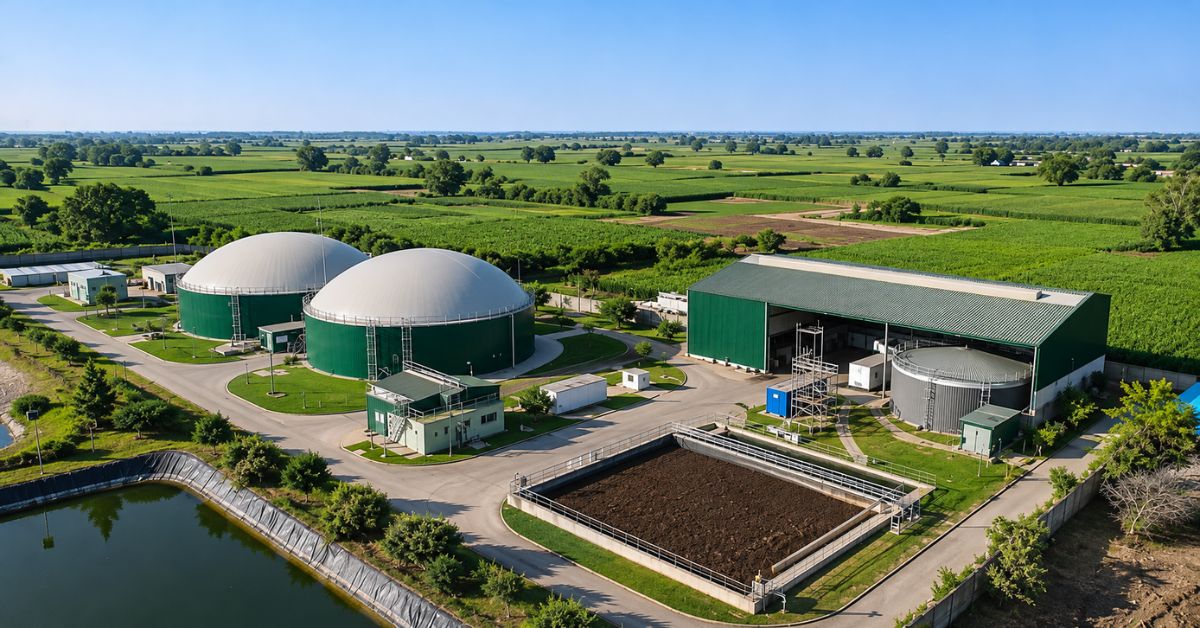
CBG offers a route to produce gas domestically from agricultural residues, cattle dung and other organic material. The Ministry of Petroleum and Natural Gas describes it as chemically equivalent to natural gas and suitable for integration into the existing gas ecosystem.
Its development also creates demand for feedstock collection, transport, plant operations and distribution of organic manure. These activities connect energy production with agricultural and waste-management supply chains.
The government’s earlier interventions included the Sustainable Alternative Towards Affordable Transportation initiative, support for biomass aggregation machinery, assistance for organic manure marketing and pipeline development. The newer GOBARdhan framework brings these types of support into an integrated programme intended to improve investment certainty and project economics.
What support does GOBARdhan provide?
The Union Cabinet approved the ₹23,731-crore GOBARdhan scheme on 6 August 2026, followed by its launch by Petroleum and Natural Gas Minister Hardeep Singh Puri on 1 October. It covers FY2026–27 to FY2035–36.
The framework combines assured offtake, administered pricing, capital assistance, pipeline connectivity, credit guarantees and technology support. It provides for mapping plants to identified city gas distribution areas or CBG clusters to establish routes to market.
Eligible new projects can receive capital assistance of up to ₹2 crore per tonne of daily installed capacity. Pipeline assistance can cover up to 80% of eligible expenditure for connections between CBG clusters and trunk networks, and up to 50% for standalone plants connecting to city gas distribution networks.
Will blending obligations create enough demand?
The procurement obligation for city gas distribution entities is set at 3% in FY2026–27, 4% in FY2027–28 and 5% from FY2028–29. It applies to compressed natural gas used in transport and piped natural gas supplied to households.
CII estimates that mandate-led demand would reach only 0.62 million tonnes by FY2029–30, substantially below the 15-million-tonne production ambition.
This distinction is important for gas suppliers and logistics businesses. A production target does not automatically become demand, and installed capacity does not necessarily translate into gas delivered to customers. Feedstock aggregation, plant utilisation, pipeline connections and purchasing arrangements must develop together.
For LNG import planning, the report’s estimate is therefore best understood as a substitution scenario. Actual savings will depend on domestic output reaching consumers, the volume of imported gas it replaces and prevailing international prices.
 Join our WhatsApp channel for more updates:
 Subscribe to our YouTube channel for more updates: