




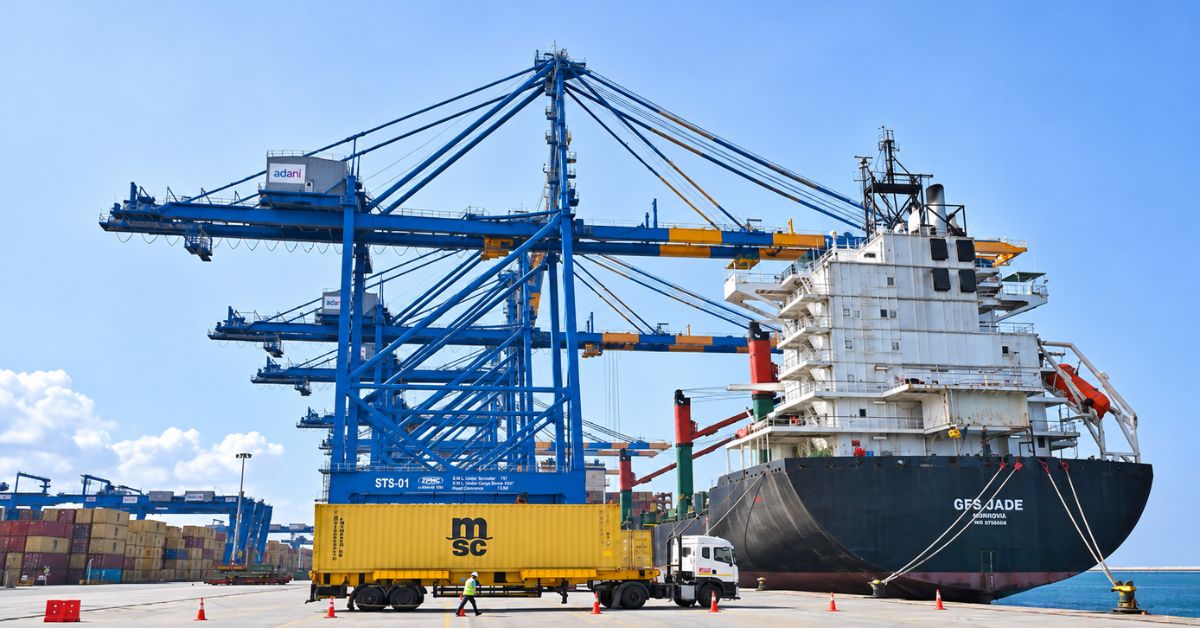

India’s manufacturing export orders expanded at their fastest pace in six months in October 2026, diverging from a slowdown in global overseas demand as higher shipping and fuel costs weighed on trade. S&P Global’s analysis, published on 6 November, identified India among the economies recording stronger growth in new business from abroad.
The findings offer a positive signal for India’s export pipeline. However, the survey measures changes in orders, rather than the value or volume of goods already shipped, making subsequent trade data important for assessing how demand translates into cargo movements.
What does the global export index show?
The seasonally adjusted Global Manufacturing Purchasing Managers’ Index (PMI) New Export Orders Index, sponsored by J.P. Morgan and compiled by S&P Global, declined to 50.9 in October from 51.6 in September.
It remained above the neutral 50-point threshold for a third consecutive month, marking the longest expansion since December 2021. Nevertheless, October recorded the weakest growth within that three-month period.
S&P Global linked the moderation to rising energy and transport costs. Global manufacturing input costs increased at their fastest pace since July 2022, while selling-price inflation reached its strongest level since 2022. Respondents’ comments identified shipping expenses as a significant contributor to higher costs and weaker export-demand momentum.
What supported India’s stronger overseas demand?
India’s manufacturers reported increased orders from markets including Bangladesh, Canada, Indonesia, Nepal, Oman, Saudi Arabia, Sri Lanka, the United Kingdom, the United States and the United Arab Emirates.
The HSBC India Manufacturing PMI, released on 2 November, nevertheless eased to 54.7 from 55.1 in September. Overall output and new-order growth moderated, even as export demand strengthened.
Manufacturers attributed new business to favourable demand conditions, customer acquisitions and marketing activity. Stronger overseas orders supported production, although the rate of output growth slowed from September.
Are Indian manufacturers facing the same inflation pressures?
India’s October survey showed a different cost pattern from the global results. Input-cost inflation eased to its lowest level since February, while selling prices increased at their slowest pace in nearly four years.
Some raw-material and energy costs rose, but overall price pressures moderated. Manufacturers also increased input inventories at their fastest pace in eight months, creating buffers against possible shortages and preparing for production requirements.
Employment rose for a second month, although hiring remained modest. Business confidence weakened from September and stayed below its long-term average, indicating caution despite stronger export orders.
How should exporters and logistics providers interpret the figures?
PMI surveys ask businesses whether conditions have improved, deteriorated or remained unchanged compared with the previous month. A reading above 50 indicates expansion; below 50 indicates contraction.
Consequently, the global reading of 50.9 does not mean exports grew by 0.9%. Similarly, India’s six-month high describes the pace of reported export-order growth, rather than a record level of export earnings.
The headline manufacturing PMI also differs from its export-order measure. It combines information on total new orders, output, employment, supplier delivery times and purchased-input inventories. India can therefore record a lower headline PMI alongside faster overseas-order growth.
For maritime and logistics businesses, the survey provides an early indication of potential cargo demand, rather than a confirmed shipment forecast. The commercial risk is that prolonged transport inflation could raise delivered costs and squeeze margins where exporters cannot recover the additional expense. That remains a forward-looking implication, rather than evidence that Indian manufacturers suffered such margin erosion in October.
 Join our WhatsApp channel for more updates:
 Subscribe to our YouTube channel for more updates: