




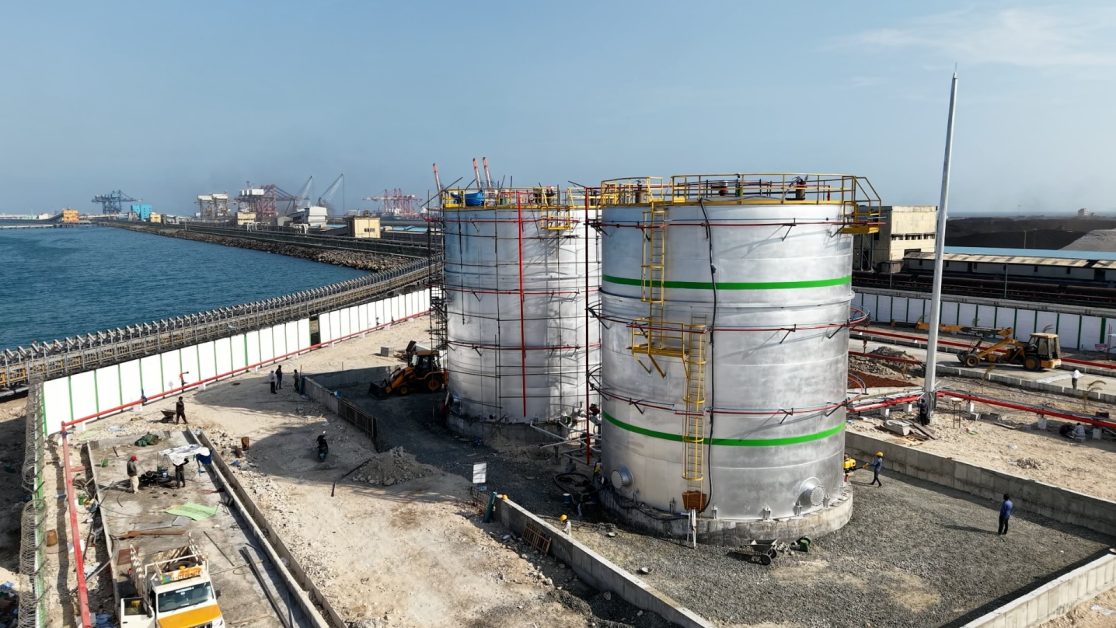

India’s first dedicated green methanol bunkering facility is expected to begin commercial operations at V.O. Chidambaranar (VOC) Port in Thoothukudi by the end of November 2026. With a storage capacity of 1,500 m³, the facility is being developed to supply alternative marine fuel to international vessels operating along the East–West shipping route.
Inaugurated by Prime Minister Narendra Modi on 11 October 2026, the project marks a new development in India’s efforts to establish infrastructure for alternative marine fuels. Its location near the international shipping corridor could allow VOC Port to attract vessels seeking green methanol supplies, including ships that do not make regular cargo calls at Thoothukudi.
According to VOC Port estimates, nearly 80% of cargo vessels operating along the East–West international shipping route pass within 130 nautical miles of Thoothukudi. The Port’s position on the Rotterdam–Tuticorin–Singapore maritime corridor provides an opportunity to serve international shipping operators transitioning towards methanol-capable vessels. VOC Port is also set to become the only port on India’s east coast to offer dedicated green methanol bunkering services.
The facility comprises two storage tanks of 750 m³ each, providing a combined capacity of 1,500 m³. A 2.8-km stainless-steel pipeline connects the storage installation to the bunkering point at the jetty. The infrastructure is designed to receive methanol through road tankers or vessels and transfer it to ships.
The bunkering system includes two transfer pumps, each rated at 120 m³ per hour, with an overall transfer arrangement designed to handle approximately 1,20,000 litres per hour. The installation also incorporates automated controls, remotely operated valves, emergency shutdown systems and dedicated fire-protection arrangements.
The project is being implemented under the National Green Hydrogen Mission, with the Ministry of New and Renewable Energy allocating ₹35.34 crore towards its development under the shipping sector. The Ministry of Ports, Shipping and Waterways has designated VOC Port as the System Implementing Agency.
Shri Susanta Kumar Purohit, IRSEE, Chairperson, V.O. Chidambaranar Port Authority, said, “The ability to offer alternative marine fuels will increasingly influence the competitiveness of ports serving international shipping. This facility is an important step towards positioning Thoothukudi as a dependable bunkering destination. Our immediate priority is to complete the necessary safety, statutory and operational preparations. We see longer-term potential for these services to support green-fuel production, maritime activity and industrial investment in the region.”
VOC Port is currently completing the required port-readiness procedures, statutory formalities and trial bunkering operations ahead of the planned commercial launch. The Port has also issued an Expression of Interest (EoI) to identify a suitable bunkering operator. Commercial supplies are expected to begin once the necessary operational arrangements and regulatory clearances are in place.
The development forms part of India’s broader efforts to establish green shipping infrastructure and expand the availability of alternative marine fuels. It also aligns with the country’s target of achieving Net Zero emissions by 2070.
FAQs
1. Where is India’s first dedicated green methanol bunkering hub being developed?
The facility is located at V.O. Chidambaranar (VOC) Port in Thoothukudi, Tamil Nadu.
2. When will the VOC Port green methanol bunkering facility begin commercial operations?
Commercial operations are targeted to commence by the end of November 2026, subject to completion of operational preparations and statutory clearances.
3. What is the storage capacity of the green methanol bunkering facility?
The facility has a total storage capacity of 1,500 m³, comprising two tanks of 750 m³ each.
4. How much funding has been allocated to the project?
The Ministry of New and Renewable Energy has allocated ₹35.34 crore for the project under the National Green Hydrogen Mission.
5. Which shipping route will the facility serve?
The facility is positioned to serve vessels operating along the East–West international shipping route, particularly the Rotterdam–Tuticorin–Singapore maritime corridor.
6. What bunkering infrastructure has been installed at VOC Port?
The infrastructure includes two 750 m³ storage tanks, a 2.8-km stainless-steel pipeline, two transfer pumps rated at 120 m³ per hour each, automated controls, emergency shutdown systems and fire-protection arrangements.
 Join our WhatsApp channel for more updates:
 Subscribe to our YouTube channel for more updates:




