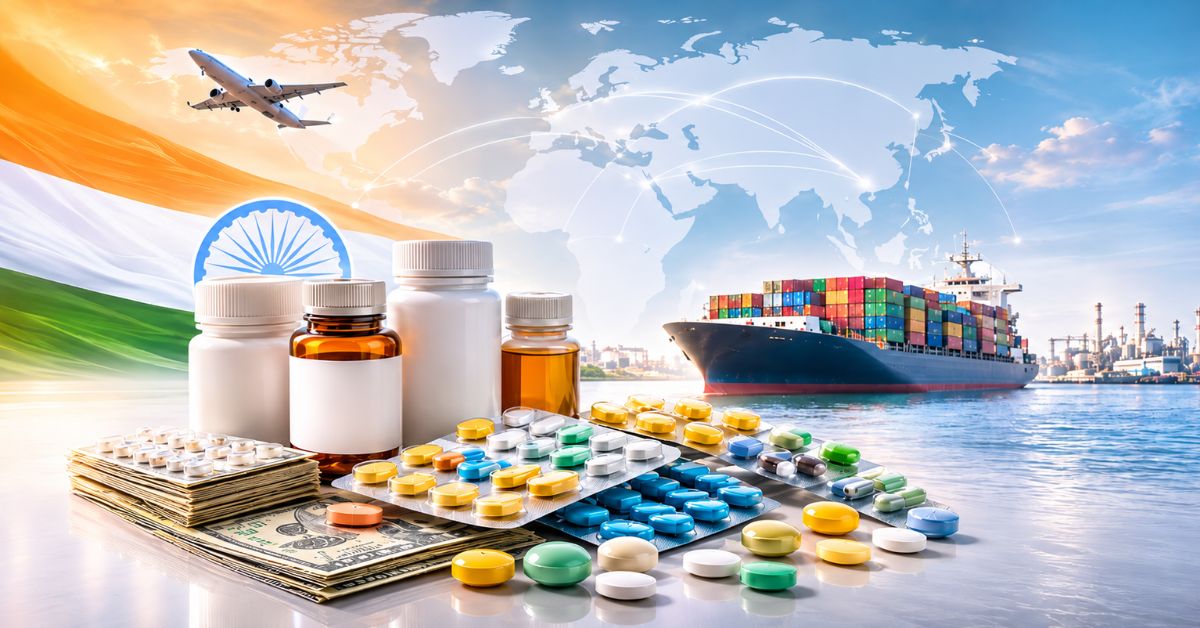

India’s pharmaceutical exports increased 4.9% year on year to US$16.14 billion during April–September 2026, supported by stronger demand across Europe, Southeast Asia and Latin America. Data from the Pharmaceuticals Export Promotion Council of India (Pharmexcil) show that overseas sales continued to expand despite uncertainty surrounding global trade.
The first-half performance builds on annual pharmaceutical exports of approximately US$31.12 billion in financial year 2025–26. India’s established manufacturing base and its presence across both developed and emerging markets provide the backdrop to the latest expansion.
Which markets are driving pharmaceutical export growth?
Europe accounted for 20.38% of India’s pharmaceutical exports during the six-month period, with shipments rising 9.66% to US$3.29 billion. Germany recorded growth of 21.57%, followed by the Netherlands at 15.93% and France at 15.02%.
Exports to the Association of Southeast Asian Nations increased 21.54%, while Latin America and the Caribbean registered growth of 16.58%. Shipments to Africa rose 6.48%.
The United States remained India’s largest pharmaceutical export destination, although growth in that market moderated. The regional figures indicate that markets outside the US are contributing to continued expansion.
India’s export network already spans a broad range of pharmaceutical markets. The US, United Kingdom, Canada, South Africa and Germany were its five leading destinations during April–June 2026, according to the India Brand Equity Foundation.
Which pharmaceutical products recorded higher exports?
Formulations and biologicals remained the largest category, representing 73.84% of first-half export earnings and growing 3.81%. Bulk drugs and intermediates expanded 12.07%, while surgical products increased 9.53%.
Pharmexcil chairman Namit Joshi has called for greater investment in research and development, technology transfer and joint development of complex generics, biosimilars and specialised therapies.
Vice-chairman Bhavin Mehta highlighted the importance of quality systems, advanced manufacturing and regulatory preparedness, particularly for micro, small and medium enterprises seeking stronger international market access. These priorities place manufacturing capability and compliance alongside geographical expansion in the sector’s export strategy.
How is India supporting its pharmaceutical export base?
Government initiatives include production-linked incentives for pharmaceuticals and critical pharmaceutical inputs, alongside support for bulk drug parks. These programmes aim to encourage domestic investment and production.
Technology upgrading is another focus. The Revamped Pharmaceuticals Technology Upgradation Assistance Scheme, introduced in March 2024, supports existing units in improving manufacturing capabilities and meeting applicable quality requirements.
Pharmexcil, established in 2004, supports exporters through regulatory guidance, market intelligence, policy advocacy and overseas buyer engagement. These functions help companies navigate the differing requirements of international pharmaceutical markets.
What does the growth mean for pharmaceutical logistics?
For logistics providers serving pharmaceutical exporters, the expansion underscores the importance of dependable storage and distribution across a geographically diverse customer base. Temperature-sensitive medicines require handling arrangements suited to their individual product specifications.
World Health Organization guidance sets out requirements for the safe storage and distribution of time- and temperature-sensitive pharmaceutical products, while recognising that local legislation takes precedence. Its supporting guidance covers transport temperature monitoring, route profiling, refrigerated vehicles and the qualification of shipping containers. These requirements provide practical context for the logistics capabilities needed to support pharmaceutical trade.
The export figures measure sales value rather than cargo tonnage or transport mode. They therefore demonstrate growth in overseas pharmaceutical business, without establishing a corresponding increase in sea freight, air freight or refrigerated container movements.
 Join our WhatsApp channel for more updates:
 Subscribe to our YouTube channel for more updates: