



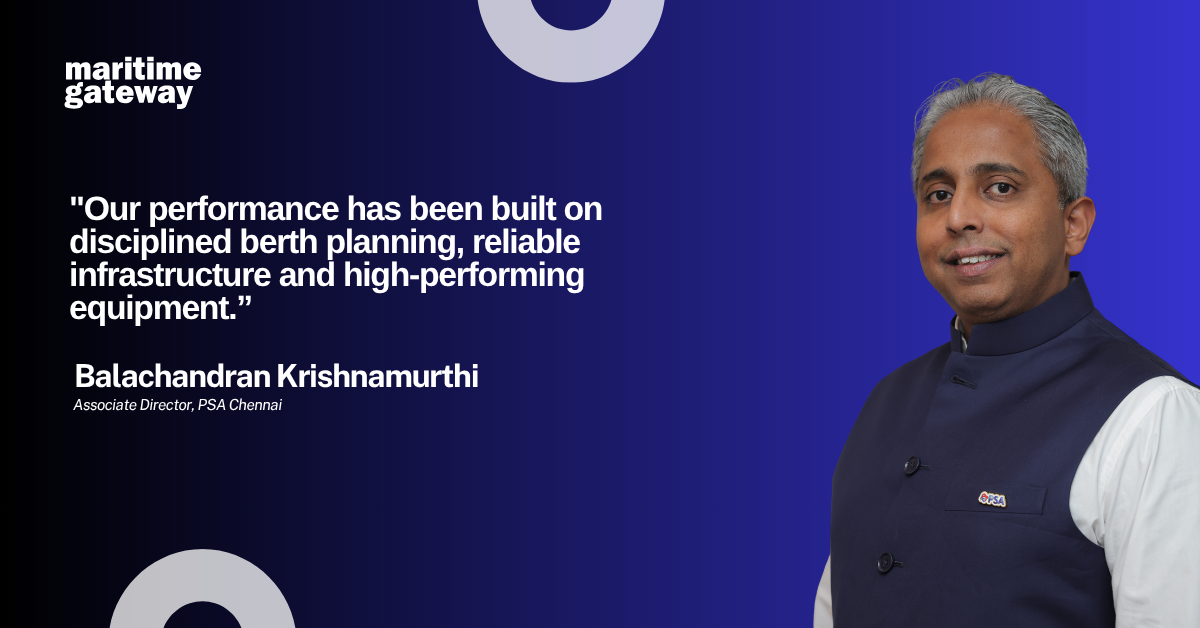

Balachandran Krishnamurthi, Associate Director of PSA Chennai, on the infrastructure,
safety culture and emerging cargo streams shaping the terminal’s next chapter
“Our performance has been built on disciplined berth planning, reliable infrastructure and high-performing equipment.”
“Lithium-ion battery manufacturing and electric vehicle production are promising segments for PSA Chennai’s next phase of growth.”
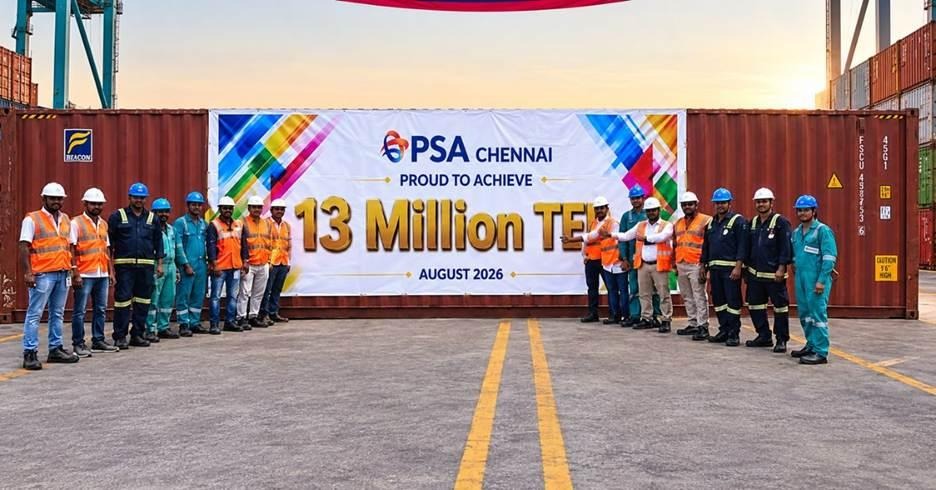
PSA Chennai has crossed 13 million TEUs over its 17-year journey. What operational practices and organizational capabilities have been most important in building that performance record?
Our performance has been built on disciplined berth planning, reliable infrastructure and high-performing equipment. Just as importantly, we continue to invest in our people and safety culture. With the support of the Chennai Port Authority, our customers, partners and staff, this enables us to deliver dependable, round-the-clock service, even amidst broader global supply chain disruptions.
Chennai is a mature but highly competitive container gateway. Where do you see the biggest opportunities to improve vessel turnaround, yard fluidity and gate efficiency over the next few years?
We see encouraging opportunities to improve cargo flow across the port ecosystem. With the expected completion of the Maduravoyal Flyover, we would have a dedicated corridor for seamless movement of trucks in and out of the port area. This, together with a well-thought-out parking plaza, would make cargo movements even more seamless than they are today.
Alongside these infrastructure improvements, PSA’s Node to Network approach enhances coordination between PSA Chennai and other ports in our global network, unlocking better service performance overall for shipping lines. India’s One Nation One Port initiative to streamline documentation and processes is also expected to make port calls more seamless going forward.
What are the most persistent bottlenecks affecting cargo movement through the Chennai port ecosystem, whether road access, rail evacuation, documentation, empty-container availability or coordination among stakeholders, and how is PSA Chennai addressing them?
Like many established port ecosystems near the city, Chennai continues to work to overcome constraints in road access to the terminal, improve interstate rail connectivity and integrate the disparate processes involved in moving cargo.
Over the years, PSA Chennai has proactively introduced pre-gate documentation checks and will be implementing gate automation in the near future to further improve traffic flows in and out of the terminal. We have also closely collaborated with the Chennai Port Authority and container train operators to improve connectivity to other states. We value their support as we work together as an ecosystem to make cargo movement through Chennai port smarter, smoother and more seamless.
PSA Chennai has publicly emphasised its safety culture. How do you translate safety from a compliance requirement into a daily operating discipline, especially as terminal equipment and throughput become more complex?
For us, safety is a top priority and begins with visible leadership and consistent engagement on the ground. We listen closely to our service providers, truck associations and port user community, whose feedback helps us improve the overall user experience in the terminal.
This engagement is complemented by disciplined oversight, continued training and the use of technology-enabled tools such as video analytics, to make safety a part of every activity in the terminal.
With shippers seeking more predictable end-to-end logistics, how is PSA Chennai expanding its role beyond the quay and yard, for example through rail-linked solutions, inland connectivity, digital visibility or collaboration with logistics partners?
We are working with partners and stakeholders to offer improved rail connectivity from PSA Chennai’s on-dock rail lines to key markets in India. This contributes to India’s national goal of shifting from road to rail, reducing emissions while improving traffic in the city.
One positive example is the restart of the weekly Hyderabad rail service, an industry collaboration with Chennai Port Authority and CONCOR. We are also working to expand our outreach to other rail-connected areas such as Cochin, Mysore and Coimbatore.
PSA Chennai is also participating in India’s One Nation One Port initiative, which is expected to enable more seamless port calls through greater digitalisation and the standardisation of documentation and procedures.
Automation, data analytics and equipment electrification are changing container-terminal operations globally. Which technologies are delivering the most tangible productivity, safety or sustainability benefits at PSA Chennai today, and where is the business case still challenging?
Data analytics is helping us to better understand performance trends and customer needs, and to identify opportunities for improvement. We are also taking a measured approach to automation and electrification, working with our technology partners to identify solutions that are sufficiently mature and can be introduced into a brownfield terminal while protecting capacity and service reliability.
PSA’s expansion in India, including PSA Mumbai’s Phase 2, signals a broader commitment to capacity, multimodal connectivity and large-vessel capability. What lessons or network advantages from PSA India’s wider portfolio can be applied to strengthen PSA Chennai’s proposition for shipping lines and cargo owners?
One of PSA India’s key strengths is our ability to connect terminal services with wider logistics solutions through our affiliate companies in PSA Supply Chain, such as PSA BDP and Port Ecosystem. By sharing best practices, technology and planning standards across our network, and working closely with customers and partners, we can offer customers a more seamless and consistent experience working with PSA.
Given Chennai’s industrial base and competition from other east-coast gateways, how do you expect the cargo mix to evolve and what changes in terminal design, equipment or processes will that require?
As Chennai handles more high-value and time-sensitive cargo, including semiconductor components, we see a growing need for more predictive operations. Better visibility of truck flows, reliable just-in-time connectivity and closer collaboration with customs authorities and logistics partners will help us respond more effectively to customers’ evolving requirements. In addition, as cargo volumes grow and vessel sizes increase, we anticipate that supporting investment in marine and terminal infrastructure will be required to accommodate the larger ships.
As India’s manufacturing and export profile shifts, including EVs, electronics, pharma and other high-value goods, where do you see the biggest upside for PSA Chennai in terms of cargo type, and what partnerships or infrastructure upgrades are needed to capture that future growth?
The biggest upside for PSA Chennai would be the development of the Chennai-Bangalore industrial corridor, spanning three states, and the recent MoU signed by the Tamil Nadu government. With continued investment, there would be capital goods as well as finished products moving bidirectionally through Chennai.
We welcome the continued efforts of government agencies and industry partners to develop this important corridor. PSA Chennai will work closely with valued customers to understand their needs and shape our service and commercial offerings accordingly.
As Chennai’s hinterland expands across Tamil Nadu and neighbouring industrial clusters, which emerging regions, commodities or customer segments do you expect to contribute most significantly to PSA Chennai’s next phase of volume growth?
Lithium-ion battery manufacturing and electric vehicle production are promising segments for PSA Chennai’s next phase of growth. As these supply chains expand and we see the development of India’s national manufacturing push, we look forward to working with manufacturers, logistics providers and the wider trade ecosystem to support their growth and the increasing flow of goods in these industries.
How can PSA Chennai balance growth in traditional containerised EXIM cargo with newer opportunities such as coastal shipping, transshipment, refrigerated cargo and specialised project-related movements, while maintaining service reliability and operational efficiency?
Our priority remains serving Chennai’s core containerised EXIM market with dependable and efficient operations. We will continue to focus our resources on supporting customers in this segment, while assessing other cargo opportunities selectively where they align with the terminal’s capabilities and long-term strategy.
| ABOUT BALACHANDRAN KRISHNAMURTHI– Associate Director and Head of PSA Chennai, a key container terminal within PSA India’s port network and part of PSA International, one of the world’s leading port groups. |
 Join our WhatsApp channel for more updates:
 Subscribe to our YouTube channel for more updates: