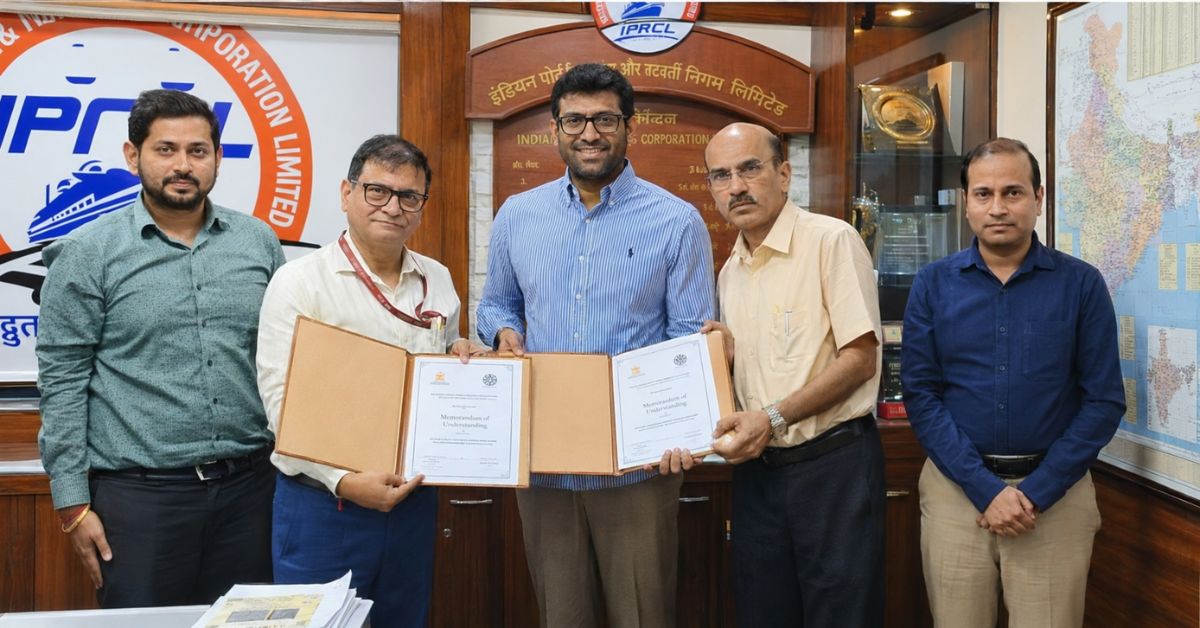

Indian Port Rail & Ropeway Corporation Limited (IPRCL) has signed a memorandum of understanding (MoU) with Yogayatan Ports Private Limited (YPPL) to cooperate on marine and civil infrastructure works associated with project implementation.
The agreement establishes a framework for the two organisations to work together on infrastructure execution, combining their engineering and organisational capabilities. IPRCL confirmed the collaboration in a company announcement.
Who signed the infrastructure agreement?
The MoU was signed by Dr Ameya Pratap Singh, Director of Yogayatan Ports, and Santosh Shukla, Chief General Manager, Civil, at IPRCL.
Arvind Kumar, IPRCL’s Director for Transportation and Business Development, was present at the signing.
The announced scope covers cooperation in marine and civil infrastructure projects. The disclosure does not identify individual construction packages, investment commitments, project capacities or completion schedules. These details will be necessary to establish the scale of any work undertaken through the arrangement.
What does the collaboration cover?
The partnership provides a basis for cooperation in planning, development and execution, including the exchange of technical knowledge and engineering expertise.
Its immediate significance is the creation of an institutional framework between a specialist transport infrastructure company and a private port-sector entity. The announcement concerns cooperation rather than a disclosed award for a particular berth, terminal or connectivity project.
Marine and civil works can involve different project requirements, making the definition of responsibilities, engineering scope and delivery arrangements important when individual assignments are developed.
What is IPRCL’s role in port infrastructure?
IPRCL was incorporated on 10 July 2015 to improve rail evacuation from India’s major ports and support higher cargo-handling capacity.
According to the Sagarmala programme’s official description, the company was established as a joint venture between 11 major ports, collectively holding 90% of its equity, and Rail Vikas Nigam Limited, holding the remaining 10%.
Its objectives include developing, designing, constructing, operating and maintaining port rail evacuation systems, particularly last-mile connections linking ports with the wider railway network. The mandate also encompasses modernisation and management of internal port railway infrastructure.
The Ministry of Ports, Shipping and Waterways describes IPRCL’s wider activities as including multimodal transport infrastructure, aerial ropeway systems and consultancy for port-related transport projects. This provides the organisational background to its cooperation with Yogayatan Ports on marine and civil works.
How does the agreement fit IPRCL’s wider activities?
IPRCL has also entered cooperation arrangements involving infrastructure beyond conventional port railway systems.
The Inland Waterways Authority of India lists an MoU with IPRCL for developing rail connectivity to inland water transport terminals at Varanasi, Sahibganj and Haldia. That agreement, dated 3 September 2024, illustrates the company’s involvement in connecting different freight transport modes.
Separately, the Directorate General of Shipping has announced an MoU with IPRCL covering the development, upgrading and renovation of seafarers’ welfare and related maritime infrastructure across India.
These arrangements provide context for IPRCL’s broader infrastructure role, while remaining separate from the Yogayatan Ports agreement.
What will determine the partnership’s practical impact?
The next substantive developments will be the identification of projects and disclosure of their technical scope, commercial arrangements and execution schedules.
For now, the MoU establishes a channel for cooperation. Its contribution to port infrastructure development will become clearer as the organisations translate that framework into defined assignments and implementation commitments.
 Join our WhatsApp channel for more updates:
 Subscribe to our YouTube channel for more updates: