
Japan’s shipping and shipbuilding establishment has committed to its most concrete ammonia undertaking yet: four ammonia-fueled car carriers, a dedicated ammonia bunkering vessel, and a ship-to-ship supply business centred on the Chubu region, all scheduled for 2030. Crucially for Indian readers, the fuel procurement leg is expected to draw green ammonia from producing regions that include India.
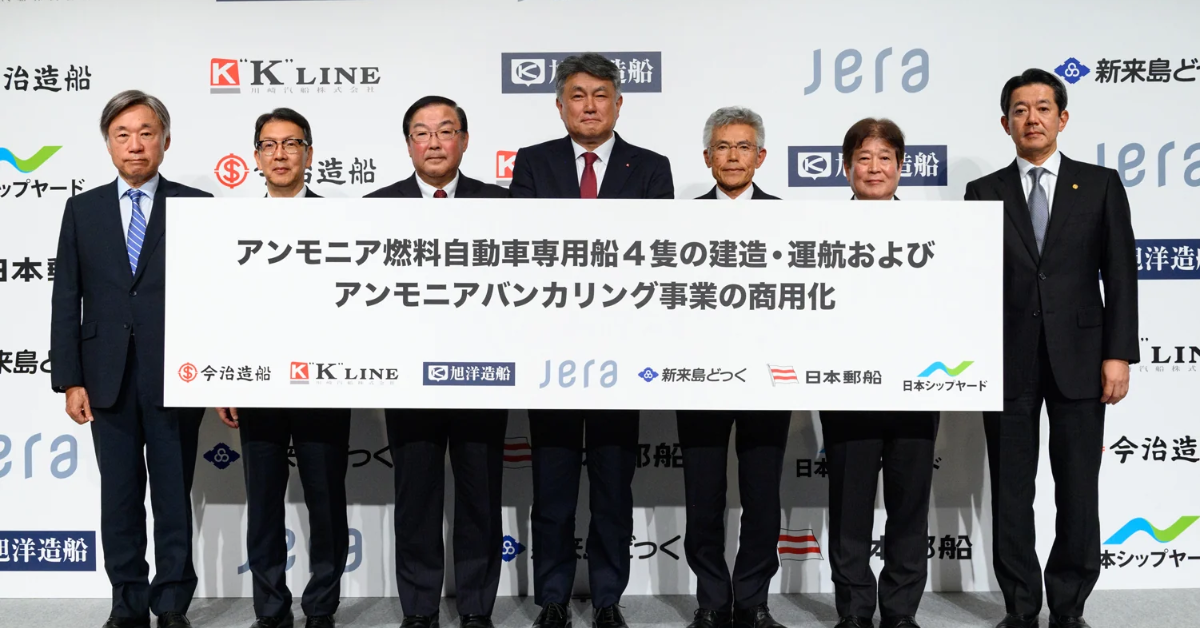
The announcement, made jointly on October 27, brings together Imabari Shipbuilding, Kawasaki Kisen Kaisha (“K” LINE), Kyokuyo Shipyard, JERA, Shin Kurushima Dockyard, Nippon Yusen Kaisha (NYK) and Nihon Shipyard. The companies describe it as the world’s first commercial supply chain that integrates fuel procurement, port supply infrastructure and vessel operations.
The Project, Decoded
Four vessels, two each for “K” LINE and NYK, will be Japan’s first ammonia-fueled car carriers. They will run dual-fuel engines and carry tanks sized to complete trans-Pacific voyages on ammonia alone — a specification that matters commercially, because it means the ships can serve the Japan-to-North America vehicle trade without reverting to conventional fuel mid-passage.
Deliveries are scheduled for 2030. Toyota Motor Corporation is named among the customers expected to use the vessels for finished-vehicle transport.
The bunkering side is where the project breaks new ground. Kyokuyo Shipyard will build a commercial ammonia bunkering vessel, also due in 2030, which NYK or a wholly owned subsidiary will own and operate. “K” LINE and NYK will then run an equally owned fuel sales joint venture supplying ammonia to the car carriers via ship-to-ship transfer, primarily at the ports of Nagoya and Mikawa.
| Workstream | Company | Role |
| Green ammonia procurement and loading facilities | JERA | Sourcing green ammonia, including from India; building ship loading facilities at the Hekinan terminal |
| Ammonia bunkering vessel | Kyokuyo Shipyard | Design and construction |
| Bunkering vessel ownership and operation | NYK | Ownership, operation and STS supply |
| Fuel sales joint venture | “K” LINE and NYK | 50:50 JV for sale and supply of ammonia fuel |
| Car carrier design and build | Shin Kurushima, Imabari, NSY | Basic design by Shin Kurushima; joint construction |
| Car carrier operation | “K” LINE and NYK | Ownership, management, operation |
Why Chubu and Hekinan Anchor the Chain
The location choice is the tell. JERA has been substituting lower-carbon ammonia at the Hekinan Thermal Power Station as part of its thermal decarbonisation strategy, and the same terminal is now being extended to serve marine fuel demand.
That co-location is the ingredient the maritime fuel transition has lacked. Ammonia bunkering has stalled globally on a chicken-and-egg problem: suppliers will not build import terminals without committed vessel demand, and owners will not order ammonia-capable ships without guaranteed supply. By stacking power generation offtake alongside bunkering volumes at one terminal, the consortium creates a base load that de-risks the infrastructure.
JERA will develop new ship loading facilities at the ammonia receiving terminal adjacent to Hekinan, establishing a stable supply channel for the bunkering vessel. Volumes for the power station and volumes for ships then share the same import and storage assets.
What India Stands to Gain
The line that should draw attention in Delhi, Mumbai and Gandhinagar is JERA’s stated intention to procure green ammonia produced using renewable energy, with supplies “intended to come from regions including India.”
That is a serious commercial signal. Indian green ammonia projects have struggled with the single hardest problem in the sector: securing bankable, long-term offtake from creditworthy international buyers. A Japanese utility and two of the world’s largest shipping companies jointly structuring a supply chain around imported green ammonia gives prospective Indian producers a credible reference offtake structure — one that spans generation, export terminal handling, ocean transport, import terminal and final combustion.
The finance implications run in sequence:
- Project finance. Lenders to Indian green ammonia capacity typically demand anchor offtake covering a majority of output. A consortium with JERA’s balance sheet improves the bankability case materially.
- Export infrastructure. Ammonia exports need dedicated berths, storage and loading arms at Indian ports. Those are port capex decisions that competing export hubs in the Middle East and Australia are already making.
- Certification and chain of custody. Green ammonia sold into Japanese power and marine use will need verifiable emissions accounting across the full chain, which pushes Indian producers toward certified renewable power and transparent MRV systems.
- Freight and chartering. Moving ammonia from India to Japan creates a new midsize gas carrier trade, adding to the ammonia carrier orderbook alongside the bunkering and car carrier demand in this project.
The competitive caveat is real: India is one of several sourcing regions under consideration, not a named exclusive supplier. Converting intention into contracts will depend on delivered cost, certification and port readiness against rival producers.
Safety Is the Underwriting Question
Ammonia is toxic and corrosive, and that shapes everything from vessel design to insurance. The car carriers will carry a multilayered safety concept covering leak prevention, leak detection and neutralisation in the event of a release. The bunkering vessel will be built with advanced leakage-prevention systems and equipment designed specifically for ammonia’s toxicity and corrosiveness.
For charterers, insurers and port authorities, the operational question is whether STS ammonia transfer at Nagoya and Mikawa establishes a repeatable safety and permitting template. If it does, the model becomes exportable to Singapore, Rotterdam, Ulsan and potentially an Indian bunkering hub — the same ports currently assessing whether to invest in ammonia infrastructure.
Crew competence is the other variable. Handling ammonia alongside LNG requires distinct training and procedures, and certification regimes for ammonia-fuelled vessels are still maturing across flag states and class societies. The 2030 delivery window gives the industry roughly three to four years to close those gaps.
Frequently Asked Questions
1. Which companies are involved in Japan’s ammonia car carrier project?
Seven: Imabari Shipbuilding, Kawasaki Kisen Kaisha (“K” LINE), Kyokuyo Shipyard, JERA, Shin Kurushima Dockyard, Nippon Yusen Kaisha (NYK) and Nihon Shipyard.
2. How many vessels will be built and when will they be delivered?
Four ammonia-fueled car carriers — two each for “K” LINE and NYK — plus one dedicated ammonia bunkering vessel, all scheduled for completion in 2030.
3. Where will the green ammonia come from?
JERA will procure green ammonia produced using renewable energy, with supplies intended to come from regions including India. Japanese authorities have not disclosed contracted volumes or suppliers.
4. How will the fuel reach the ships?
Through ship-to-ship bunkering, with the dedicated bunkering vessel coming alongside the car carriers at berth or at anchor. Supply will be concentrated primarily at the ports of Nagoya and Mikawa in the Chubu region.
5. Why does this matter for Indian green ammonia producers?
It creates a concrete, creditworthy offtake structure combining a Japanese utility with two major shipping lines, giving Indian projects a template for export-linked contracts — provided they can meet delivered-cost, certification and port-infrastructure requirements.
 Join our WhatsApp channel for more updates:
 Subscribe to our YouTube channel for more updates: