



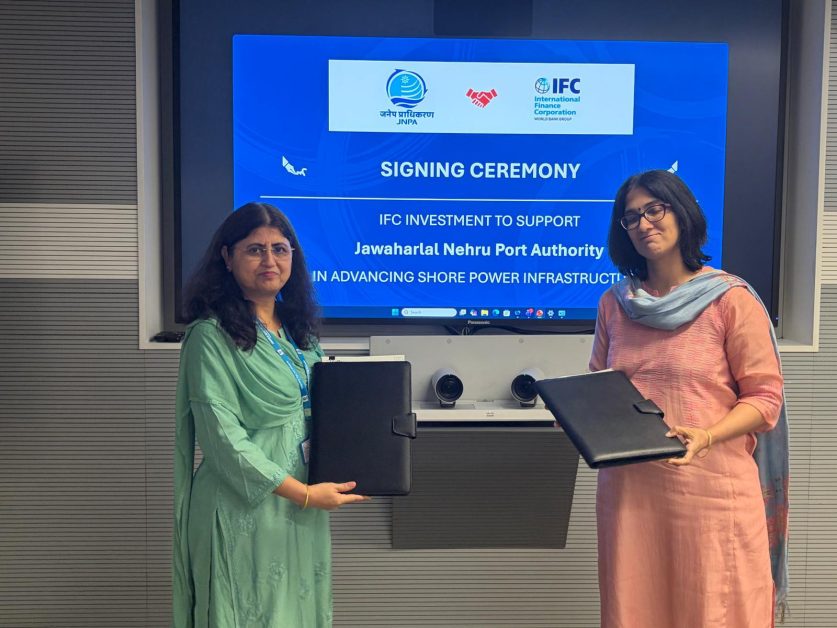

The Jawaharlal Nehru Port Authority (JNPA) has partnered with the International Finance Corporation (IFC) to establish what the organisations describe as India’s first blue financing framework for the maritime sector, with a US$70 million IFC investment planned for shore power infrastructure at JNPA.
The financing will support Shore Power Supply (SPS) systems across JNPA’s terminals, allowing vessels at berth to shut down their onboard diesel engines and draw electricity from the shore. According to the project details, the infrastructure is expected to reduce carbon emissions by 63% and harmful air pollution by up to 90%, while creating more than 400 jobs.
The collaboration is intended to provide a financing model for sustainable port infrastructure and support the adoption of shore power technology at Indian ports.
First blue financing for port infrastructure in Asia-Pacific
The project is described as the first labelled blue financing for port infrastructure in the Asia-Pacific region and one of the first transactions aligned with the new Blue Finance guidelines under the Indian Ports Act, 2025.
It also marks the first investment by a development finance institution (DFI) in India’s state-owned major port authorities, according to JNPA and IFC.
Shore power remains an emerging technology for Indian ports, with no major Indian port having commercially deployed the technology at scale to date. The long-term financing from IFC is expected to help JNPA address the early-stage commercial and operational challenges associated with SPS deployment.
A successful implementation at JNPA could provide a model for similar investments at other Indian ports and in emerging markets.
JNPA highlights demonstration potential
Commenting on the collaboration, Shri Gaurav Dayal, IAS, Chairperson, JNPA, said:
“Indian ports have not yet commercialized SPS at scale. Funding from international development institutions like IFC will enable JNPA to manage early-stage commercial risks, build operational experience, and bring international best-practices, prior to scale-up. A successful operational and commercial demonstration by India’s largest container port would provide proof of concept for broader adoption of SPS across Indian ports and other emerging markets, delivering economic as well as environmental benefits. The Project is expected to demonstrate JNPA’s pioneering commitment to achieving Harit Sagar Green Port Guidelines, setting a new benchmark for Indian Ports infrastructure sector.”
IFC links financing to port decarbonisation
Manuel Reyes Retana, Division Director, South Asia, IFC, said:
“India’s ports are critical to its trade, and this investment is about making them futureready. By partnering with India’s largest and busiest container port we are going beyond an infrastructure upgrade to demonstrate that sustainable financing can work for the country’s maritime sector at scale. This is how the World Bank Group adds value: unlocking, mobilizing and expanding access to finance, creating jobs, and helping India scale modern smart infrastructure that expands trade, applies first-in-market innovation, and builds a maritime economy the world will look to.”
The investment aligns with India’s Maritime India Vision 2030, which seeks to develop globally competitive, digitally advanced and environmentally sustainable ports.
The project also supports the objectives of the Harit Sagar Green Port Guidelines, which provide a framework for reducing emissions and pollution from port operations and encouraging the adoption of cleaner technologies and fuels.
JNPA develops sustainable finance framework
Alongside the SPS project, IFC supported the development of JNPA’s Sustainable Finance Framework. The framework is intended to help the port mobilise additional green and blue financing for future investments.
DNV’s Second Party Opinion has confirmed that the framework aligns with the Loan Market Association’s Green Loan Principles and IFC’s Blue Finance Guidelines.
The JNPA-IFC transaction is therefore expected to combine infrastructure financing with the development of a broader sustainable finance mechanism for future port investments.
 Join our WhatsApp channel for more updates:
 Subscribe to our YouTube channel for more updates: