



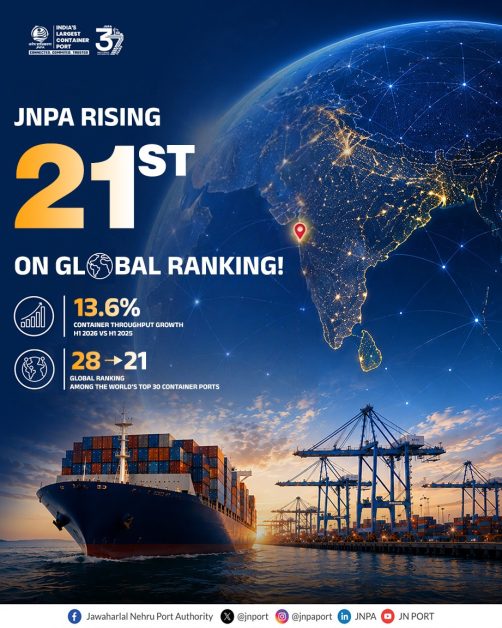

Jawaharlal Nehru Port Authority (JNPA), India’s largest container port, has risen to 21st position globally in the first half of 2026, from 28th in 2025, in Alphaliner’s review of the world’s top 30 container ports.
Alphaliner is a global provider of liner shipping data and intelligence and tracks container port performance based on throughput.
According to a statement issued by the port authority, the seven-position rise reflects JNPA’s sustained focus on operational efficiency, faster cargo evacuation, improved vessel handling and enhanced multimodal connectivity over the past year.
JNPA said these capabilities were particularly tested during the global trade disruptions in H1 2026 arising from the US-Iran conflict, when the port introduced proactive measures to facilitate cargo movement, manage additional operational requirements and support the continuity of export-import trade. The port’s ability to maintain efficient operations and respond swiftly to disruptions has further strengthened its position as a reliable gateway for India’s international trade.
Gaurav Dayal, Chairperson, JNPA, said the collaborative performance of the port’s terminal operators, stakeholders and the entire port community is reflected in JNPA’s rise to the 21st position in the global ranking. He said their combined efforts have strengthened JNPA’s capacity to provide dependable and effective cargo-handling services, especially in tackling the intricacies of worldwide trade interruptions throughout the year, and that the port will build on this momentum to further elevate its ranking as one of the top container ports in the world.
JNPA handled about 2.99 million TEUs of containers and 36.62 million tonnes of total cargo from April 2026 to July 2026, higher by 14.37% and 11.95% respectively compared with the corresponding period in the previous financial year.
The port, based near Mumbai, currently has a cargo-handling capacity of 10.1 million TEUs a year and is on course to stretch its existing infrastructure to handle up to 12 million TEUs over the next few years.
 Join our WhatsApp channel for more updates:
 Subscribe to our YouTube channel for more updates: