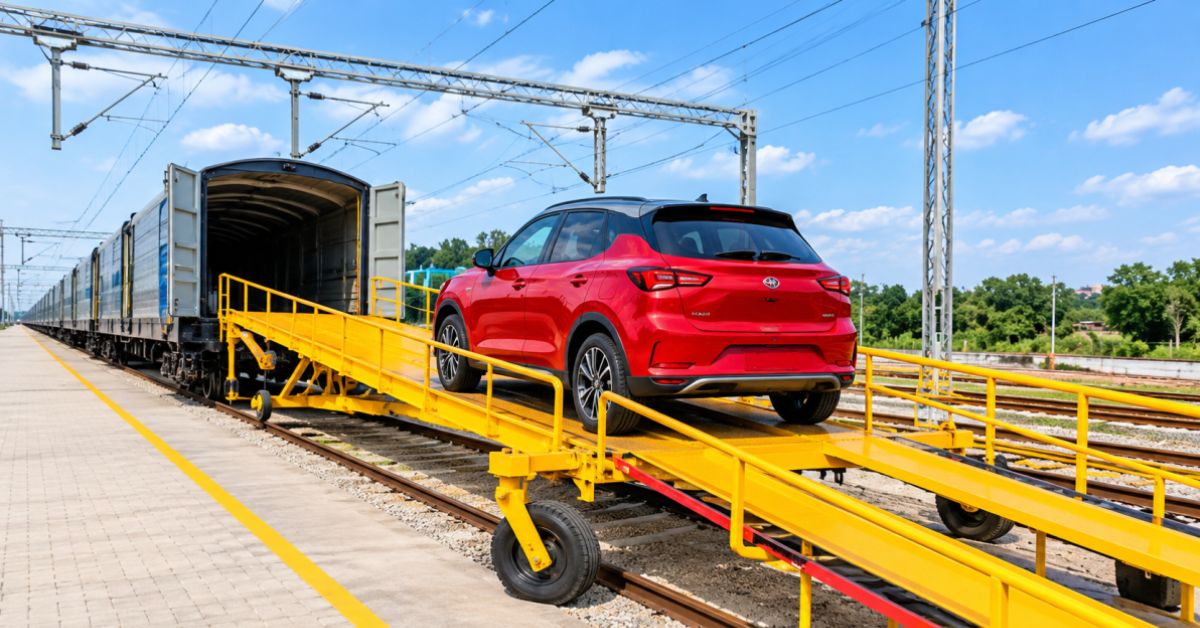

Jujhar Logistics Limited is investing ₹329.53 crore through its subsidiary to expand its rail-based vehicle transport business in India. Jujhar Logistics & Travels Limited placed the order with Texmaco Rail & Engineering Limited for 15 rakes, or sets of rail wagons, designed to carry passenger cars and sport utility vehicles (SUVs). Texmaco disclosed the contract on 5 November 2026, and the parent company notified BSE the following day.
What the ₹329.53 crore Texmaco order covers
Texmaco will manufacture and supply 434 higher-clearance auto carrier wagons of the ACT 1 and ACT 3 types. Its exchange filing also lists 15 BVCM wagons alongside the auto carriers. The contract value includes taxes. The buyer, Jujhar Logistics & Travels, is a 51%-owned subsidiary of BSE-listed Jujhar Logistics Limited.
Texmaco is due to supply the first ACT 1 rake within five months, with each subsequent ACT 1 rake due within 50 days of the preceding one. The ACT 3 rakes will be delivered in phases. The filing did not specify the split between the two types or a final delivery date for the full order.
Higher-clearance wagons can carry SUVs on both decks
Jujhar said the new wagon designs can accommodate SUVs on both decks as well as conventional passenger cars. That gives the operator more flexibility to carry mixed loads as SUVs account for a growing share of manufacturers’ vehicle line-ups. The company said the wagons were designed within the clearance profile used for double-stack dwarf containers.
Arshdeep Singh Mundi, managing director of Jujhar Group, said the investment would build rail capacity alongside the group’s road transport network. Jujhar expects the additional wagons to increase vehicle volumes and revenue and plans to offer rail transport to major automobile manufacturers. It did not identify customers, routes or loading terminals for the new rakes.
Indian Railways opens the door to route-specific auto wagons
In March 2026, the Ministry of Railways announced changes allowing industry to develop specialised, higher-capacity auto carrier wagons for specific routes. The ministry put rail’s share of passenger vehicle transport at about 24%. In August, it reported that around 54 industry-owned rakes were operating under its separate automobile transport scheme, giving a measure of the existing fleet against which the Jujhar order will be delivered.
 Join our WhatsApp channel for more updates:
 Subscribe to our YouTube channel for more updates: