





Summary
Jupiter Wagons has secured a ₹1,140 crore Railway Board order to manufacture 2,583 BOXNHL and BOXNS freight wagons. The award strengthens its government business alongside demand from private operators and leasing companies. Separately, the manufacturer expects approximately ₹2,000 crore in additional orders during January–March 2027.
Railway Board places bulk-wagon contract
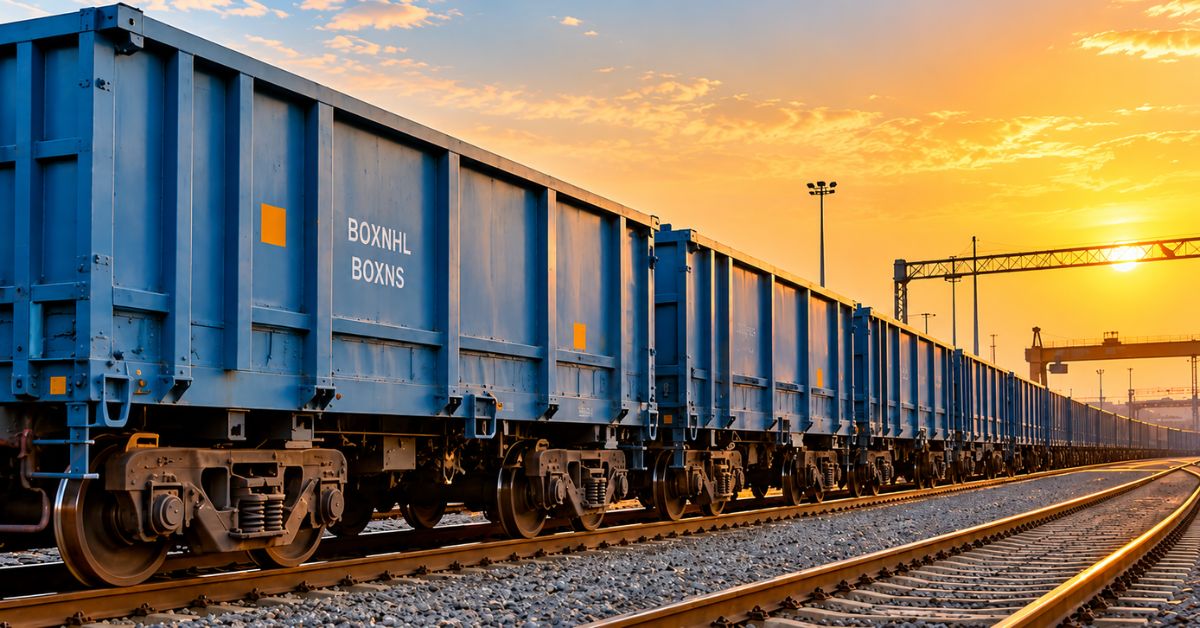
The Jupiter Wagons railway order, received on 28 October and announced on 29 October 2026, covers the manufacture and supply of 2,583 wagons across two categories: BOXNHL and BOXNS.
The aggregate contract value of ₹1,140 crore includes taxes. The award adds to the manufacturer’s freight rolling-stock pipeline as Indian Railways continues procuring equipment for bulk cargo movement.
Managing Director Vivek Lohia linked the award to the company’s manufacturing capabilities and execution record. Jupiter also reported continuing demand from private freight operators, wagon-leasing businesses and core-sector customers.
Its expectation of approximately ₹2,000 crore in additional fourth-quarter FY2026–27 orders is a management outlook, separate from the confirmed Railway Board award.
Wagon types serve bulk freight requirements
BOXNHL and BOXNS belong to the open-wagon family used for commodities such as coal and other bulk materials.
Railway technical documentation identifies BOXNS as a 25-tonne axle-load design. The higher axle-load capability forms part of the railway system’s effort to carry more freight within available train capacity.
In its earlier explanation of “Mission 25 Tonne”, the Ministry of Railways identified BOXNS among new designs offering approximately 12–17% greater carrying capacity than equivalent lower-axle-load wagons.
That comparison describes a broader design programme rather than a quantified productivity gain for this particular contract. Actual loading and deployment depend on approved routes, infrastructure capability and operating requirements.
Earlier contracts demonstrate a wider customer base
The latest award follows orders announced in June 2026 from JSW (South) Rail Logistics and Central Warehousing Corporation.
Jupiter signed a letter of intent with JSW for five BFNSM1 rakes with BVCM wagons, valued at ₹122.88 crore. The announced execution period was seven months from signing.
Central Warehousing Corporation separately awarded a ₹141.44 crore contract for eight BLSS rakes. That package comprised 32 BLSS-A wagons, 352 BLSS-B wagons and eight brake vans, with completion expected within one year of the award.
Together, those transactions were valued at approximately ₹264.32 crore. They illustrate demand for different wagon platforms across industrial cargo and container logistics, alongside the bulk-freight requirements addressed by the new Railway Board contract.
These earlier orders provide background to Jupiter’s customer mix; their announcement does not establish that deliveries have since been completed.
Component investment supports manufacturing strategy
Jupiter’s expansion also extends into wheels, axles and associated components.
Its FY2025–26 annual report describes a planned ₹3,000 crore wheel-and-axle facility in Odisha, targeting annual capacity of 100,000 forged wheelsets and 20,000 loose wheels by the end of 2027.
The report also records a ₹113 crore order for 9,000 LHB axles and a ₹215 crore letter of intent for 5,376 wheelsets for the Vande Bharat programme.
These activities broaden the group’s exposure beyond complete freight wagons. They also demonstrate how component manufacturing serves several markets, including freight, passenger coaches and other rail systems.
The Odisha capacity remains a development target. Its contribution to production will depend on commissioning, qualification and the subsequent operating ramp-up.
Execution will determine commercial contribution
For a rolling-stock manufacturer, a large order provides production visibility, but its financial contribution emerges through manufacturing, inspection, acceptance and delivery.
The combination of Railway Board procurement and private-sector contracts gives Jupiter exposure to several sources of demand. Different wagon types also require production scheduling and component procurement to be coordinated across the orderbook.
For cargo owners, the eventual benefit of additional wagons is greater transport capacity. Turning that equipment into reliable freight services also requires suitable loading facilities, available train paths and efficient turnaround at destination.
The immediate development is therefore a substantial manufacturing award. Delivery performance and the conversion of anticipated fourth-quarter business into firm contracts will determine how the company’s freight pipeline develops over the coming months.
FAQs
Who placed the order?
The Ministry of Railways, through the Railway Board.
What is the contract value?
₹1,140 crore, including taxes.
How many wagons will Jupiter supply?
A total of 2,583 BOXNHL and BOXNS wagons.
What are these wagons used for?
They are open freight wagons used for bulk commodities, including coal.
Are the additional ₹2,000 crore orders confirmed?
No. That figure represents the company’s expectation for incremental orders during January–March 2027.
 Join our WhatsApp channel for more updates:
 Subscribe to our YouTube channel for more updates:




