



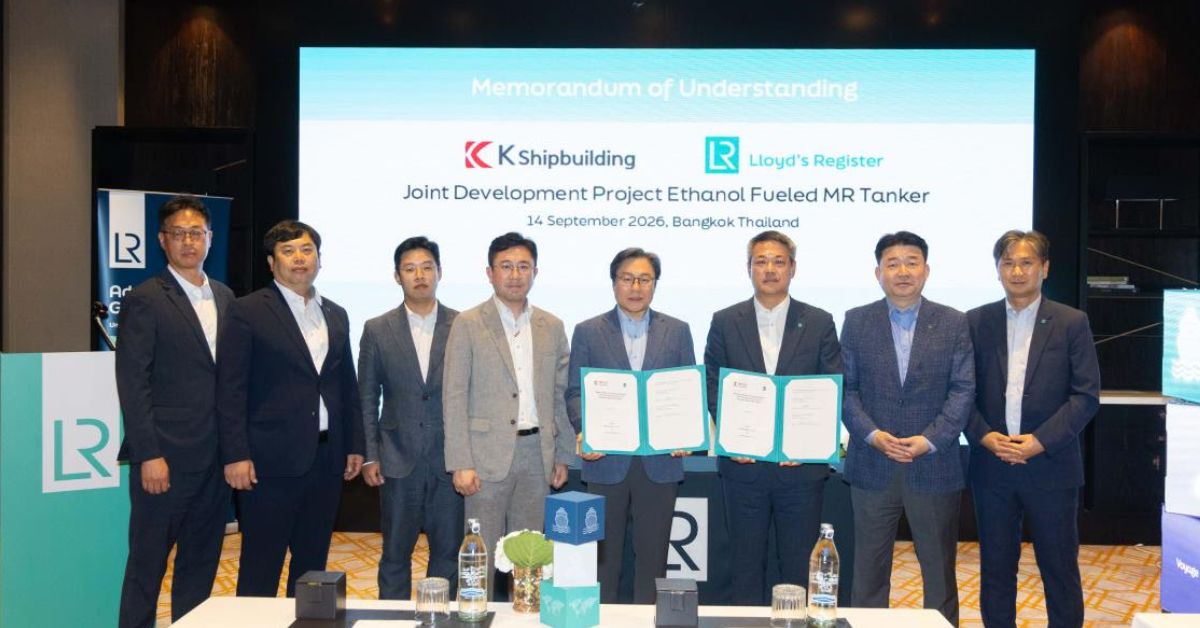

K Shipbuilding and Lloyd’s Register (LR) have signed a Memorandum of Understanding (MoU) to jointly develop a 50,000 dwt medium-range (MR) product tanker capable of operating on ethanol as a marine fuel.
The project was announced during Gastech 2026 in Bangkok and will examine the technical, safety and regulatory requirements involved in developing an ethanol-fuelled tanker. The companies intend to work towards Approval in Principle (AiP) from LR for a vessel concept aimed at the global product tanker market.
What will the ethanol-fuelled tanker project cover?
K Shipbuilding will be responsible for the vessel’s design and development, while LR will undertake technical reviews of key areas, including the ship’s general arrangement, stability, structural requirements and integration of ethanol fuel tanks.
The development programme will also examine opportunities to optimise the vessel’s design and operational performance while ensuring compliance with applicable classification requirements and international regulations.
Ethanol is already carried as cargo on product tanker routes. The project will therefore assess its application as a marine fuel for vessels operating in a market where ethanol is already part of the cargo mix.
Theo Kourmpelis, Global Business Director for tankers, Lloyd’s Register, said: “Ethanol is already a familiar cargo across the product tanker trades, which makes the MR segment a practical place to assess it as a fuel. As ethanol production and seaborne trade continue to develop, owners active in these trades are well placed to connect its role as a cargo with its use onboard.
“This project will give owners a clearer basis for evaluating ethanol within their fleet strategies, and help lay the groundwork for its broader uptake across the tanker sector.”
Why is ethanol being assessed as a marine fuel?
The project comes as shipowners assess different alternative-fuel technologies as they respond to evolving environmental regulations and long-term fleet investment requirements.
The companies said the development will focus on establishing the technical and commercial considerations associated with using ethanol as a marine fuel in the MR tanker segment.
Andy McKeran, Chief Growth Officer, Lloyd’s Register, said: “Shipping’s energy transition is unlikely to be delivered through a single fuel solution. Shipowners are increasingly looking at a range of fuel options and want confidence that emerging technologies can be implemented safely, efficiently and in compliance with evolving regulations.
“This project will help deepen industry understanding of ethanol’s potential in the tanker sector and provide owners with greater insight into how alternative fuel solutions can be incorporated into commercially viable vessel designs.”
The joint development programme will assess the technical requirements of the vessel alongside market considerations to determine the viability of the ethanol-fuelled MR tanker concept.
K Shipbuilding to lead vessel development
K Shipbuilding will lead the design and development work under the MoU, with LR providing technical assessment and classification input.
Tae-Hyun Koh, Chief Technology Officer, K Shipbuilding, said: “We see growing interest in fuel flexibility as shipowners make long-term investment decisions in an increasingly complex regulatory environment. Through this collaboration with Lloyd’s Register, we aim to develop a practical and competitive ethanol-fuelled MR tanker design that addresses both operational and market requirements.”
The companies will use the joint development project to assess the feasibility of an ethanol-fuelled 50,000 dwt MR tanker and work towards securing LR’s Approval in Principle.
 Join our WhatsApp channel for more updates:
 Subscribe to our YouTube channel for more updates: