
Summary
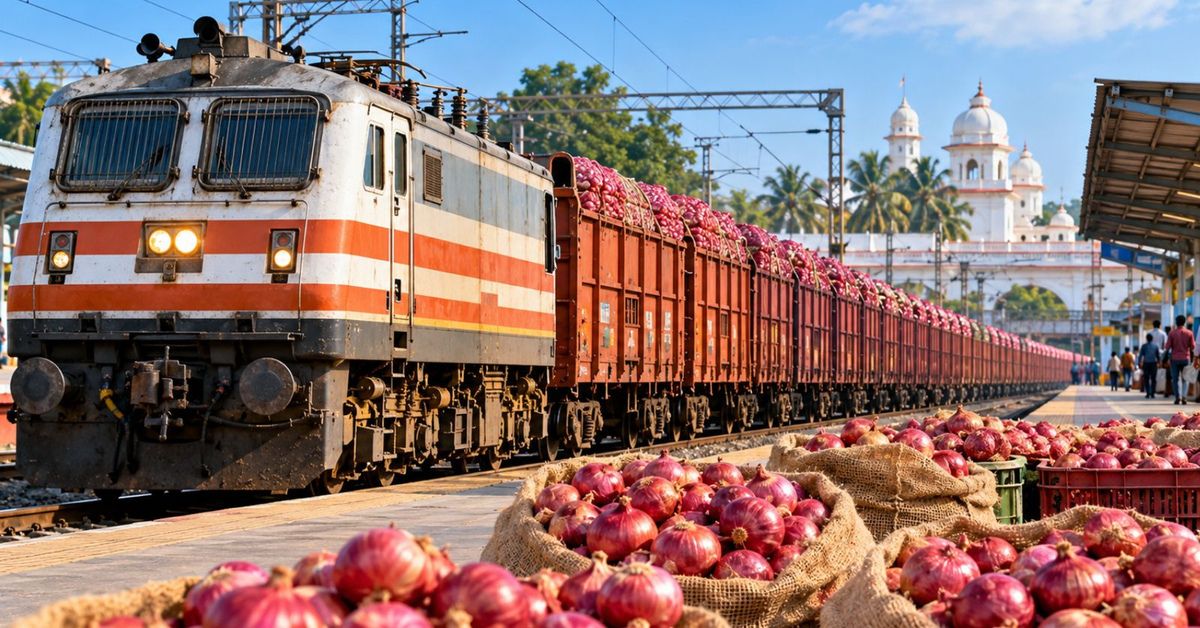
The Centre has extended its Kanda Express onion-distribution initiative to Tripura, with approximately 440 tonnes of buffer stocks expected to reach Agartala by 18 October. The consignment is intended to strengthen supplies across seven districts during the festive season, combining bulk rail transport with onward road distribution.
First rail movement targets Agartala
The first Kanda Express consignment to Tripura is being moved under the Department of Consumer Affairs’ Price Stabilization Fund intervention, expanding the government’s rail-based onion supply network in the Northeast.
The approximately 440-tonne shipment was scheduled to reach Agartala by 18 October, according to the department’s announcement on 16 October. Arrival and unloading had not been confirmed in the information available for this report.
The distribution programme is intended to cover Dhalai, South Tripura, Khowai, Unakoti, West Tripura, Gomati and Sepahijala.
It follows earlier rail deliveries to Assam, extending the use of bulk transport to another consumption centre in the region. The objective is to supplement market availability and moderate excessive price fluctuations during a period of seasonal demand.
Rail and road serve different distribution needs
The Tripura movement forms part of a wider Northeast supply intervention.
By 16 October, the department reported that two rail rakes carrying 840 tonnes and 452 tonnes, together with 44 truck consignments carrying 1,513.46 tonnes, had supplied more than 2,800 tonnes across the region.
These dispatches covered locations in Assam, Tripura and Nagaland.
The combination illustrates the different roles of transport modes. Rail concentrates larger volumes on the main journey, while trucks distribute stocks to markets beyond the unloading point.
For the Agartala consignment, effective onward movement will determine how quickly the additional supply reaches consumers. Delivery to a rail terminal is therefore one stage in the intervention, rather than its final outcome.
Market arrivals also influence prices
The additional buffer supply comes as fresh kharif arrivals improve availability.
The department reported that the all-India average mandi price had moderated from approximately ₹3,600 per quintal at its September peak to around ₹3,300 in October.
It also recorded retail-price declines in 211 cities over the preceding two weeks.
These national observations provide context for the intervention but do not establish a particular retail price in Tripura. Nor can changes occurring before the consignment’s arrival be attributed to that shipment.
The eventual local effect will depend on the quantity released, distribution timing and prevailing commercial supplies.
Earlier operations established the rail model
The initiative builds on a transport approach introduced under the government’s onion price-stabilisation programme in October 2024.
At that time, the Department of Consumer Affairs announced a 1,600-tonne movement from Nashik to Delhi-NCR using 42 railway wagons. The onions had been procured by the National Cooperative Consumers’ Federation of India.
The department identified rail as a means of moving buffer stocks in bulk to major consuming centres, alongside the road network already used for distribution.
Its October 2024 announcement also sought railway support for additional destinations serving the Northeast, including New Jalpaiguri, Dibrugarh, New Tinsukia and Changsari.
The current Tripura operation consequently represents an extension of an established logistics programme, rather than the introduction of onion transport by rail nationally.
Programme expanded substantially in 2025–26
A subsequent government update in August 2026 showed how the rail component had grown.
During 2024–25, nearly 12,000 tonnes of buffer onions moved through 14 railway rakes to five cities. In 2025–26, approximately 88,000 tonnes were transported through 86 rakes to 16 cities.
The Central Warehousing Corporation was also brought into the distribution mechanism to support storage and stock movement.
Those figures indicate a broader role for organised bulk logistics in the government’s market intervention. They describe the national programme, rather than volumes delivered specifically to Tripura.
The August update also confirmed continued use of both rail and road, underscoring that expanding railway movements supplements other distribution arrangements.
Local distribution will determine the practical result
For Tripura, the immediate significance is an additional supply channel during the festive period.
For logistics providers, the operation highlights the importance of coordinating rail arrivals, unloading, temporary storage and district-level dispatches. Delays between those stages could weaken the benefit of moving a bulk consignment quickly over the main route.
The next operational milestones are confirmed receipt, movement into local markets and monitoring of availability. Those results will provide a clearer measure of the shipment’s contribution than its dispatched tonnage alone.
FAQs
How many onions are being sent to Tripura?
Approximately 440 metric tonnes.
When was the consignment expected?
It was scheduled to reach Agartala by 18 October 2026.
Has arrival been confirmed?
The information reviewed announced the expected arrival; it did not confirm unloading.
Which programme supports the shipment?
The Department of Consumer Affairs’ Price Stabilization Fund intervention.
Is this India’s first Kanda Express movement?
No. It is the first movement to Tripura. The wider programme began in 2024.
 Join our WhatsApp channel for more updates:
 Subscribe to our YouTube channel for more updates: