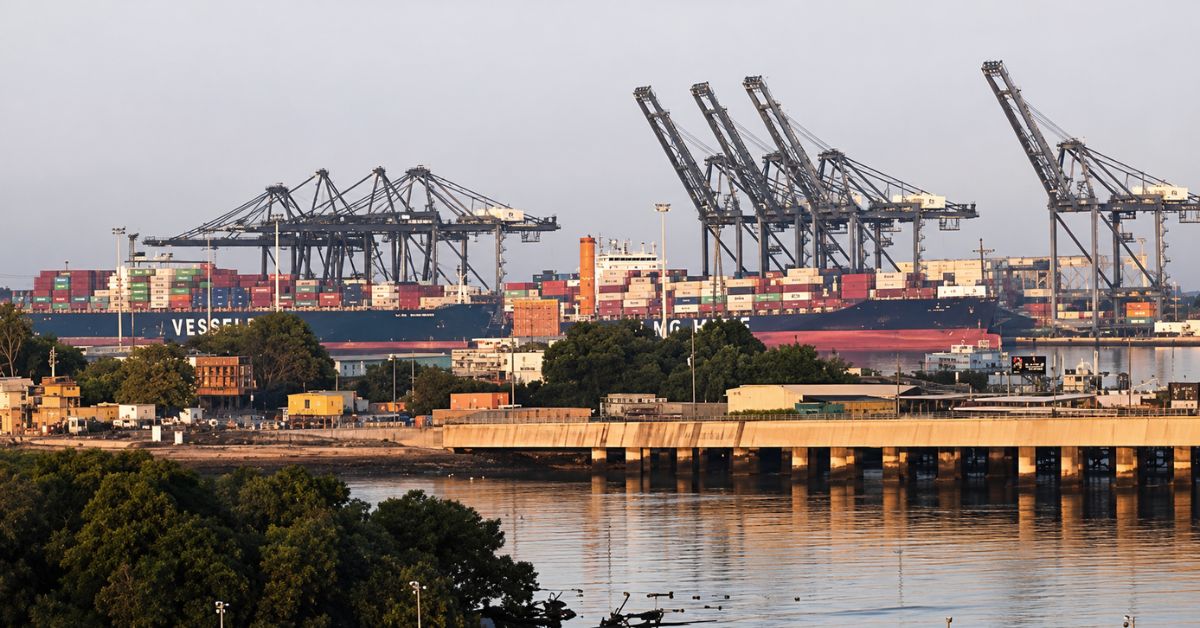

Karachi Port handled 14.523 million tonnes of cargo between 7 August and 7 November 2026, according to the Karachi Port Trust (KPT) reporting snapshot supplied for the period. Imports accounted for nearly two-thirds of total tonnage, while inbound and outbound container movements were more evenly balanced.
The Pakistan port recorded 9.230 million tonnes of imports and 5.294 million tonnes of exports. Container throughput reached approximately 702,000 twenty-foot equivalent units (TEUs), comprising 356,000 import TEUs and 346,000 export TEUs.
The figures provide a three-month view of activity at one of Pakistan’s main maritime gateways, covering cargo handled across its container, dry cargo and liquid cargo facilities.
How were imports and exports distributed?
Based on the reported figures, imports represented approximately 63.6% of cargo tonnage, with exports contributing 36.4%. Inbound cargo exceeded outbound volumes by about 3.94 million tonnes.
The rounded import and export figures add up to 14.524 million tonnes, marginally above the stated total of 14.523 million tonnes. The difference is 1,000 tonnes at the reporting precision used.
Container movements showed a narrower gap. Imports accounted for approximately 50.7% of total TEUs and exports for 49.3%, with an inbound surplus of around 10,000 TEUs.
The distinction between cargo tonnage and container throughput is important. Tonnage measures cargo weight, whereas TEUs measure container capacity. A relatively balanced container count therefore does not mean that inbound and outbound cargo weights, shipment values or loaded-container volumes were equal.
What does the three-month reporting period show?
The 7 August–7 November figures cover a rolling reporting window rather than a conventional calendar quarter. They should therefore be identified by their start and end dates when used in comparisons.
KPT’s online reporting tool allows users to select dates and provides separate figures for imports, exports, dry cargo, liquid cargo and container movements. Its default reporting window changes as the page is updated.
The supplied snapshot does not include an equivalent earlier-period comparison. Consequently, the figures establish the scale and direction of port flows but do not, by themselves, demonstrate year-on-year growth or a change in Pakistan’s overall trade performance.
How does this relate to Karachi Port’s annual activity?
KPT’s published statistics show that Karachi Port handled 53.951 million tonnes in financial year 2024–25, compared with 51.654 million tonnes in 2023–24. This represented an increase of approximately 4.4%.
Container throughput rose more strongly over the same period, increasing from 2.277 million TEUs to 2.651 million TEUs, or approximately 16.4%. The 2024–25 container total comprised 1.362 million import TEUs and 1.289 million export TEUs.
Dry cargo accounted for 41.675 million tonnes of annual throughput, while liquid bulk contributed 12.276 million tonnes. These annual figures provide historical context, although they are not directly comparable with the August–November reporting window.
What infrastructure supports the cargo flows?
Karachi Port has handled containerised cargo since 1973. Its East, West and South wharves each have a dedicated container terminal, supporting services operated by international shipping lines.
The port also has three dedicated liquid cargo piers and facilities for warehousing, transit storage and cargo clearance. Supporting infrastructure includes oil tankages, bulk cargo areas, container freight stations and facilities for handling dangerous cargo.
This combination enables Karachi Port to serve several cargo markets alongside container shipping. The August–November snapshot reflects that diversity: imports dominate the overall weight of cargo handled, while container movements are distributed more evenly between the two trade directions.
 Join our WhatsApp channel for more updates:
 Subscribe to our YouTube channel for more updates: