





Summary
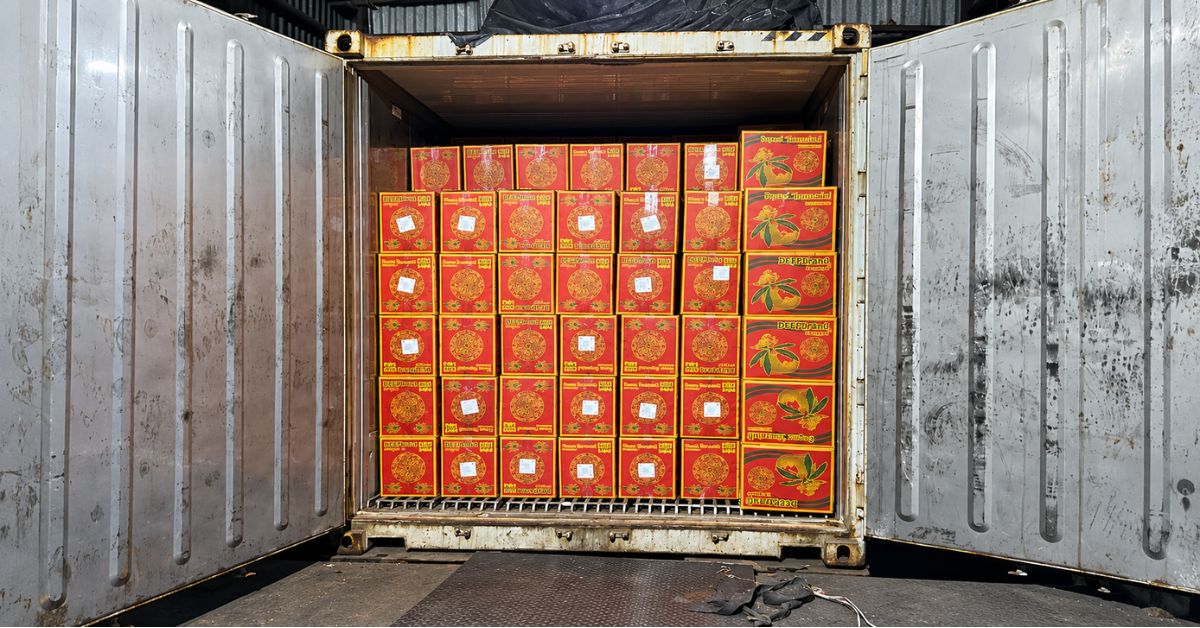
The Directorate of Revenue Intelligence seized approximately 55,000 e-cigarettes valued at ₹13.5 crore from two Nepal-bound transshipment containers at Kolkata’s Syama Prasad Mookerjee Port. Officers found the devices concealed among cargo declared as drinking glasses and ceramic mugs during examinations conducted on 24 October 2026.
Intelligence-led checks uncover concealed shipments
The Kolkata e-cigarette seizure followed specific intelligence that two containers moving through the port as Nepal-bound transshipment consignments contained prohibited products.
DRI officers intercepted the containers and conducted detailed examinations. One consignment had been declared as “water glass”, while the other was declared as “ceramic mugs”.
The first container yielded 40,000 IGET-brand e-cigarettes in various flavours. Officers recovered approximately 15,000 additional devices from the second container, including products bearing the VTV, VOKO, Bang and Ejoy brands.
The e-cigarettes were concealed among the declared goods, which served as cover cargo. DRI seized both the devices and the accompanying cargo under relevant provisions of the Customs Act.
The agency disclosed the operations in an announcement issued on 28 October.
Consignments were declared for onward movement to Nepal
The containers’ declared destination was Nepal, making the interceptions relevant to the monitoring of goods moving through India under transshipment arrangements.
The announcement does not identify the consignors, consignees, shipping lines, customs brokers or countries of origin. It also does not state whether the two consignments were connected.
No arrests, prosecution details or findings establishing individual responsibility were disclosed.
The Nepal-bound declaration should therefore be treated as the consignments’ stated routing. The announcement does not establish that the devices were intended for diversion into India, nor does it identify their eventual customers.
What DRI has reported is the discovery of concealed e-cigarettes behind declarations describing different goods. Further findings would be required to establish the full commercial and logistical chain.
Seizures form part of wider enforcement activity
DRI said it had seized approximately 300,000 e-cigarettes valued at more than ₹120 crore during FY2026–27 across ports, airports and inland container depots.
The locations covered Maharashtra, Gujarat, Delhi and West Bengal, indicating enforcement activity across several cargo gateways and transport channels.
These are reported seizure totals, rather than an estimate of the overall illicit market. They do not establish how many prohibited devices may have escaped detection.
The announcement also does not clarify whether the latest Kolkata haul is included in the financial-year figures. The quantities should consequently not be added together without further confirmation.
Similarly, the ₹13.5 crore valuation describes DRI’s assessment of the seized e-cigarettes. It should not be presented as customs revenue recovered or a penalty imposed.
India’s prohibition dates to 2019
India prohibits the production, manufacture, import, export, transport, sale, distribution, storage and advertisement of electronic cigarettes under legislation enacted in 2019.
The prohibition covers electronic nicotine delivery systems and related devices. Government guidance identifies the legislation as a public-health measure and states that contraventions are punishable under its provisions.
The policy originated in an ordinance promulgated in September 2019, followed by the legislation. The government’s stated concerns included nicotine addiction, uptake among young people and the implications for tobacco-control efforts.
In the Kolkata operations, DRI specifically reported seizure under the Customs Act. The announcement does not set out individual charges under the electronic-cigarette legislation or disclose the outcome of any adjudication.
Misdeclaration places cargo accuracy in focus
For the maritime logistics industry, the case highlights the importance of accurate commodity descriptions and consistency between shipping documents and physical cargo.
Declarations identifying ordinary household goods can conceal a materially different consignment. In these operations, intelligence-led examination allowed officers to establish what was actually inside the containers.
The seizure does not, by itself, establish wrongdoing by every business involved in handling or transporting them. Responsibility will depend on evidence concerning the preparation, declaration and movement of each consignment.
The next substantive developments would be identification of the parties responsible, clarification of links between the containers and any resulting enforcement proceedings. Until those details emerge, the confirmed outcome remains the seizure of approximately 55,000 concealed devices and their cover cargo.
FAQs
Where and when did the seizures take place?
At Syama Prasad Mookerjee Port, Kolkata, on 24 October 2026.
How many e-cigarettes were recovered?
Approximately 55,000: 40,000 from one container and around 15,000 from another.
What goods had been declared?
The declarations described “water glass” and “ceramic mugs”.
Were the containers destined for Nepal?
They were declared as Nepal-bound transshipment consignments.
Were any arrests announced?
The supplied announcement did not disclose arrests or identify the parties responsible.
 Join our WhatsApp channel for more updates:
 Subscribe to our YouTube channel for more updates:




