



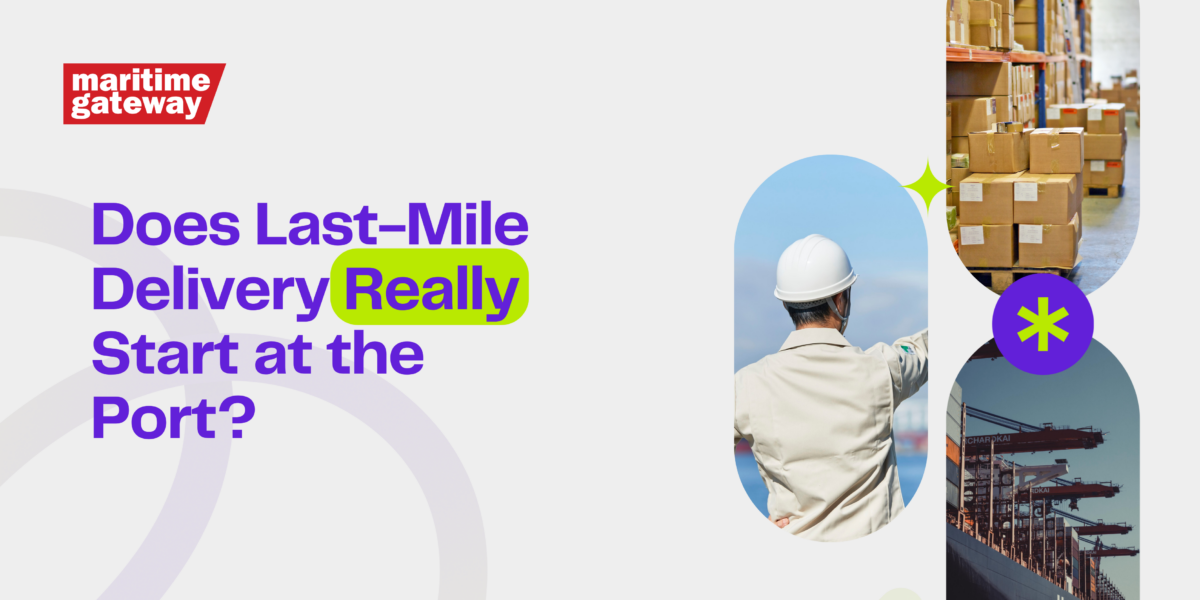
Last-mile delivery is often considered the final and most critical stage of the logistics chain. It is the point where the customer experience is defined, where timelines are judged, and where efficiency becomes visible.
But this widely accepted perspective may be incomplete.
Because in reality, last-mile delivery does not begin in the city. It begins much earlier at the port.
Rethinking where the journey starts
Ports are often viewed as transit points, places where cargo simply arrives and moves on. But in today’s interconnected supply chain, they play a far more influential role.
Every process at the port—clearance, handling, documentation, and dispatch—sets the tone for everything that follows. Delays at this stage do not remain isolated. They travel through the system, eventually showing up at the customer’s doorstep.
In that sense, the efficiency of last-mile delivery is deeply rooted in port operations.
The invisible beginning of delivery timelines
By the time a shipment reaches a warehouse or distribution center, much of its timeline has already been defined.
A delay in customs clearance, congestion at terminals, or inefficiencies in cargo handling can push schedules off track before the last-mile process even begins.
However, conventional thinking rarely associates these early-stage challenges with last-mile delivery.
This disconnect is where the problem lies.
The ripple effect of port inefficiencies
Port congestion remains one of the most visible challenges. High volumes, limited capacity, and operational bottlenecks often lead to delays in cargo movement.
In addition, the continued reliance on manual processes in certain areas slows down documentation and approvals. The lack of seamless integration between ports, transport systems, and warehouses further complicates coordination.
Each of these factors may seem minor in isolation, but together they create a ripple effect that impacts the entire supply chain.
By the time the shipment enters the last-mile phase, the delay is already built into the system.
Why this matters in today’s logistics landscape
The rise of e-commerce and the growing demand for faster deliveries have significantly increased pressure on logistics systems.
Customers today expect speed, reliability, and transparency. They may not see what happens at ports, but they experience the outcome.
In such a scenario, even small inefficiencies can lead to missed timelines and reduced customer satisfaction.
The role of connectivity beyond the port
Efficient last-mile delivery is not just about urban logistics. It depends heavily on how smoothly cargo moves from ports to inland destinations.
Strong road networks, efficient rail connectivity, and the use of inland waterways can significantly reduce transit time and improve overall efficiency.
Without this integration, even the most optimized last-mile systems will struggle to perform.
Technology as the bridge
Digital transformation offers a way to connect these fragmented processes.
Port community systems, real-time tracking, automation, and AI-driven planning can improve visibility and coordination across the supply chain.
When stakeholders have access to shared data and real-time updates, decision-making becomes faster and more effective.
Breaking silos in logistics
One of the biggest challenges in logistics is the siloed approach.
Ports, transporters, warehouses, and delivery networks often operate independently, each optimizing their own processes without considering the larger system.
But last-mile efficiency cannot be achieved in isolation. It requires a collaborative approach where every stakeholder works as part of an integrated ecosystem.
India’s moment to rethink logistics
With increasing investments in port infrastructure and multimodal logistics, India is at a crucial stage of transformation.
This is an opportunity not just to build better infrastructure but to adopt a more integrated approach to logistics.
Shifting the focus from isolated operations to end-to-end efficiency can redefine how supply chains function in the country.
A shift in perspective
Perhaps the most important change required is in how we define last-mile delivery itself.
It is not the final step. It is part of a continuous journey that begins at the very first touchpoint—the port.
Recognizing this can lead to better planning, improved coordination, and more efficient outcomes.
Conclusion
Last-mile delivery may be the most visible part of logistics, but it is not where the story begins.
The foundation is laid much earlier, in the processes and systems that operate at ports.
If the goal is to build faster, more reliable, and more efficient supply chains, the focus must shift to where it all starts.
Because in modern logistics, the last mile does not start at the warehouse. It starts at the port.
 Join our WhatsApp channel for more updates:
 Subscribe to our YouTube channel for more updates: