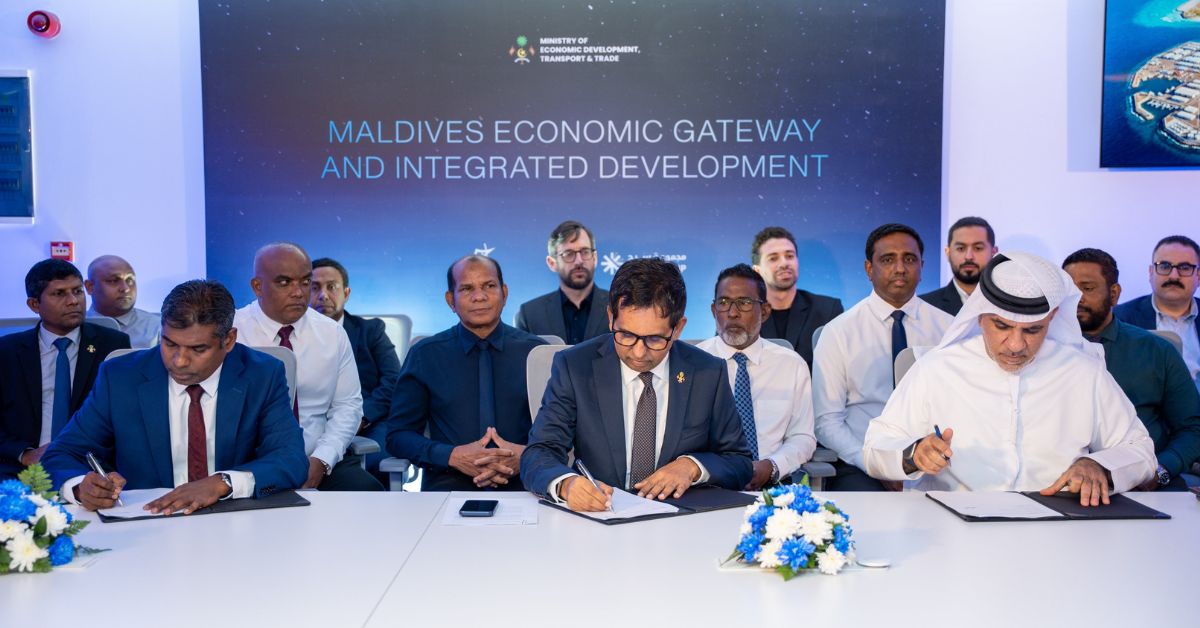

The Maldives government has signed an agreement with State Trading Organization (STO) and Abu Dhabi-based SERH Group for Technical Services to advance an international port and integrated economic hub at Ihavandhippolhu in the northern Maldives.
Signed on 16 November 2026, the agreement supports the Maldives Economic Gateway and Integrated Development Project. The proposed development seeks to use the location’s proximity to the Eight-Degree Channel shipping route to attract maritime, logistics and industrial activity.
Who signed the agreement?
Minister of Economic Development, Transport and Trade Mohamed Saeed signed on behalf of the government. STO was represented by Chief Executive Officer and Managing Director Shimad Ibrahim.
Ahmed Ibrahim Ali Mohamed Almutawa, Chief Executive Officer for Port and Industrial City Development, signed for SERH Group. The ministry describes the Abu Dhabi company as active in energy logistics, marine support and industrial services.
The agreement provides a basis for progressing towards implementation. Investment value, financing arrangements, port capacity and a construction timetable were not disclosed.
What does the proposed development include?
An international port forms the centre of the project, supported by maritime and industrial operations, energy activities, tourism, commercial facilities and associated infrastructure.
The government links the initiative to President Mohamed Muizzu’s Vision 2040 agenda and its objective of broadening economic activity across the northern atolls.
Earlier government investment material provides further context for the wider Economic Gateway concept. A project brief published in 2024 identified cargo handling, bunkering, warehousing, transshipment support and ship repair among the proposed activities.
It also envisaged an export processing zone for repacking and value-added businesses serving nearby markets, alongside tourism and mixed-use property development. These were components of the broader development concept, rather than confirmed construction packages under the latest agreement.
The brief identified a potential reclaimable area of up to 4,000 hectares. That figure describes the scope considered in the earlier concept and should not be treated as land already reclaimed or a confirmed footprint for the SERH agreement.
How was the wider project intended to be developed?
The 2024 investment brief proposed phased development, reflecting the project’s scale and long-term nature. It identified the state-owned Maldives Industrial Development Free Zone as the master developer at that time.
Potential delivery models included public-private partnerships, joint ventures and contractor-financed development. The government also envisaged using the Special Economic Zones framework to attract investors through available tax and non-tax incentives.
That earlier framework illustrates the range of investment structures considered for the Economic Gateway. The November agreement advances engagement with a specific partner, while its detailed commercial and implementation arrangements remain to be established.
What maritime services already operate in the north?
The proposed port would build on an existing maritime services presence in Ihavandhippolhu.
STO’s 2024 annual report records the launch of international bunkering operations in the atoll in September 2024 through a partnership with Vitol Asia. The business was established to supply vessels using shipping routes near the Maldives and develop an additional source of fuel-trading revenue.
Bunkering is therefore an operating activity, while the international port and wider land-based development remain proposed infrastructure. The distinction is important when assessing the project’s progress.
STO’s sustainability reporting also identifies marine environmental protection as a requirement of its bunkering expansion, including measures to address oil-spill risks and adherence to international operating protocols.
As the Economic Gateway moves towards implementation, the next substantive milestones will be the definition of development phases, financing and construction arrangements. Those details will determine how the proposed port, industrial facilities and existing offshore services are brought together.
 Join our WhatsApp channel for more updates:
 Subscribe to our YouTube channel for more updates: