





Summary
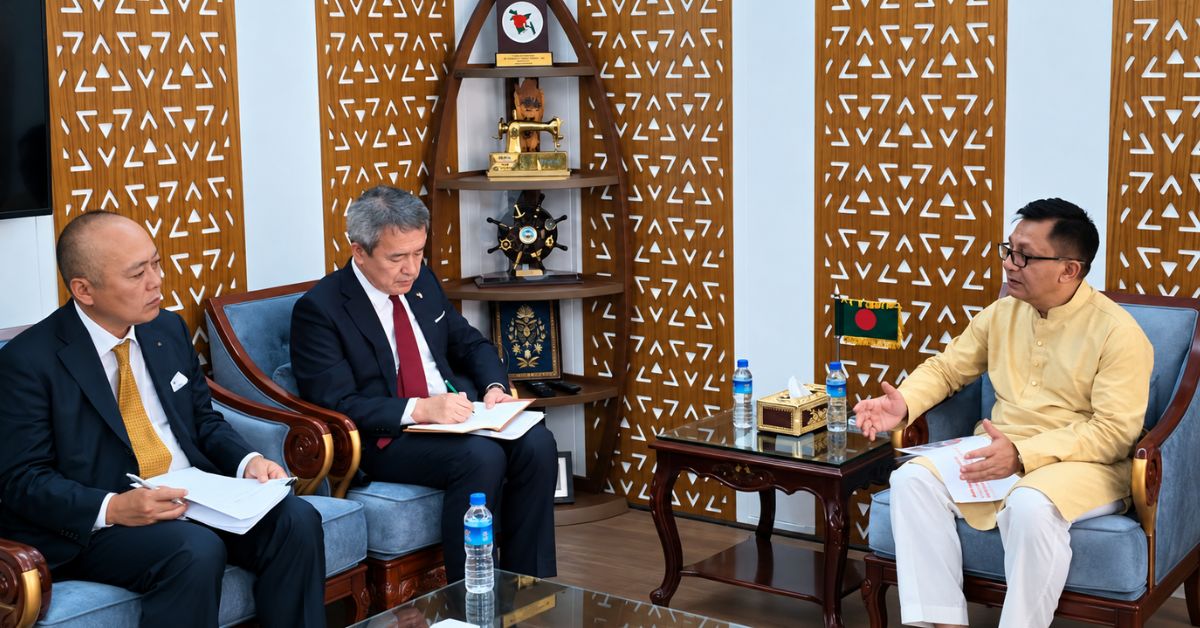
Japanese trading house Marubeni Corporation wants to expand its investments in Bangladesh and enter new sectors including fertiliser, information technology and environmentally friendly ship recycling. President and CEO Masayuki Omoto discussed opportunities, including modernising the Karnaphuli Fertilizer Company, with Commerce Minister Khandakar Abdul Muktadir in Dhaka on October 11.
Article
Dhaka: Marubeni Corporation is seeking to expand its Bangladesh investment portfolio and move into new industries, the country’s commerce ministry said after a meeting between the Japanese conglomerate’s top executive and Commerce Minister Khandakar Abdul Muktadir on Sunday, October 11, 2026.
A Marubeni delegation led by President and CEO Masayuki Omoto met the minister at the commerce ministry, where the two sides discussed fertiliser, IT, ship recycling, automobiles and energy.
What are Marubeni’s plans in fertiliser?
Marubeni, an equity investor in the Karnaphuli Fertilizer Company (KAFCO), sees scope to modernise the plant, improve its natural gas efficiency and raise fertiliser production capacity.
Omoto also expressed interest in new investment and technology cooperation for producing diammonium phosphate (DAP) and triple superphosphate (TSP) fertilisers.
Where does IT fit in?
Omoto highlighted Bangladesh’s potential in information technology, noting that hundreds of Bangladeshi engineers at Bangladesh Japan Information Technology (BJIT), a joint venture, serve international clients including in Japan. He said there was room to expand cooperation in artificial intelligence and IT offshoring.
Marubeni announced a business and capital alliance with BJIT Group in April 2023, investing in BJIT Ltd and BJIT Global Pte Ltd to expand offshore digital transformation services.
What about ship recycling and other sectors?
The talks covered investment in modern, environmentally friendly technologies for Bangladesh’s ship recycling industry, along with a proposal for Toyota vehicle manufacturing and steps to ensure uninterrupted power supply to economic zones. Small modular reactor (SMR) technology was also discussed as an option for long-term energy security.
Muktadir said there are opportunities to expand joint ventures in shipbuilding and ship recycling, automobiles, agro-based industries and high-tech sectors, and that the government is pursuing reforms to support investment in these areas.
What did the government promise investors?
The minister said Bangladesh is prioritising simpler company registration, trade licensing and investment approvals, and is working to ensure foreign investors can repatriate profits and capital. He assured Japanese companies of government support and said Japanese technology and investment could play a significant role in developing Bangladesh’s manufacturing base.
Both sides also discussed deepening economic ties under the Bangladesh-Japan Economic Partnership Agreement (EPA). The minister separately outlined plans to diversify the jute sector into higher-value blended products.
What is Marubeni’s existing footprint?
Marubeni has installed about 1,300 MW of gas-fired and hydropower plants in Bangladesh and supplied the full railway system for Dhaka Metro Rail’s MRT Line 6. Globally, the group reported revenue of ¥7.79 trillion in the year ended March 2025 and employs more than 52,000 people.
Why does the ship recycling interest matter?
Bangladesh is one of the world’s largest ship recycling nations. Its accession to the Hong Kong Convention in June 2023 helped trigger the treaty’s entry into force on June 26, 2025, which requires ships sent for recycling to carry an Inventory of Hazardous Materials.
Upgrading yards remains a challenge. Bangladesh’s shipping adviser has warned yards to convert to green standards or exit the business, noting that only 14 had obtained certification by the deadline. Investment and technology from a major trading house such as Marubeni could help accelerate compliance and strengthen Bangladesh’s position as shipowners increasingly favour certified, environmentally sound recycling facilities.
FAQs
Which sectors is Marubeni interested in?
Marubeni wants to expand in fertiliser, information technology and environmentally friendly ship recycling, and discussed Toyota vehicle manufacturing and SMR energy technology.
What is Marubeni’s role in KAFCO?
Marubeni is an equity investor in the Karnaphuli Fertilizer Company and sees opportunities to modernise the plant and raise output.
Who met during the visit?
Marubeni President and CEO Masayuki Omoto met Bangladesh Commerce Minister Khandakar Abdul Muktadir in Dhaka on October 11, 2026.
What has Marubeni already built in Bangladesh?
It has installed about 1,300 MW of power plants and supplied the railway system for Dhaka Metro Rail’s MRT Line 6.
Why is ship recycling investment significant for Bangladesh?
The Hong Kong Convention entered into force in June 2025, and Bangladeshi yards need upgrades to meet green recycling standards.
 Join our WhatsApp channel for more updates:
 Subscribe to our YouTube channel for more updates:



