




Five vessels return to the canal on select Asia-Europe and India-Mediterranean strings as four-week transit volumes hit a two-year high
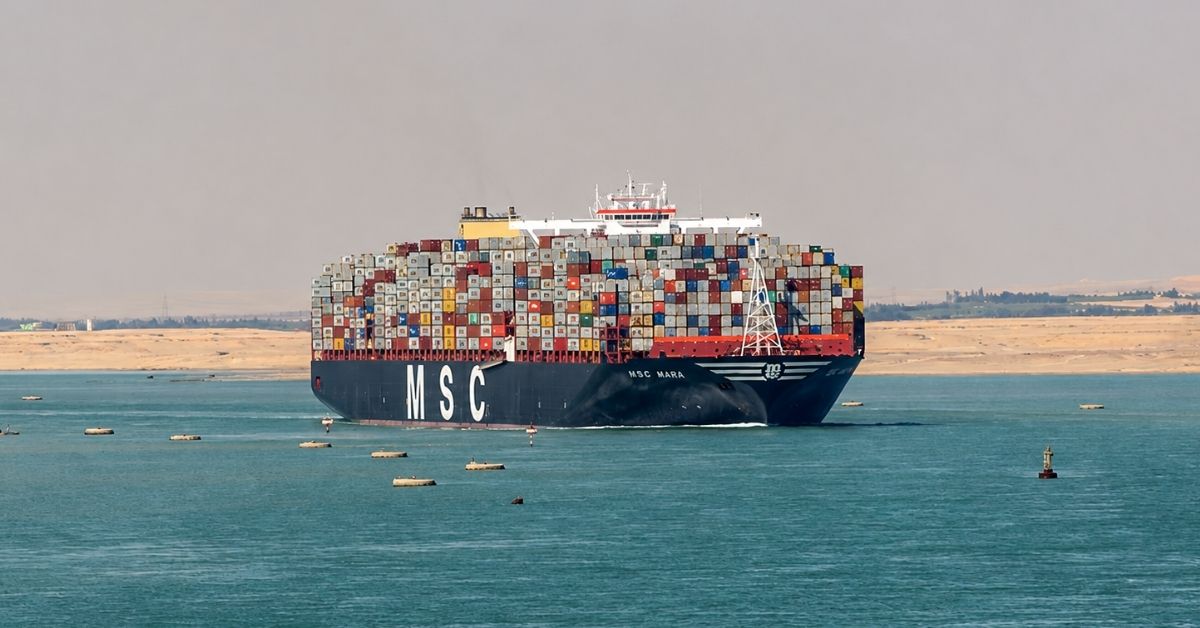
Mediterranean Shipping Company, the world’s largest container line, has begun restoring a limited number of sailings through the Suez Canal, marking one of the clearest signs yet of a tentative recovery in traffic through the waterway after months of mass diversions around the Cape of Good Hope. MSC announced on August 24 that it would resume selected eastbound and westbound sailings following an internal review of security and operational conditions along the Red Sea corridor.
The initial phase covers four services — Jade and Tiger, both linking Asia and the Mediterranean; Albatros, running between Asia and North Europe; and, notably for Indian shippers, the Himalaya service connecting India directly with the Mediterranean. Five vessels are involved in the restart: MSC Michel Cappellini, MSC Josefina, MSC Anna, MSC Tina and MSC Beryl. The inclusion of an India-Mediterranean string in the first wave of restored services is being read by Indian exporters and freight forwarders as an early signal that carriers see enough stability to bring back some of the shortest, most cost-efficient routings for Indian cargo bound for European markets.
The move comes as broader canal traffic data shows a gradual, if partial, recovery. The Suez Canal recorded 1,090 transits in the four-week period ending August 20 — the highest four-week total since 2024 — up from 1,070 transits in the prior four-week window and roughly 14 per cent above the depressed average of 946 transits recorded between January and mid-June this year. Even so, current volumes remain about 41 per cent below the levels seen before the crisis, underlining how far traffic still has to climb before the canal returns to anything resembling pre-war normalcy.
The recovery follows nearly a year and a half of disruption. Major carriers including Maersk, Hapag-Lloyd and CMA CGM suspended or diverted the bulk of their Suez transits from early March, when escalating conflict in the region made the Red Sea and Bab-el-Mandeb corridor too risky for routine transits. At the peak of the diversions, 60 to 80 vessels a week were rerouting via the Cape of Good Hope for Europe-bound cargo, adding 6,000 to 9,000 additional kilometres — roughly 10 to 15 extra sailing days — to affected voyages, and helping drive a reported 340 per cent surge in Asia-Europe container freight rates within weeks of the initial disruption.
Industry analysts caution that MSC’s restart remains selective and reversible: the carrier has framed the move explicitly as conditional on continued security and operational stability, and other major lines have so far been slower to follow with formal announcements of their own, even as informal signs point to a broader carrier cascade back toward Suez in the coming weeks. Freight forwarders note that any full-scale return of Asia-Europe capacity to the canal route would likely ease the elevated freight rates and extended transit times that have persisted on that corridor for much of the past year, but that the timeline for such normalisation remains highly dependent on developments in the wider regional conflict rather than commercial factors alone.
For Indian exporters, the restoration of a direct India-Mediterranean sailing is a welcome, if tentative, development after a prolonged period in which shipments to European markets faced longer transit times and higher freight costs via the Cape route. Logistics planners nonetheless caution against assuming a swift full return to pre-crisis routings, given how quickly previous partial recoveries earlier in the conflict were reversed as security conditions shifted.
 Join our WhatsApp channel for more updates:
 Subscribe to our YouTube channel for more updates: