



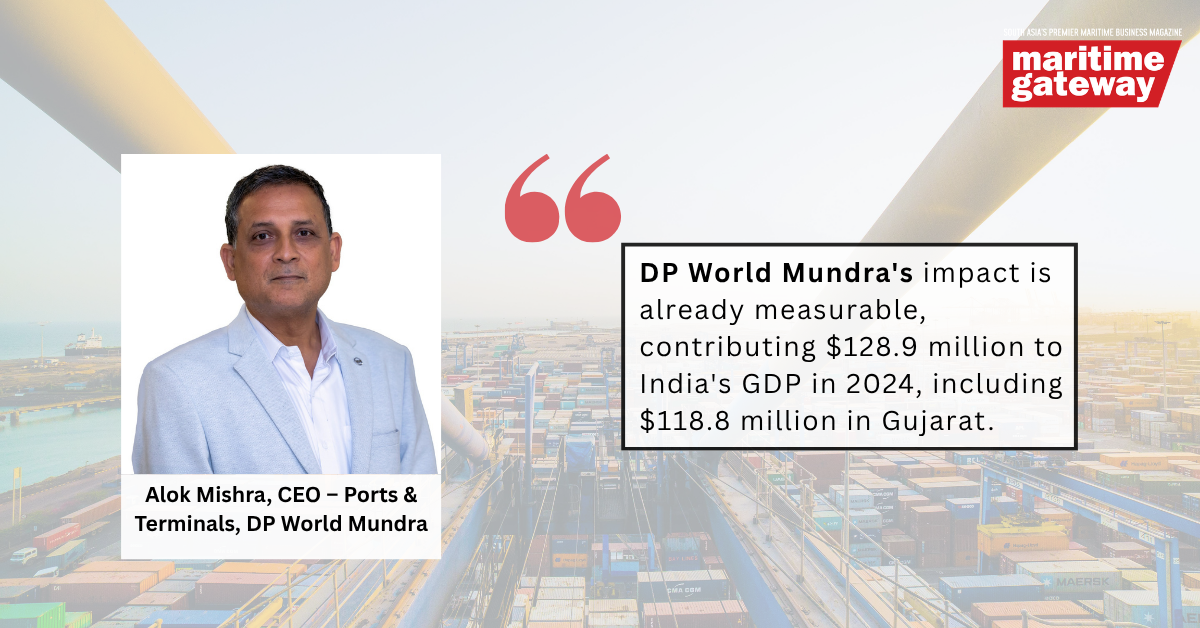

Alok Mishra, CEO – Ports & Terminals, DP World Mundra, sits with Ramprasad Ravi to talk about MICT’s 13.6% throughput growth, its expanding rail network, and the terminal’s next phase of capacity investment
The Oxford Economics report puts MICT’s GDP contribution at $128.9 million in 2024, with a projection of $9.2 billion by 2035. How do you see that trajectory playing out, and what gives you confidence in those numbers?
DP World’s Mundra International Container Terminal (MICT) delivered strong performance in CY25, with throughput rising 13.6% to nearly 1.5 million TEUs. Momentum extended into early 2026, with January volumes reaching 1,46,063 TEUs and February hitting 1,32,590 TEUs, both surpassing prior year levels and solidifying DP World Mundra’s role as a major gateway connecting Indian businesses with global markets. As the Oxford Economics report highlights, DP World Mundra’s impact is already measurable, contributing $128.9 million to India’s GDP in 2024, including $118.8 million in Gujarat.
Improved global market access through MICT supports business expansion, higher exports and productivity gains. As India’s manufacturing, exports and trade volumes grow, this underscores the need for sustained investment in port, inland logistics and supply chain infrastructure.
MICT handled 1.4 million TEU in 2024. What is your target for the next two to three years, and what are the primary drivers of volume growth right now? Where is the growth coming from — is it export-led, import-driven, or are you seeing a shift in the cargo mix?
Building on its growth momentum, MICT handled nearly 1.5 million TEUs in CY25, marking a 13.6% year-on-year increase in throughput. Our focus remains firmly on expanding capacity and enhancing connectivity. A key milestone in this journey has been the significant strengthening of our rail infrastructure, with increased handling capacity of nearly 50-55%. These advancements have not only improved operational efficiency but have also bolstered MICT’s position as a reliable and future-ready logistics hub.
We are seeing robust demand from emerging industries in the Kutch region, particularly solar manufacturing and electronics, alongside rising trade with Gulf and African markets. Enhanced rail connectivity and integrated logistics services are enabling seamless movement of both import and export cargo.
MICT currently connects to 73 global ports. Which trade lanes are seeing the strongest momentum, and are there any new services or port calls in the pipeline?
MICT’s growth is driven by its strong global connectivity, with access to 73 international ports and 14 weekly vessel calls. We are connected to all major trade lanes, including Southeast Asia, the Middle East, Africa, Europe and the Americas, with particularly strong momentum currently coming from the Far East and Middle East corridors.
Our multimodal network, supported by robust rail connectivity to key manufacturing and consumption hubs across western and northern India, further enhances the terminal’s value proposition by enabling faster, more efficient cargo movement. This combination of global maritime connectivity and inland logistics allows our customers to benefit from greater schedule reliability, shorter transit times and seamless access to international markets.
Rail connectivity across Gujarat, Rajasthan, Haryana, Punjab and Delhi is clearly central to your value proposition. How has multimodal uptake evolved, and where do you see the biggest untapped hinterland potential?
Businesses that have historically relied on road transport are now shifting towards multimodal logistics, driven by cost, reliability and sustainability advantages. This is creating significant headroom for additional rail-led cargo growth across North, Central and Western India, particularly among MSMEs and export-oriented manufacturers.
Across India, DP World has invested more than INR 1,800 crore in rail infrastructure and operates eight inland terminals, including Pali-Rewari, Modinagar, Panipat, Hazira, Hindaun, Ahmedabad, Hyderabad, and Pawarkheda. These are supported by over 100 owned container rakes, enabling deeper access into India’s manufacturing and consumption centres.
Additionally, the launch of dedicated multimodal rail services such as SARAL, SARAL-2 and SARAL-3 demonstrates growing demand for integrated logistics solutions. These services have expanded connectivity between Gujarat, Chennai and the NCR, providing assured transit times, door-to-door delivery, cargo visibility and lower-carbon alternatives to road transport.
As part of DP World’s integrated logistics network, MICT combines port infrastructure, rail services, inland terminals, coastal shipping and first- and last-mile trucking to deliver seamless end-to-end solutions. This allows cargo to move seamlessly from factories in inland markets to global shipping routes through Mundra. As of 2026, MICT handles over 320 trains per month, including EXIM cargo, with 70% operating as double-stack. This network links India’s inland manufacturing centres to global trade routes through Mundra.
The Aten Papers case study illustrates how local businesses are using Mundra to access global recycled material markets. What other cargo segments or industries are emerging as significant users of the terminal? How would you describe the current cargo profile at MICT — which commodities dominate, and is that profile changing?
The Aten Papers case study reflects a broader trend at Mundra, with recycling-led manufacturing increasingly leveraging global supply chains. Beyond recycled paper, the terminal is seeing strong demand from industries such as chemicals, automotive and auto components, consumer goods, agriculture, manufacturing, and project cargo.
MICT efficiently manages a wide spectrum of cargo, including containerised, reefer, hazardous, out-of-gauge, and transshipment cargo. Project cargo has shown strong growth, with Mundra emerging as a key gateway for Morbi tiles, fresh agro produce, automotive products, auto parts, and industrial goods.
MICT was commissioned in 2003 as a container terminal at a non-major port. What infrastructure investments are currently underway or planned to sustain the next phase of growth? Are there any capacity expansion plans — berths, yard equipment, rail sidings — that you can share at this stage?
Ever since its commissioning in 2003, MICT has played a pivotal role in establishing Mundra as a critical gateway for containerised trade. Today, the terminal boasts a 632-metre berth with a 15.5-metre draft, three operational rail sidings, 18,500 sq. m of warehousing, and 50 acres of open container storage.
To support future growth, we have added a new quay crane and electric RTGs, while continuing to enhance berth productivity, yard efficiency, and vessel turnaround times. Combined with our on-dock rail connectivity and at-gate freight station, these investments enable us to deliver highly customised, customer-centric solutions — making MICT the preferred choice for trade, even during periods of market disruption.
 Join our WhatsApp channel for more updates:
 Subscribe to our YouTube channel for more updates: