


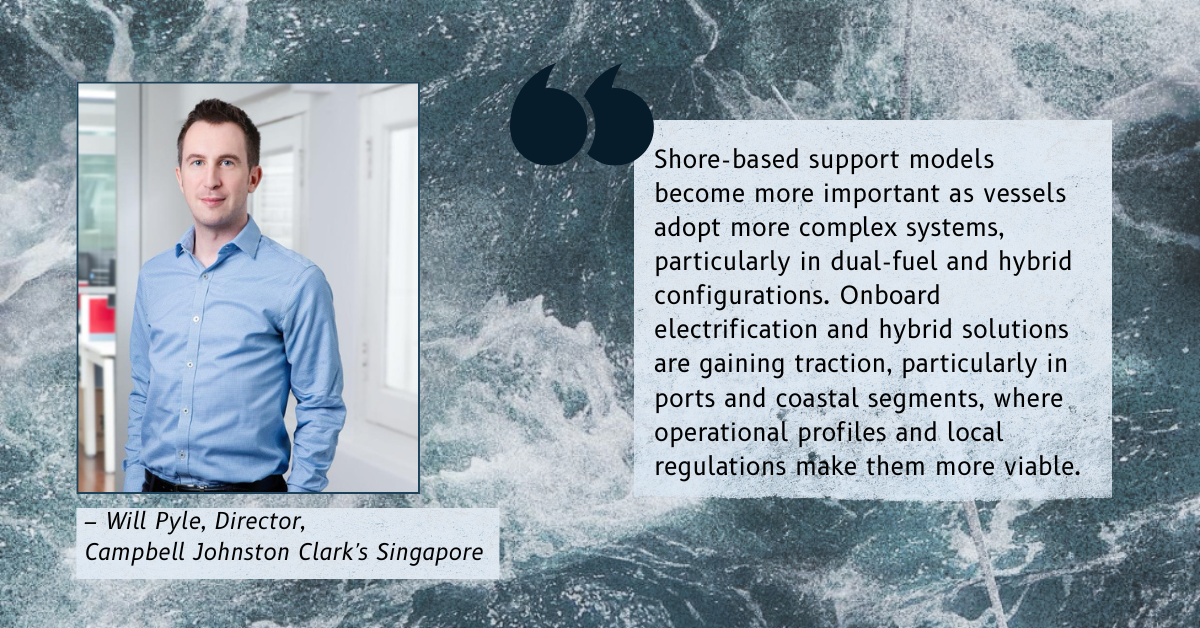

Will Pyle is a Director at Campbell Johnston Clark’s Singapore office, where his practice is focused almost exclusively on maritime disputes. He represents ship owners, P&I clubs, charterers, and cargo interests across a wide spectrum of cases including casualties, charter party disputes, and cargo claims. In this interview with Ramprasad Ravi, Maritime Gateway, Pyle speaks candidly about the legal risks that keep the shipping industry up at night.
Will, can you start by giving us a sense of the nature of your practice in Singapore and the kinds of disputes your team handles?
My practice in Singapore focuses on maritime disputes. We represent ship owners and their P&I clubs most frequently, but also charterers and sometimes cargo interests. Roughly half of my work involves casualty matters, fires, collisions, groundings, and other incidents at sea, while the other half covers contractual disputes, including charter party claims, cargo claims, and ship management-related issues. We also see some shipbuilding and offshore services disputes. In terms of sector exposure, container shipping features prominently, whether that is cargo damage claims, fire incidents on container vessels, or claims by terminals against vessels for damage to port infrastructure.
There is growing complexity around compliance in shipping, whether that is decarbonisation, geopolitical tensions, or sanctions exposure. What categories of legal risk do you see most sharply in this space?
From a lawyer’s perspective, you always come back to the contractual framework. When owners are navigating new compliance territory, whether that is fuel specification changes driven by decarbonisation requirements or the geopolitical constraints affecting trading areas, their primary concern has to be how risk is allocated in the charter party. An owner on a time charter will naturally want to push compliance risk onto the time charterer to the extent possible. BIMCO has been at the forefront of developing standard clauses to address new fuel specifications and decarbonisation obligations, and those have been widely adopted. But the quality of protection always depends on whose interest you represent. What is drafted as a balanced clause often contains words like ‘reasonable’ or ‘reasonable view’, and as soon as that language appears, there is scope for lawyers on both sides to argue about what those words actually mean in a commercial context. That ambiguity is where disputes are born.
You mentioned casualty work as a significant part of your practice. From your experience handling some of the industry’s more serious casualties, what are the most common mistakes ship owners and P&I clubs make in the immediate aftermath of an incident?
There are two patterns I see repeatedly. The first is a failure to appreciate the severity of an incident at the early stage. Container ship fires are a good example. A smouldering container on deck might look contained, perhaps the crew can see smoke but no visible flames, and there is a temptation for the owner and the P&I club to treat it as a manageable situation rather than a potential total loss. Therefore, there is a risk that resource mobilisation is insufficient, and then when the fire spreads and engulfs the entire vessel, the response infrastructure is simply not in place.
The second issue, and this is arguably more pervasive, is the failure to properly collect and preserve evidence in the early stages of smaller casualties. Say there is a minor collision, some limited damage between two vessels, or a small fire that the crew successfully suppresses. The owner decides not to instruct lawyers, not to commission a specialist fire expert, because the anticipated losses seem modest and the cost of investigation seems disproportionate. What they do not see at that point is that delay claims or significant cargo claims may materialise months later. By then, we are brought in a year after the casualty to defend a substantial claim, and when we ask whether crew statements were taken, whether a fire investigation expert went on board to preserve evidence, the answer is invariably no. There is a surveyor report, but nothing more. That is a very difficult position from which to mount a defence.
With market volatility, freight rate swings, port congestion, and war risk rerouting creating enormous pressure on standard charter parties right now, which categories of disputes have risen most sharply?
The Persian Gulf situation is generating a significant volume of disputes at present. Time charterers operating vessels in that region are paying hire to owners but are struggling to recover equivalent detention or waiting time costs from voyage charterers down the chain. They are caught in a commercial squeeze. At the same time, owners themselves face exposure around whether their vessels should enter or remain in the region at all, and what the contractual position is for vessels that become operationally constrained or stuck. These are live disputes with real commercial consequences and they will keep generating litigation for some years to come.
Which brings us naturally to the drafting of force majeure and sanctions clauses. Are today’s contracts being drafted with sufficient precision to handle these scenarios?
That is a broad question, and an honest answer requires acknowledging the structural challenge. Clauses are typically drafted well before the specific conflict or regulatory change they end up being tested against. A clause negotiated five years ago was not necessarily drafted with today’s Strait of Hormuz dynamics or the current sanctions architecture in mind. So there will always be interpretive gaps when reality outpaces the drafting.
The more interesting tension is the one that bodies like BIMCO face when they try to produce balanced standard clauses for time charter use. If they protect owners too strongly, charterers will not accept the clause. If they lean the other way, owners resist. That compromise produces clauses where certain obligations or thresholds are expressed in qualified terms, such as ‘reasonable steps’ or ‘in the owner’s reasonable judgment’, and those qualifications, while necessary for commercial acceptance, are precisely where disputes concentrate. The grey areas are not accidental. They are the price of achieving a clause that both sides will sign.
Finally, tell us about CJC’s positioning as a firm. What sets you apart in the Singapore maritime disputes market?
We are a specialist firm. In our Singapore practice, we are one hundred percent focused on marine disputes. That focus matters because maritime disputes require deep technical knowledge, an understanding of how vessels actually operate, how casualty investigation works, how P&I and hull insurance interact, and how maritime arbitration in London or Singapore functions in practice. Our team in Singapore is sizeable by the standards of international firms practising shipping law here, which means we can bring appropriate resources to complex, multi-party casualties or high-value charter party disputes without stretching the team. We also have a partner handling non-contentious work, including ship sale and purchase and ship finance, which gives clients a more complete service when they need it.
 Join our WhatsApp channel for more updates:
 Subscribe to our YouTube channel for more updates: