




China now holds six of the top 10 global container port spots as Shanghai stays comfortably at No. 1
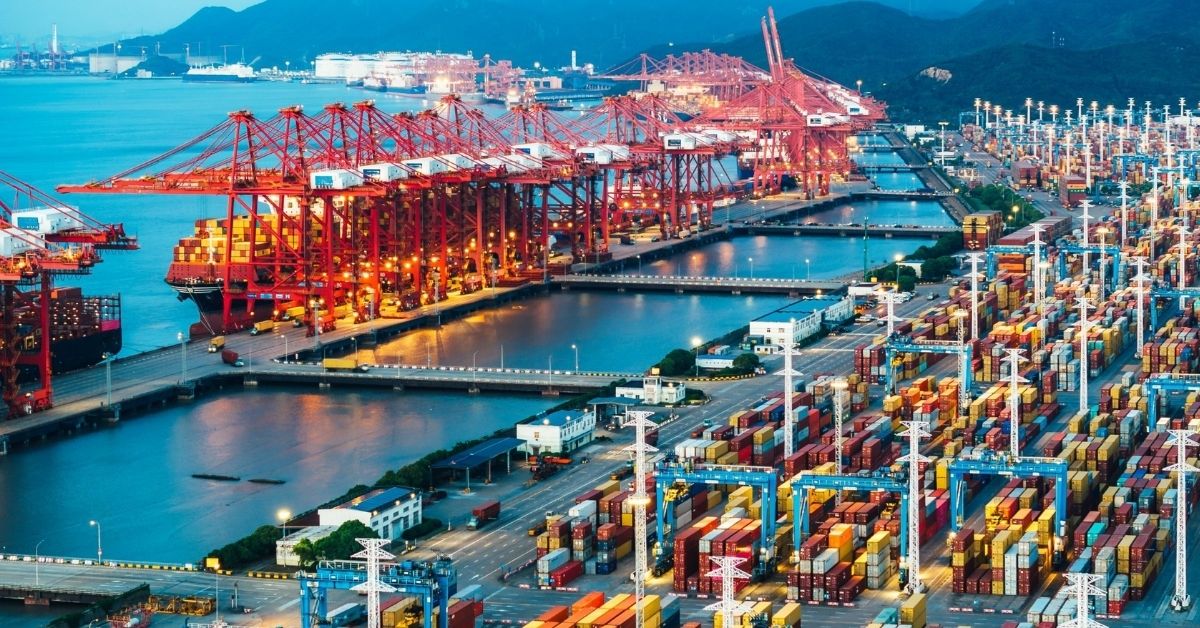
China’s Ningbo-Zhoushan port complex has edged past Singapore to claim second place in Alphaliner’s latest ranking of the world’s busiest container ports, in a shift that reflects the broader momentum Chinese ports have built over the past year. According to the first-half 2026 data, Ningbo-Zhoushan handled 22.90 million TEUs between January and June, an 8.8 per cent year-on-year increase, compared with Singapore’s 22.74 million TEUs, up 4.7 per cent over the same period — a growth rate roughly half that of its Chinese rival.
The two ports finished 2025 separated by only around 800,000 TEUs, so the swap in rankings had been visible on the horizon for some time. Ningbo-Zhoushan’s continued double-digit-adjacent growth, against a comparatively more modest expansion at Singapore, was enough to tip the balance in the first half of this year. Shanghai remains comfortably the world’s busiest container port, handling more than 28.7 million TEUs in the same period, keeping China’s largest gateway well clear of any near-term challengers.
The reshuffling underscores a broader trend: China now accounts for six of the top 10 spots on Alphaliner’s global container port throughput chart, a concentration of volume that reflects both the scale of Chinese manufacturing and export activity and continued heavy investment in port capacity and efficiency across the country’s coastal hubs. Industry analysts tracking the rankings have also linked some of the shift to the way ongoing geopolitical disruption — particularly the diversion of vessels away from the Suez Canal and Red Sea — has altered network patterns for major carriers, in some cases favouring transshipment and direct-call patterns that route more volume through Chinese ports relative to Southeast Asian hubs.
For Singapore, slipping to third place is unlikely to be received as anything more than a temporary setback given the sheer scale of ongoing investment in the Tuas mega-port project, which is being built in phases and is designed to eventually consolidate all of Singapore’s container operations into a single, highly automated facility with far greater ultimate capacity than the port’s current combined terminals. Analysts note that rankings based on half-year snapshots can shift again once new capacity phases come online, and that Singapore’s transshipment-dependent business model gives it structural advantages that a pure throughput ranking does not fully capture.
The rankings carry indirect relevance for India as well. Indian ports handling international transshipment cargo — historically routed heavily through Colombo, Singapore and, increasingly, Middle Eastern hubs — are watching closely as global carriers recalibrate network calls amid the ongoing disruption in the Red Sea and Gulf. A more China-centric global transshipment map, if it persists, could have implications for how Indian exporters’ cargo is routed and priced on onward legs to Europe and the Americas, adding another variable for Indian shipping lines and freight forwarders to factor into long-term network planning.
Whether Ningbo-Zhoushan can hold its new position through the second half of the year will depend partly on how durable the current growth differential proves to be, and partly on how quickly Singapore’s Tuas expansion translates additional automated capacity into throughput gains of its own.
 Join our WhatsApp channel for more updates:
 Subscribe to our YouTube channel for more updates: