



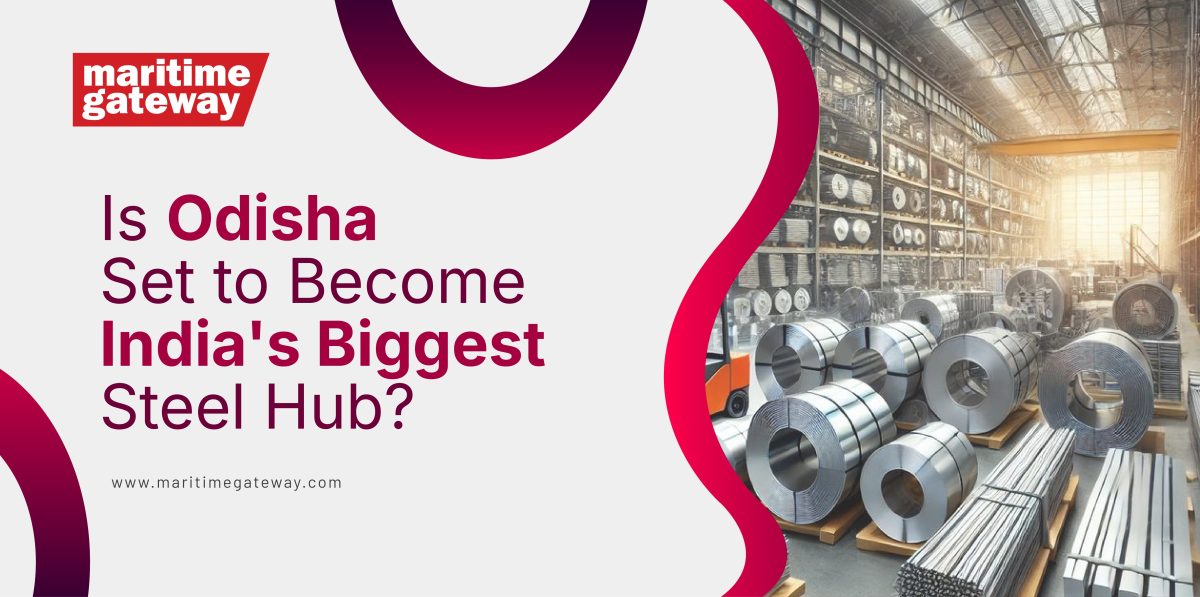

Odisha’s steel story has moved from resource endowment to real, ground-level construction. In the space of a few months, the state has watched bulldozers break ground at Paradip and Sambalpur, chief ministers flag off mega-projects at Dhinkia; and industry majors from JSW to Vedanta commit sums that individually rival the annual budgets of mid-sized states. The question that now follows every announcement is a simple one: is Odisha actually on track to become India’s largest steel manufacturing base, or is this another round of ambitious paper commitments that may take years, if ever, to fully materialize?
The answer, going by the events of the past 18 months, leans toward the former but with important caveats around execution, land, environment clearances and logistics that any serious observer of Odisha’s industrial history will recognize.
Why does Odisha keep attracting steel investment?
The state sits on a geological advantage that is difficult to replicate. Odisha holds roughly a third of India’s iron ore reserves and produces close to half the country’s iron ore output, alongside significant chromite, bauxite, manganese and coal deposits. This resource base, combined with a long coastline offering direct port access at Paradip, Dhamra and Gopalpur, gives steelmakers a rare combination of raw material proximity and export-import logistics in one location. Odisha’s Directorate of Mines and Geology has tracked the state’s installed crude steel capacity rising from around 4 million tonnes per annum (MTPA) in 1999-2000 to roughly 33 MTPA by 2020-21, with projections of 100 MTPA by 2030. Some industry estimates go further, suggesting the state could touch 130 MTPA by the end of the decade if every announced project reaches completion
What has changed on the ground in 2026?
The most visible development this year has been JSW Steel’s decision to begin actual construction rather than simply sign paperwork. In late May 2026, the company started work on an integrated steel plant at Paradip, spread across nearly 2,950 acres, targeting a capacity of 13.2 MTPA in phases. The project is reported to carry an investment of roughly ₹65,000 crore, and construction activity was formally launched by Chief Minister Mohan Charan Majhi at Dhinkia. Odisha’s government has framed the project as one of India’s largest single industrial investments in steel to date, citing its expected contribution to regional employment and downstream manufacturing.
Alongside this, JSW has also moved forward with a separate joint venture — JSW JFE Steel Limited — with Japan’s JFE Steel Corporation, unveiled in April 2026 at Rengali in Sambalpur district. This partnership is aimed squarely at import substitution: India currently imports several million tonnes of high-grade automotive and precision steel each year from Japan, South Korea and Germany because domestic mills have lacked the metallurgical know-how to produce those grades at scale. The joint venture plans to scale the Sambalpur facility from its current 4.5 MTPA to more than 15 MTPA over the long term, with an investment program worth approximately ₹32,000 crore.
Who else is building capacity in the state?
JSW is far from alone. Odisha’s steel landscape now includes commitments from nearly every major domestic producer:
● Tata Steel’s Kalinganagar plant remains one of India’s largest integrated greenfield steel facilities, with capacity that has been scaled up to 8 MTPA and further expansion plans reportedly in the pipeline.
● ArcelorMittal Nippon Steel India (AM/NS India) received state approval for a 24 MTPA integrated steel plant in Kendrapara district’s Mahakalpara block, carrying an investment of roughly ₹1.02 lakh crore — one of the largest single manufacturing proposals in the country when it was cleared.
● Jindal Steel and Power (JSP), led by Naveen Jindal, has committed to expanding its existing Angul plant from 6 MTPA to 25 MTPA by 2030, an investment of around ₹70,000 crore that the company describes as aiming to make Angul the world’s largest and greenest steel facility.
● Vedanta, while primarily known in Odisha for its aluminium operations through the Lanjigarh refinery, has also signed commitments worth roughly ₹1 lakh crore covering alumina refining and green aluminum capacity that feeds into the broader metals ecosystem.
Odisha’s mining department notes that 47 steel plants with a combined installed capacity of 32.45 million tonnes were already operating in the state, of which only Rourkela Steel Plant, run by SAIL, sits in the public sector—the rest belong to private players.
How much money has actually been committed?
The scale of the announced investment is difficult to overstate. At the Utkarsh Odisha – Make in Odisha Conclave held in Bhubaneswar in January 2025, the state government reported investment intents worth ₹16.73 lakh crore across 593 projects and more than 20 sectors, with 145 formal memoranda of understanding signed for roughly ₹12.89 lakh crore. Steel and metallurgy featured prominently: JSW alone proposed a ₹35,000 crore, 5 MTPA plant in Keonjhar district (the chief minister’s home district), and Naveen Jindal used the conclave to formally announce the Angul expansion.
More recent approval rounds have added to the tally in smaller but still substantial increments. In October 2025, the state’s high-level clearance authority approved 33 projects worth ₹1.46 lakh crore, spanning Angul, Jharsuguda, Sundargarh, Ganjam and Kendrapara districts, with Tata Steel and Jindal Steel & Power both proposing capacity expansions and downstream processing units, and JSW Energy, Vedanta and AM/NS India securing approvals for renewable and metallurgical projects. In March 2026, a further batch of 23 projects worth ₹4,510 crore was cleared across 11 districts, covering metals processing alongside pharmaceuticals, chemicals and textiles—a sign that the state’s industrial base, while still steel-and-metals heavy, is beginning to diversify.
What is driving the state government’s push?
Much of this activity sits inside Odisha’s Vision 2030 industrial policy, which frames balanced regional development and green industrial growth as its central goals. Chief Minister Majhi has personally set a target of 100 million tonnes of steel capacity for the state by 2030, and in April 2026 he convened a high-level meeting with mining and industry stakeholders in Bhubaneswar to push companies toward a concrete roadmap for that goal. Officials at the meeting flagged the need to raise iron ore output in step with minimum dispatch obligations under mine development and production agreements while staying within regulatory limits—an acknowledgement that raw material supply, not just capital, will determine how quickly capacity actually comes online.
The state is also building administrative infrastructure to support faster clearances: officials say a district-wise database of land acquired for compensatory afforestation is being prepared to help investors assess availability, alongside an annual mining block auction calendar for 2026-27 intended to make allocation more predictable.
How does this fit into India’s national steel targets?
Odisha’s ambitions track a broader national push. Under the National Steel Policy of 2017, India has targeted 300 million tonnes of installed steelmaking capacity by 2030, alongside a rise in per capita steel consumption toward 158 kg. As of FY2025-26, India’s total installed capacity stood at approximately 220 MTPA, with crude steel production for the year through February 2026 at 153.6 million tonnes, putting the country on a trajectory that officials describe as broadly on track, though it will require roughly 65-80 million tonnes of fresh capacity addition in the remaining years of the decade.
The Ministry of Steel has also floated the idea of “Purvodaya”—an integrated steel hub concept spanning Odisha, Jharkhand, Chhattisgarh, West Bengal and northern Andhra Pradesh, intended to concentrate future capacity growth in India’s eastern mineral belt rather than spreading it thinly across the country.
Green steel is becoming a parallel theme. Under the government’s Green Steel Initiative, certificates have been issued to 94 producers across 15 states as of May 2026, with most certified products achieving the highest five-star rating. Tata Steel has already commissioned a ₹3,200 crore scrap-based electric arc furnace green steel plant in Ludhiana, and Jindal’s Angul expansion is explicitly being pitched as a green-steel project using similar low-carbon technology pathways.
What could slow this down?
None of this is guaranteed to unfold on schedule. Odisha’s steel sector has a documented history of projects that were announced with fanfare and then stalled — sometimes for years — over land acquisition disputes, environmental clearances, or changes in ownership and market conditions. Industry commentary around JSW’s Paradip project has already flagged execution and regulatory risk, pointing to past disputes in the area over land acquisition and environmental litigation as a caution against assuming smooth timelines. Logistics costs, tighter export restrictions in markets like Europe, and volatility in raw material prices for coking coal and iron ore add further uncertainty to how quickly and profitably this capacity gets utilised once built.
There is also a structural question about whether India’s domestic steel demand will grow fast enough to absorb the capacity being planned. Finished steel consumption in India grew a healthy 8-9 percent year-on-year through early and mid-2026, driven by construction, infrastructure and automobile demand, but steel imports have also risen sharply in the same period — up over 60 percent in May 2026 alone — turning India into a marginal net importer in some months even as domestic capacity expands. That combination suggests the growth in demand and the growth in supply will need careful matching if new Odisha capacity is not to arrive into an oversupplied market.
So, is Odisha’s steel boom real?
The honest answer is that it is real in terms of capital committed and, increasingly, in terms of construction activity. JSW’s decision to start building at Paradip rather than simply signing another MoU is a meaningful signal. But the gap between announced investment intent (measured in the tens of lakh crore at conclaves) and actually operational capacity has historically been wide in Odisha, and will likely remain so for large greenfield projects like AM/NS India’s Kendrapara plant, which was first approved back in 2021 and has yet to see construction begin at scale.
What does appear settled is the direction of travel: Odisha is positioning itself, with active state government backing, mineral advantages, port access and now serious construction milestones, as the anchor of India’s next phase of steel capacity growth. Whether it reaches 100 MTPA, 130 MTPA, or something in between by 2030 will depend less on further investment announcements and more on how quickly land, environmental clearances, raw material linkages and demand growth align with the capital that has already been pledged.

Register Now—https://smartlogisticssummit.in/
 Join our WhatsApp channel for more updates:
 Subscribe to our YouTube channel for more updates: