





Summary
Odisha brought policymakers, trade specialists and entrepreneurs together in Bhubaneswar on 13 October to explore how businesses can benefit from India’s free trade agreements. The workshop focused on strengthening MSME export competitiveness and converting preferential market access into commercial opportunities, against the backdrop of the state’s export diversification efforts.
Workshop connects trade agreements with business needs
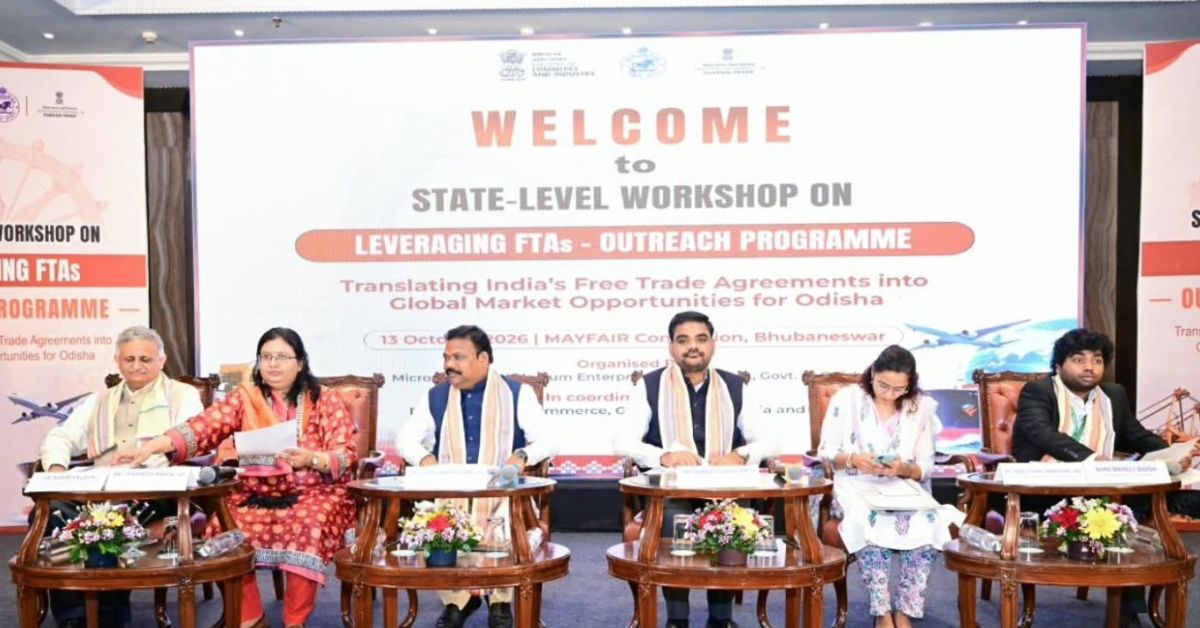
An Odisha FTA outreach workshop held in Bhubaneswar on 13 October 2026 examined opportunities for the state’s micro, small and medium enterprises to expand into international markets through India’s trade agreements.
The programme, titled “Leveraging FTAs – Outreach Programme”, brought together policymakers, trade experts, industry representatives, exporters, entrepreneurs and startups. Discussions centred on using trade agreements to strengthen Odisha’s global commercial presence.
Sampad Chandra Swain, Minister of State for Industries, Skill Development and Technical Education, and Gokulananda Mallick, Minister of State for Fisheries and Animal Resources Development and MSME, addressed participants.
Both ministers emphasised the importance of turning opportunities under India’s trade agreements into practical benefits for industries and entrepreneurs. The event was an outreach initiative; no new trade agreement or export incentive package was announced.
Preferential access requires export readiness
The commercial value of a free trade agreement depends on whether a business can establish that its products qualify for the available concessions.
The India–Australia Economic Cooperation and Trade Agreement, which entered into force on 29 December 2022, provides one example. Australia’s phased tariff elimination has reached the point where qualifying imports from India can enter duty-free.
However, preferential treatment depends on meeting the agreement’s rules of origin. Exporters and importers must identify the appropriate product classification, check tariff treatment and establish that the goods satisfy the relevant origin criteria.
Supporting documentation, including a certificate of origin, is required for claims under the agreement. Goods do not become eligible simply because they are shipped through an agreement partner.
These requirements illustrate why trade outreach must connect market opportunities with product-level compliance. For an MSME, understanding the applicable rules is part of assessing whether preferential access can improve its competitive position.
Odisha’s policy supports diversification
The workshop fits within the broader direction of Odisha’s Export Policy 2022, which seeks to promote exports, value addition, employment and access to new markets.
Although minerals and metals have historically dominated the state’s exports, the policy identifies opportunities in marine products, agriculture, horticulture, handicrafts, handlooms, chemicals and services.
Its objectives include improving product quality, supporting certification, developing export skills and strengthening trade infrastructure. Market diversification and entrepreneurship are also priorities.
The policy set an export target of ₹3.5 lakh crore by 2026–27 and an ambition to place Odisha among India’s top five exporting states. These are policy goals rather than results established by the latest workshop.
The framework also provides assistance for eligible exporters participating in selected exhibitions and trade fairs, alongside support for specified registration and certification expenses. Eligibility conditions and scheme limits apply.
Seafood offers an established export base
Odisha’s marine products sector provides a concrete example of the export activity that can underpin further market development.
An earlier government update in June reported that the state exported 100,897 tonnes of seafood during 2025–26, valued at US$623.28 million, or ₹5,428.67 crore. Export quantity increased 9.63%, while value rose 11.90% over the previous year.
The state had 64 registered seafood exporters, 45 processing plants and 36 shrimp hatcheries. This production and processing network gives businesses an established foundation from which to assess additional overseas opportunities.
The same update reported growth in containerised seafood shipments through Paradip Port, with container movement increasing from 76 to 158. It also identified agricultural export potential in products including cashew nuts, groundnuts, millets, spices, fruit and processed foods.
Logistics and compliance shape commercial outcomes
For Odisha’s exporters, tariff preferences are one element of international competitiveness. Their usefulness also depends on production quality, documentation, storage and dependable transport to overseas buyers.
The state’s policy emphasis on certification and trade infrastructure therefore complements the workshop’s focus on market access. For seafood and agricultural businesses, processing and cold storage capabilities form part of that wider export preparation.
The workshop placed these opportunities before the state’s business community. Its practical value will depend on enterprises identifying suitable markets, confirming eligibility under individual agreements and developing commercially viable export plans.
FAQs
What was the purpose of the workshop?
To help Odisha businesses explore export opportunities under India’s free trade agreements.
When and where was it held?
In Bhubaneswar on 13 October 2026.
Do FTA tariff concessions apply automatically?
No. Goods must meet the relevant agreement’s eligibility and rules-of-origin requirements, with appropriate documentation.
Which Odisha sectors have export potential?
The state’s policy identifies marine products, agriculture, horticulture, handicrafts, handlooms, chemicals and services, alongside minerals and metals.
Did the workshop announce a new trade agreement?
No. It focused on using India’s trade agreements to support business opportunities.
 Join our WhatsApp channel for more updates:
 Subscribe to our YouTube channel for more updates:



