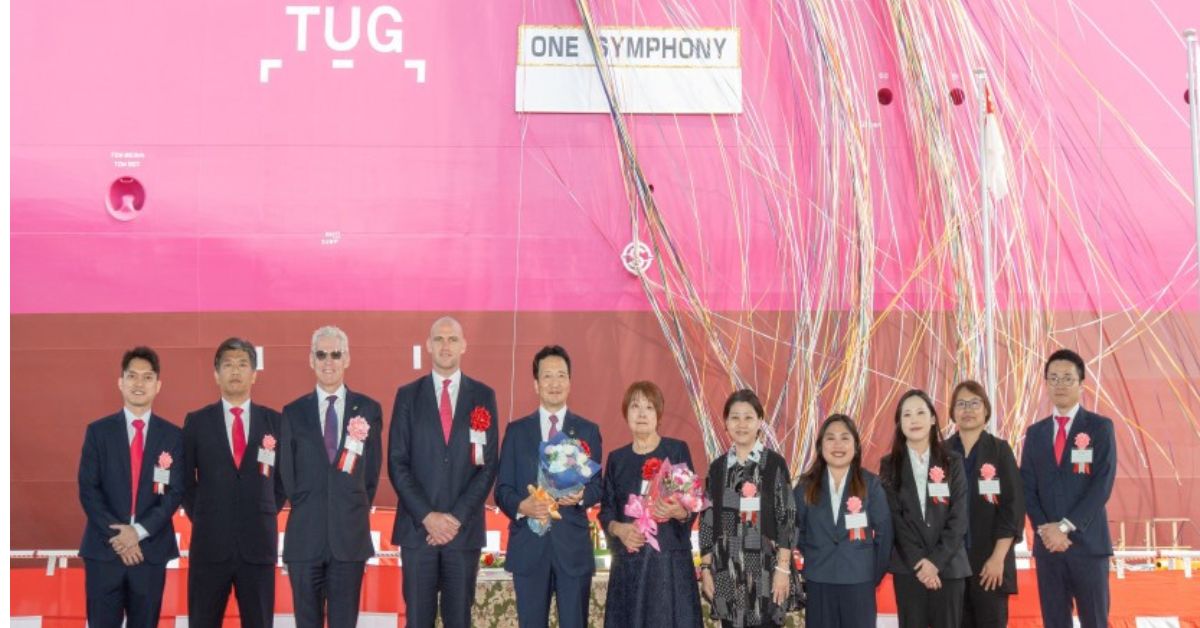

Ocean Network Express (ONE) held the naming ceremony for its new container vessel ONE Symphony in Japan on 22 October 2026, advancing a 20-ship newbuilding programme designed to accommodate future adoption of ammonia or methanol as fuel.
The vessel has a capacity of approximately 14,000 twenty-foot equivalent units (TEUs). ONE’s fleet register lists its precise capacity as 13,932 TEUs, with Singapore registration and a 2026 build year.
Who attended the ONE Symphony naming ceremony?
ONE Chief Executive Officer Till Ole Barrelet and Senior Advisor Jeremy Nixon attended the ceremony alongside representatives from Yusen Logistics, Imabari Shipbuilding and Nihon Shipyard.
The company selected the name ONE Symphony to reflect teamwork, drawing on the coordination between different sections of an orchestra. The naming recognises collaboration among the carrier, customers, shipbuilders and other partners involved in its operations.
The announcement identifies the ship as part of ONE’s fleet modernisation programme, but does not specify its commercial deployment or port rotation.
How does the vessel fit ONE’s newbuilding programme?
ONE Symphony belongs to a series of 20 large container vessels described by the carrier as ammonia- and methanol-ready.
ONE’s published investment plans identify these ships as vessels with capacities exceeding 13,700 TEUs, incorporating provisions for future fuel technologies. The programme forms part of its approach to renewing container capacity while retaining options for subsequent conversion.
An earlier milestone came in June 2025, when ONE named the 13,900-TEU ONE Singapore at Imabari Shipbuilding’s Hiroshima yard. That ship was the sixth vessel in the 20-ship series.
ONE Singapore followed ONE Sparkle, which the company identified as its first owned newbuilding, and other sister vessels entering the fleet.
What does ammonia- and methanol-ready mean?
Fuel readiness concerns provisions for a potential future installation or conversion. It does not establish that a ship is already operating on ammonia or methanol.
ONE’s published explanation describes a classification society’s “ready” notation as recognition that the basic design meets requirements for systems anticipated to be used in the future. The carrier has also referred to approval in principle, an assessment of a proposed design rather than confirmation of an operational fuel system.
This distinction matters when evaluating the environmental significance of a new vessel. Preparing for conversion preserves a technical option, while actual emissions performance depends on the propulsion system, fuel used and operating conditions.
How does ONE’s dual-fuel investment differ?
Alongside its fuel-ready newbuildings, ONE has a separate programme for methanol dual-fuel container ships, with deliveries scheduled to begin in 2027.
The carrier’s published sustainability plans distinguish the 20 ammonia- and methanol-ready ships from 12 methanol dual-fuel vessels. The latter represent a different stage of alternative-fuel investment, involving ships intended to use methanol through dual-fuel propulsion systems.
ONE also lists optimised hull designs, waste-heat recovery and bow windshields among measures planned for its forthcoming dual-fuel fleet. Selected vessels will incorporate air lubrication systems and shaft generators. These features should not automatically be attributed to ONE Symphony without vessel-specific confirmation.
The naming of ONE Symphony marks further progress in the carrier’s large-vessel renewal programme. Its immediate significance is additional container capacity, combined with design provisions intended to retain flexibility as alternative marine fuels develop.
 Join our WhatsApp channel for more updates:
 Subscribe to our YouTube channel for more updates: