



As the maritime industry grows more complex amid constant disruptions, it has an opportunity to set a new standard for how we support the people who keep global commerce moving. – Leonardo Sonzio, Global Head, Fleet Management & Technology | A.P. Moller – Maersk
The shipping industry has always demanded a great deal from its seafarers, who spend months away from their families, navigating some of the world’s most challenging environments, so that global trade can continue smoothly. These seafarers do so with precise skills and incredible resilience, while quietly adopting a different style of life, spending months at sea. Seafarers are proud of the role they play in global trade, enabling goods to move around the world. When at sea, they are committed to their role onboard and when at home, they cherish every day with their families.
In my 12 years of working closely with seafarers around the world, I can confidently say that the environment in which seafarers operate today has changed significantly. Disruptions are not new to the industry, but the pace at which they occur and the complexity they pose now are very challenging. 24/7 connectivity is no longer limited to life ashore. In the last few years, it has reached vessels as well, bringing clear benefits, most notably, the ability for seafarers to stay visually connected with loved ones, easing the loneliness of long months at sea. But constant connectivity also means unrestricted access to information, which can fuel anxiety, particularly when coverage of maritime risks is inaccurate or sensationalised.
When global conflicts escalate, the world’s attention understandably turns to geopolitics, trade disruptions, and economic consequences. Far less visible, however, are the thousands of seafarers who continue to navigate these uncertain waters in real time while often operating in proximity to emerging risks.
A shift from routine risk to unusual risk
For generations, maritime risk management has been built around the known: weather patterns, mechanical reliability, and navigational hazards. These are risks that can be modelled, trained for, and mitigated through technology, established protocols and safety procedures. What has emerged from the recent disruptions we have witnessed is something categorically different and highly unpredictable.
In recent years, disruptions such as the pandemic and geopolitical conflicts have not only challenged and caused strain on seafarers’ physical safety, but also their mental wellbeing and resilience. These aren’t just abstract issues. They may have serious consequences for seafarers’ health and ultimately impact the safety of the crew and the vessel.
As shipowners or operators, we cannot overlook or underestimate these challenges. It is our responsibility and accountability to maintain compliance with standards and, in some cases, even exceed them. We must proactively work with crew welfare, transparently communicate about the risks crews may face, and mitigate the consequences of these disruptions.
What a good crisis response actually looks like on board
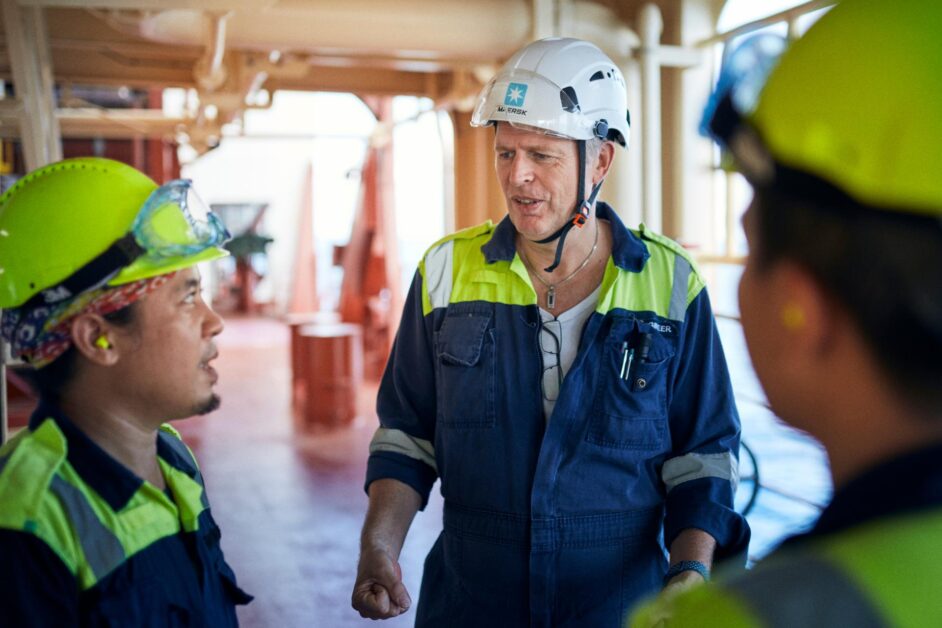
When a crisis arises, the first action on a well-prepared vessel is not to wait for instructions from shore. In fact, the vessel and the crew are the central command and shore teams are its support functions. At Maersk, we have empowered the Master to call an extraordinary safety or security meeting with senior officers. We ensure they receive information from a single source, our shore team, which collects all relevant information from official security briefings, maritime advisories, and other intelligence, and reviews it collectively. They then brief the crew on the situation and potential risks, and set aside time to raise questions or share experiences from past voyages. That last element matters more than it might appear: seafarers who have transited contested waters in the past carry knowledge that should shape, not be overridden by, the decisions made from a shore-based operations centre.
From that point, the bridge team maintains continuous monitoring of updates. Voyage planning is reassessed in real time. The vessel’s security level may be raised, triggering a defined set of additional measures: heightened bridge vigilance, controlled access protocols, readiness drills, and verified emergency communication systems. Crucially, daily morning briefings ensure that this is not a one-time communication event but a sustained practice that keeps every crew member, not just officers, informed and focused.
Communication between the vessel and shore intensifies significantly during such periods. Updates may be received multiple times daily, depending on the vessel’s proximity to an affected area. The quality of that communication, its frequency, its honesty, and its two-way character are among the clearest differentiators between operators who take crew welfare seriously and those who treat it as secondary to operational continuity.
Morale is a safety variable, not an HR concern
The physical safety of seafarers rightly commands attention. However, the psychological dimension still receives far less of it. Both are two sides of the same story, and mental well-being is just as important as physical safety. A recent high‑potential safety incident left one of our seafarers seriously injured. Despite extremely challenging conditions, the evacuation was successful, but our responsibility did not end there. The incident deeply affected the injured colleague, fellow crew, and teams ashore, prompting focused psychological support and collective reflection. Recovery, learning, and care had to happen together.
The Master’s role in maintaining crew morale during a crisis is rarely discussed. Leadership onboard is not just about technical authority; it’s about how a senior officer communicates under pressure, manages uncertainty without resorting to speculation or rumours, and creates an environment where the crew feels both informed and trusted. Keeping normal routines, including consistent work schedules, shared meals, and the everyday rhythms of life onboard, provides a stabilising framework when the external environment is far from stable. Seafarers are accustomed to demanding conditions. What they are not prepared for is the uncertainty.
Access to family is a critical and underappreciated dimension of this. The ability to speak regularly with one’s family is a direct factor in psychological resilience at sea. As introduced earlier, connectivity technology that once required a port visit is now available continuously. All Maersk vessels are now well-equipped with Starlink for uninterrupted connectivity, and the difference this makes to crew welfare is significant. Operators who invest in this infrastructure are making a safety investment, not simply a welfare one.
Lastly, around-the-clock confidential mental health support available to seafarers and their families alike represents another meaningful step that more operators should take. The willingness of a crew member to seek professional support is largely shaped by whether they believe doing so is safe and private, and by whether they trust it will not affect their professional standing. Building that trust requires active cultural effort, not just the existence of a helpline.
Redefining care for a changed world
Shipowners and operators, particularly those with the scale and visibility to set industry norms, have an opportunity and an obligation to lead. This means, in some cases, going beyond the minimum requirements of flag state regulations and international conventions. It means committing to standards that reflect the actual risk environment in which seafarers operate today. It means treating crew welfare data with the same rigour applied to vessel performance data. And it means advocating, within industry bodies, for regulatory frameworks that keep pace with the realities of modern maritime conflict and geopolitical disruption. We must adopt an approach that balances the set norms required for the smooth functioning of a complex maritime setup with cultural transformations in other areas that involve the human equation.
The seafarers on our vessels are not asking for the impossible. They are asking to be seen, informed, and protected; and when a crisis comes, to be trusted with the truth about what they are sailing into.
Meeting that expectation is not a cost of doing business. It is the business.
 Join our WhatsApp channel for more updates:
 Subscribe to our YouTube channel for more updates: