



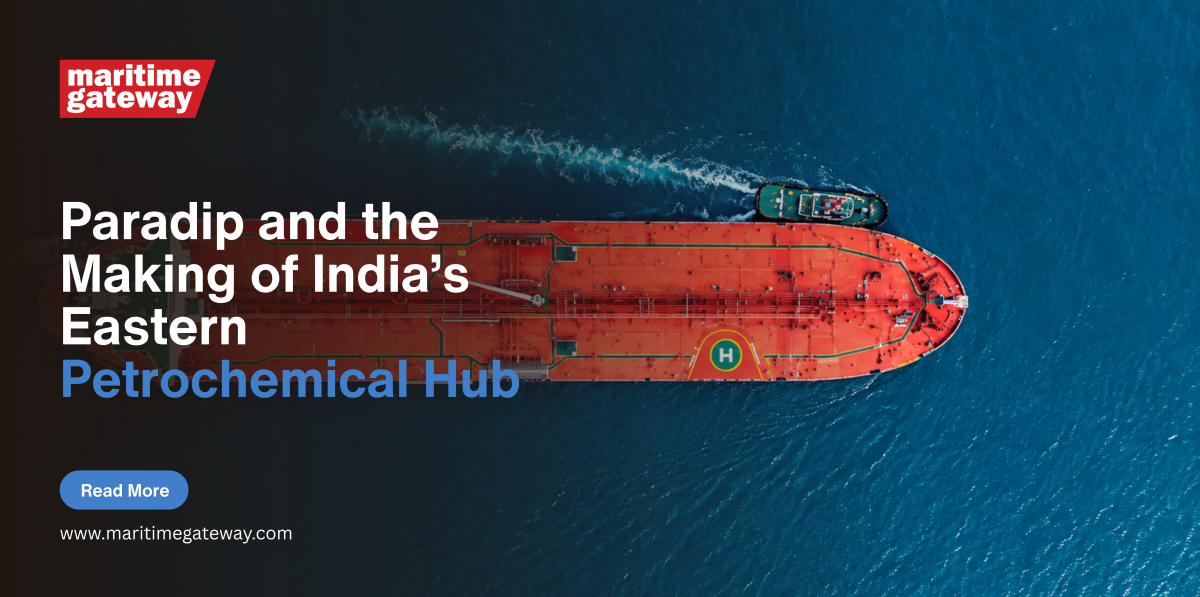

The Paradip petrochemical project is Indian Oil Corporation Limited’s (IOCL) largest-ever single-location investment—a ₹61,000+ crore integrated complex anchored around a world-scale dual-feed naphtha cracker and multiple downstream units near Paradip Port in Odisha’s Jagatsinghpur district. Conceived as the next major value-addition layer atop the existing 15 MMTPA Paradip refinery (commissioned in 2016), the project is designed to lift India’s petrochemical self-reliance, deepen the Paradip Petroleum, Chemicals and Petrochemicals Investment Region (PCPIR), and position Odisha as an eastern manufacturing and export gateway for polymers and chemicals.
Project Overview and Strategic Context
Anchor Refinery and PCPIR Framework
The Paradip refinery, with a sanctioned capacity of 15 MMTPA (and record throughput of 16.35 million tonnes in FY26), has been the anchor investment for the Paradip PCPIR since its inauguration in February 2016. Official data indicates around ₹47,000 crore of cumulative investment and ~40,000 jobs in the PCPIR so far, with the refinery fully operational and downstream petrochemical development progressing in phases.
The Paradip petrochemical complex is the logical “Phase II” of this ecosystem—moving from fuels and basic aromatics to a full-slate cracker-based portfolio (polyolefins, PVC, phenol, and specialty chemicals) that captures more value from each barrel of crude processed.
Scale and Investment
Total investment: Approximately ₹61,077 crore (often rounded to ₹61,000 crore), making it IOCL’s biggest single-site capital commitment.
Core unit: A 1.5 MTPA dual-feed naphtha cracker configured to produce ethylene and propylene as primary building blocks.
Downstream slate: Multiple derivative units, including polypropylene (PP), polyethylene (HDPE/LLDPE), PVC, phenol, isopropyl alcohol (IPA) and other aromatics/olefins derivatives.
Associated infrastructure: The complex is planned alongside a Paradip Plastic Park to encourage downstream converters, compounders and specialty chemical MSMEs.
This scale places Paradip among India’s emerging “mega” petrochemical hubs, alongside IOCL’s Panipat cluster and other national projects targeting higher petrochemical intensity in refining.
Technical Configuration and Product Portfolio
Dual-Feed Naphtha Cracker
The heart of the complex is a 1.5 MTPA dual-feed naphtha cracker. “Dual-feed” implies design flexibility to process different naphtha cuts (and potentially other light feeds in future configurations) to optimize yields of ethylene and propylene based on market signals and feedstock economics.
A cracker of this size typically produces:
Ethylene: Feedstock for polyethylene (HDPE, LLDPE), ethylene glycol (EG/MEG), PVC (via EDC/VCM route), and other derivatives.
Propylene: Feedstock for polypropylene, propylene oxide, cumene/phenol, acrylonitrile, and more.
IOCL’s stated ambition is to raise Paradip’s “Petrochemical Intensity Index” significantly—shifting the refinery’s product mix from predominantly fuels toward higher-value polymers and chemical intermediates.
Downstream Units and Value Chain
Location, Land and Infrastructure
Site and Land Acquisition
The complex is sited near Paradip Port in Jagatsinghpur district, within the notified Paradip PCPIR boundary, leveraging proximity to:
- Paradip Port for crude imports, product exports and coastal shipping.
- Existing refinery utilities (power, steam, water, offsites) to lower incremental capex and speed integration.
- Road and rail corridors under PM Gati Shakti and Odisha’s industrial connectivity plans.
In 2025–26, the Odisha government initiated formal land acquisition for the project, issuing social impact assessment notifications and revenue department orders to assemble the required parcels near Paradip. Reports describe the land acquisition process as underway, with administrative coordination and local consultations ongoing.
Utilities and Enabling Infrastructure
Large petrochemical complexes require:
- Reliable power (often 300–600 MW equivalent for a cracker of this scale, depending on configuration).
- Large water volumes for cooling and process needs, typically met via dedicated intake, treatment and recycling systems.
- Steam and hydrogen networks integrated with refinery units.
- Effluent treatment and zero-liquid-discharge systems to meet stringent environmental norms.
While detailed utility figures for Paradip’s new complex are not fully disclosed in public summaries, the design is expected to reuse and augment the refinery’s existing utility backbone, with additional captive power and water infrastructure as required.
Regulatory and Environmental Clearances
Environmental Clearance Process
As a Category-A project under India’s EIA Notification (2006), the Paradip petrochemical complex requires:
- Environmental Clearance (EC) from MoEFCC, based on a comprehensive EIA covering air, water, ecology, land use, traffic, risk assessment and disaster management.
- Consent to Establish (CTE) and later Consent to Operate (CTO) from the Odisha State Pollution Control Board under the Water (1974) and Air (1981) Acts.
- MSIHC compliance (for major accident hazards), PESO approvals for pressure vessels and petroleum-related installations, and Fire NOC as per the National Building Code.
Public hearings and stakeholder consultations are standard for such large projects, especially in coastal and agriculturally sensitive districts. While detailed EC documents for the new cracker are not fully summarized in open sources yet, the project’s progression through land acquisition signals that pre-clearance scoping and baseline studies are advancing.
Coastal and CRZ Considerations
Given Paradip’s coastal location, the project must align with Coastal Regulation Zone (CRZ) norms and port-area zoning under the Paradip Port Authority and Odisha’s coastal management plans. This typically constrains certain activities within specific distances from the high-tide line and mandates detailed coastal processes and erosion studies.
Economic Impact and Employment
Investment and Fiscal Contribution
At over ₹61,000 crore, the Paradip petrochemical complex represents one of the largest greenfield petrochemical investments in eastern India. For context, cumulative investment at the Paradip site (refinery plus associated units) has already crossed ₹43,000 crore, with FY26 alone contributing over ₹30,000 crore to central and state exchequers via taxes and duties.
Adding the new complex is expected to:
- Multiply the site’s total capital base toward the ₹1 lakh crore range over the next decade when combined with other IOCL expansions.
- Strengthen Odisha’s position as a chemicals and petrochemicals hub on the eastern seaboard, complementing fertilizer and port-led logistics clusters.
Jobs and Skill Development
While exact employment projections for the new complex are not uniformly disclosed, comparable IOCL petrochemical projects and the existing Paradip footprint suggest:
- Thousands of direct jobs during construction (engineering, civil, mechanical, instrumentation, safety).
- Hundreds to low-thousands of permanent operational roles across process, utilities, maintenance, HSE, logistics and administration.
- Significant indirect employment in contracting, services, downstream converters in the Plastic Park, and ancillary MSMEs.
Odisha’s recent investor outreach highlights that the state secured ₹16.73 lakh crore in investments across sectors, generating 12.88 lakh jobs; the Paradip petrochemical push is a core component of this chemicals and manufacturing narrative.
Strategic Importance for India’s Petrochemical Sector
Import Substitution and Self-Reliance
India remains a net importer of several key polymers and intermediates (notably certain grades of PP, PE, PVC, phenol and specialty chemicals). A world-scale cracker at Paradip will:
- Add domestic ethylene and propylene capacity, reducing reliance on imported monomers and polymers.
- Support “Make in India” value chains in packaging, automotive, construction, consumer durables and agriculture.
- Enhance export potential from the eastern coast to Southeast Asia and the Bay of Bengal region, leveraging Paradip Port’s deep-draft upgrades.
Integration with National Corridors and Ports
The complex benefits from:
- Paradip Port’s 18.5-metre deep-draft capability, enabling larger Capesize vessels and lower freight costs for crude and products.
- Ongoing road and pipeline connectivity (including product and LPG pipelines radiating from Paradip) that integrate the site with eastern and central Indian markets.
- Alignment with PM Gati Shakti multimodal planning, which seeks to decongest logistics and reduce turnaround times for industrial clusters.
Challenges and Controversies
Land Acquisition and Local Concerns
As with many large industrial projects in coastal Odisha, land acquisition has faced:
- Local resistance from some farmers and fishing communities worried about displacement, livelihood impacts and environmental externalities.
- Administrative and coordination delays between central, state and local bodies on land pooling, compensation and rehabilitation frameworks.
Odisha’s revenue department has moved forward with social impact assessments and notifications, but effective, transparent rehabilitation and benefit-sharing will be critical to social licence.
Environmental and Safety Risks
Petrochemical crackers and derivative units are inherently hazardous, requiring:
- Robust risk assessment and disaster management plans, especially in a cyclone-prone coastal zone.
- Stringent emission controls, continuous ambient air and water quality monitoring, and community emergency preparedness.
- Strong process safety culture and third-party audits to prevent major accidents seen in other global petrochemical hubs.
Environmental groups and local stakeholders are likely to scrutinise effluent discharge, groundwater impacts, and cumulative pollution loads as the PCPIR densifies.
FAQs
1. What exactly is the Paradip petrochemical project?
It is Indian Oil’s ₹61,000+ crore integrated petrochemical complex near Paradip Port in Odisha, centered on a 1.5 MTPA dual-feed naphtha cracker and multiple downstream units (PP, PE, PVC, phenol, IPA, etc.) to produce polymers and chemical intermediates.
2. How does it relate to the existing Paradip refinery?
The complex is an extension of the 15 MMTPA Paradip refinery (operational since 2016), using refinery off-takes and utilities to produce higher-value petrochemicals and raise the site’s “petrochemical intensity” beyond fuels and basic aromatics.
3. What is the current status of land acquisition and clearances?
As of 2025–26, the Odisha government has initiated formal land acquisition and social impact processes for the project, while environmental and other statutory clearances are progressing under central and state regulations.
4. When is the project expected to be completed and operational?
Associated PX-PTA and related Paradip petrochemical projects are targeted for completion by December 2026, with the full cracker-based complex likely to be commissioned around 2028–2029, depending on final approvals and construction progress.
5. What are the main benefits and concerns associated with the project?
Benefits include large-scale investment, jobs, import substitution, and positioning Odisha as a chemicals hub; key concerns involve land acquisition impacts, environmental safeguards, and industrial safety in a coastal, cyclone-prone region.
 Join our WhatsApp channel for more updates:
 Subscribe to our YouTube channel for more updates: