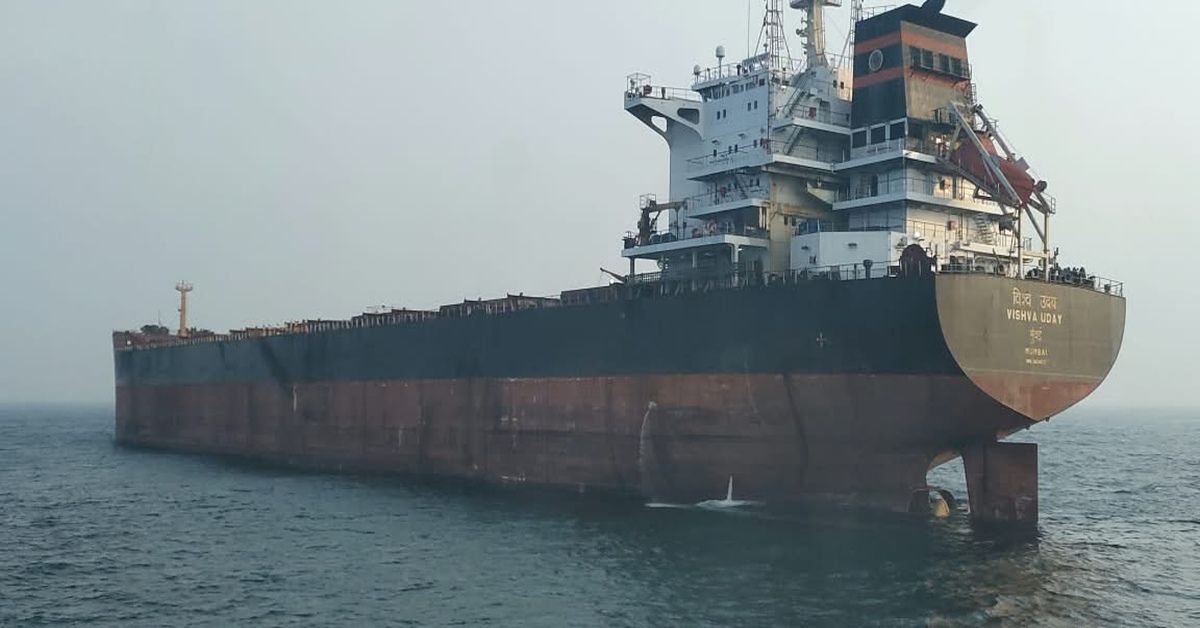

Paradip Port Authority (PPA) completed the towing of the distressed bulk carrier Vishva Uday to an anchorage off its outer port limits on 17 November 2026, following flooding and a propeller shaft breakdown approximately 50 nautical miles off the Odisha port. All 27 crew members were reported safe after an operation involving the Indian Coast Guard and the port’s marine team.
The response involved two stages: Coast Guard personnel boarded the vessel to control water ingress, while PPA subsequently deployed two tugs to bring the ship to safety.
What caused the maritime emergency?
The Shipping Corporation of India (SCI) alerted PPA that Vishva Uday was taking on water and had suffered a propeller shaft breakdown at coordinates 19°47’N, 087°22’E.
The Coast Guard described the emergency as severe engine-room flooding caused by a damaged tail shaft. Its District Headquarters at Paradip coordinated assistance during the intervening night of 15–16 November, deploying Indian Coast Guard Ships Amulya and Vijaya.
A specialist damage-control team boarded the bulk carrier despite adverse sea conditions. Personnel installed submersible pumps and brought the water ingress under control, according to the Coast Guard.
The Coast Guard confirmed that everyone aboard was safe and advised the vessel to proceed to Paradip for permanent repairs. It also coordinated with port authorities to arrange towing assistance.
How did Paradip Port conduct the towing operation?
Following regulatory approval, PPA dispatched Dolphin 25 and Dolphin 20 at 12:30 pm on 16 November.
Harbour Master Capt. Indranil Mukherjee led the operation, with Dolphin 25 serving as the lead tug and Dolphin 20 providing support. The vessels brought Vishva Uday to an anchorage off the outer port limits the following morning.
PPA Chairperson Susanta Kumar Purohit commended the marine department’s response and stressed the importance of emergency preparedness and operational readiness.
Which vessel was involved?
Vishva Uday is listed in SCI’s bulk carrier fleet. Built in 2013, it has a deadweight of 81,696 tonnes and gross tonnage of 44,861. Its International Maritime Organization identification number is 9604005.
Deadweight measures the total weight a vessel can carry, including cargo, fuel, stores and other loads. It does not establish how much cargo was aboard during the incident. SCI’s published fleet particulars identify the ship’s capacity but do not provide an incident-specific cargo declaration.
How does the response fit India’s maritime rescue framework?
The Indian Coast Guard is responsible for coordinating and conducting maritime search-and-rescue operations within India’s designated search-and-rescue region, which covers approximately 4.6 million square kilometres.
Its Director General serves as the National Maritime Search and Rescue Coordinating Authority. The national maritime search-and-rescue manual sets out agreed coordination arrangements for responding to emergencies within this area.
For Vishva Uday, the Coast Guard’s intervention addressed the immediate flooding emergency, followed by port-led towing. The confirmed outcome was the vessel’s safe anchoring on 17 November. Neither announcement confirmed completion of permanent repairs or a date for the ship to resume its voyage.
 Join our WhatsApp channel for more updates:
 Subscribe to our YouTube channel for more updates: