
Summary
Bangladesh’s Payra Port continues to face restrictions on large-vessel access despite investment of around Tk16,000 crore over 13 years. Rapid sedimentation has reduced channel depth, increasing reliance on smaller vessels for cargo movement. A proposed Tk4,662 crore dredging programme remains awaiting a decision as terminal and road infrastructure moves towards completion.
Shallow channel limits access
The Payra Port navigability crisis continues to constrain the use of Bangladesh’s southern seaport, with sediment accumulation undermining access through the 75-kilometre Rabnabad Channel connecting the port with the Bay of Bengal.
Charts for May 2026 indicated average water depths of approximately 5.4–5.9 metres, substantially below the level achieved through earlier capital dredging. These measurements describe conditions at that time; they should not be treated as a current sailing advisory.
Restricted access requires cargo to be transferred to smaller vessels, adding handling stages and transport costs for users, including nearby coal-fired power plants.
Earlier dredging established deeper access
The present difficulties follow a major dredging campaign intended to make Payra accessible to larger commercial ships.
On 26 March 2023, completion of capital dredging enabled the channel to open to vessels with draughts of up to 10.5 metres. The work involved removing more than 50 million cubic metres of material, using a fleet that included cutter suction dredgers, trailing suction hopper dredgers and a water injection dredger.
That achievement established an initial navigation channel. Maintaining it requires further intervention as sediment returns. Capital dredging creates or deepens a channel, while maintenance dredging preserves its operating dimensions.
For Payra, the distinction is commercially important: the benefit of deeper access depends on sustaining it throughout the port’s operating life.
Dredger ownership forms part of proposed response
The proposed response combines maintenance dredging with the acquisition of two trailing suction hopper dredgers, giving the port its own equipment for continuing channel management.
A proposal valued at Tk4,662 crore was already under consideration in June 2025. At that stage, scrutiny included requests for clearer revenue, expenditure and earnings projections before final approval. The earlier assessment shows that the financial sustainability of channel maintenance has been a longstanding consideration.
Under the latest reported proposal, approximately Tk1,400 crore would cover the two dredgers. The Planning Commission returned the submission over cost concerns, leaving a decision pending. Purchasing equipment therefore remains a proposed measure rather than an established operational solution.
Terminal infrastructure advances alongside channel concerns
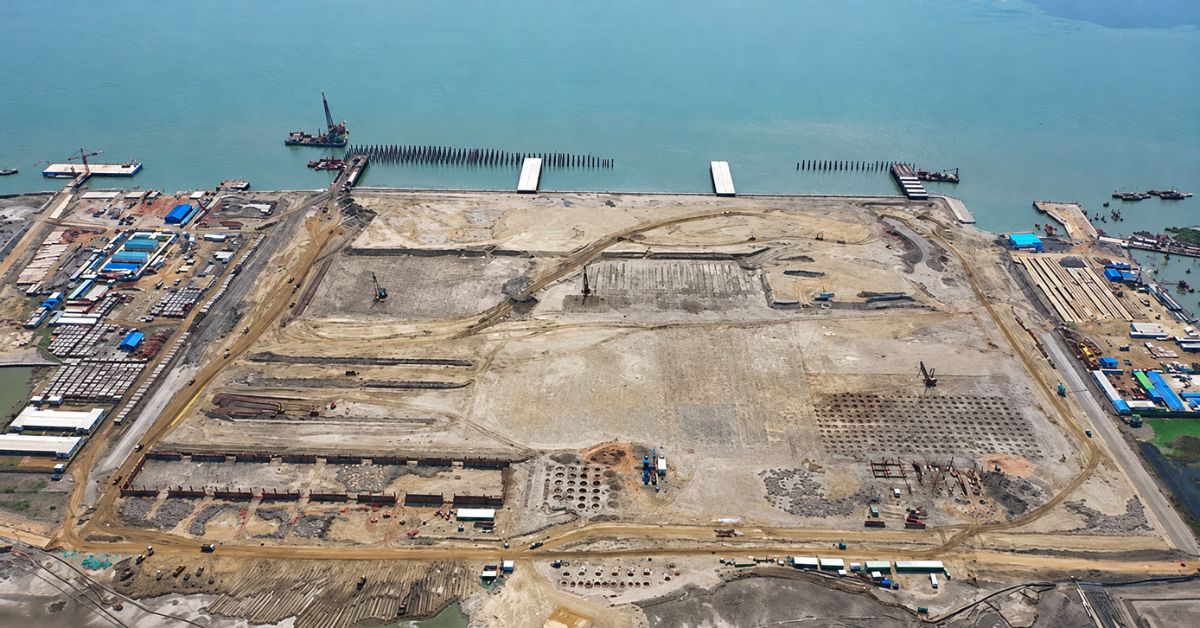
Payra’s development extends beyond its approach channel. The first terminal project includes a 650-metre jetty and a 325,000-square-metre backup yard, together with cargo-handling equipment and supporting facilities.
A 6.35-kilometre, six-lane access road and a 1,180-metre, four-lane bridge over the Andharmanik River are intended to improve connections with the Dhaka–Kuakata highway.
Shipping Minister Shaikh Rabiul Alam told parliament in April that heavy sedimentation made continuous dredging necessary. His statement also identified the importance of the port to two nearby coal-fired power plants with combined generating capacity of 2,640 MW.
The infrastructure programme consequently addresses both ends of the logistics chain: maritime access and movement between the terminal and inland destinations. Reliable performance requires those elements to develop together.
Cargo growth masks a narrow traffic base
Cargo throughput alone does not fully describe Payra’s operating position.
An earlier assessment put cargo handled in FY2025–26 at roughly 5.5 million tonnes, an increase of 12.8%. Coal for power generation accounted for almost all imports, with relatively small quantities of stone and cement.
The same assessment recorded 2,962 vessel calls, including 29 foreign vessels. The distinction matters because foreign vessel calls represent only one component of total activity. Higher aggregate cargo volumes can coexist with limited direct access for larger ocean-going ships.
Commercial outlook hinges on dependable access
For shipping lines and cargo owners, the central issue is predictability. A terminal can offer berths, storage and road connections, but vessel deployment still depends on the channel’s available depth.
Repeated transfers between ships and smaller craft introduce additional handling requirements. Addressing those constraints would strengthen the practical value of the infrastructure already developed.
The commercial test is whether Payra can sustain navigability at an affordable cost while attracting a broader cargo base. Completing construction will provide assets; dependable channel management will determine how effectively customers can use them.
FAQs
What is causing Payra Port’s navigability problems?
Sediment accumulation in the Rabnabad Channel reduces water depth and restricts access for larger vessels.
What did the earlier capital dredging achieve?
It enabled the channel to open to vessels with draughts of up to 10.5 metres in March 2023. That historical figure does not establish current access conditions.
What measures are proposed?
Maintenance dredging and the purchase of two trailing suction hopper dredgers form part of the proposed response.
Why is channel maintenance commercially important?
Reliable depth helps operators plan vessel movements and can reduce the need to transfer cargo through smaller vessels.
 Join our WhatsApp channel for more updates:
 Subscribe to our YouTube channel for more updates: