




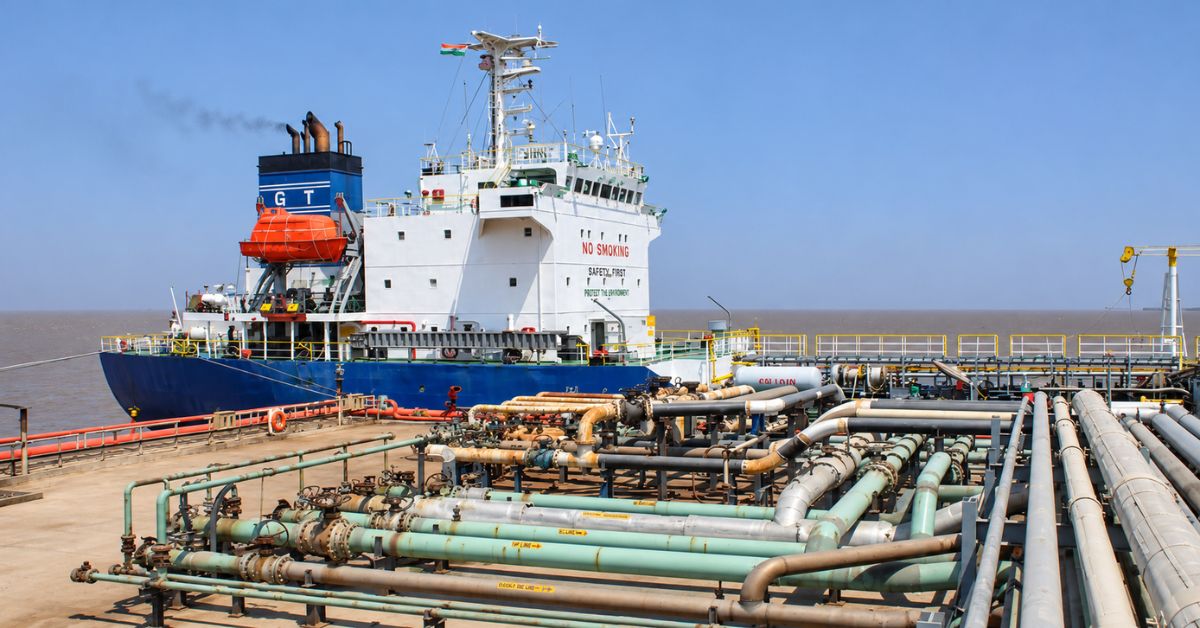

Gujarat Pipavav Port Limited (GPPL) now expects to commission its new liquid cargo berth in late March or early April 2027, following construction delays that have pushed completion beyond the earlier December 2026 target. Managing Director Girish Aggarwal confirmed the revised schedule during the company’s second-quarter earnings call on 5 November.
The US$90-million project is intended to increase the Gujarat port’s annual liquid cargo handling capacity from 2 million tonnes to 5.2 million tonnes. It represents a substantial expansion of infrastructure serving liquefied petroleum gas (LPG) and other liquid commodities.
Why has commissioning been delayed?
Aggarwal attributed the roughly three-month revision to delays in the overall construction of the jetty. Management placed the expected start of operations around the end of March or beginning of April.
The revised timing puts commissioning close to the transition between financial years 2026–27 and 2027–28. Management expects liquid cargo volumes of approximately 1.4 million tonnes in FY2026–27, rising to around 2.5–2.6 million tonnes in FY2027–28. LPG, ammonia and petroleum products are expected to drive growth.
The project has experienced an earlier timetable revision. GPPL’s FY2024–25 annual report recorded an original commissioning target of December 2025, subsequently moved to December 2026 because statutory and regulatory approvals were taking longer than anticipated. The latest explanation concerns construction progress.
How much capacity will the new berth add?
The planned increase from 2 million tonnes to 5.2 million tonnes amounts to 3.2 million tonnes of additional annual handling capacity.
GPPL’s FY2025–26 annual report stated that capital dredging had been completed and civil construction was progressing. The report retained December 2026 as the expected commissioning date, which has now been superseded by management’s latest guidance.
The expansion follows growth in the port’s liquid business during FY2025–26. Throughput increased by approximately 8% to 1.59 million tonnes, compared with 1.46 million tonnes a year earlier, primarily because of higher LPG volumes. The company also reported that cryogenic storage commissioned by its tank-farm operator had improved pumping rates and vessel turnaround.
How does the berth connect with storage and inland transport?
Pipavav’s existing liquid facilities handle petroleum products, chemicals, vegetable oils, bitumen and LPG. The port has railway sidings for liquid cargo and pipeline connections between storage facilities and those sidings.
Its LPG rail facility can accommodate a full rake carrying approximately 1,200 tonnes, according to the port operator. This provides an inland distribution option alongside road transport and links marine handling with delivery to customers in the hinterland.
Storage investment has also expanded the surrounding LPG infrastructure. Aegis Vopak Terminals reported commissioning a 48,000-tonne cryogenic LPG terminal at Pipavav in June 2025, taking its total LPG storage capacity at the location to 70,800 tonnes. Its June 2026 investor update identified the new jetty as part of a broader handling and distribution system incorporating storage, bottling, rail and truck-loading facilities.
What is happening in the port’s other cargo businesses?
GPPL raised its FY2026–27 container volume growth outlook to 8–10%, from 4–5%, supported by increased transshipment associated with West Asian shipping disruptions.
Container volumes rose 18% during the second quarter. Liquid volumes, however, declined 15% in the quarter and 32% in the first half, which management largely attributed to the regional conflict.
The revised berth schedule therefore comes as Pipavav manages different conditions across its cargo segments. Completing the new facility will add handling capacity, while the anticipated increase in liquid throughput remains dependent on cargo demand and the development of supporting distribution flows.
 Join our WhatsApp channel for more updates:
 Subscribe to our YouTube channel for more updates:




