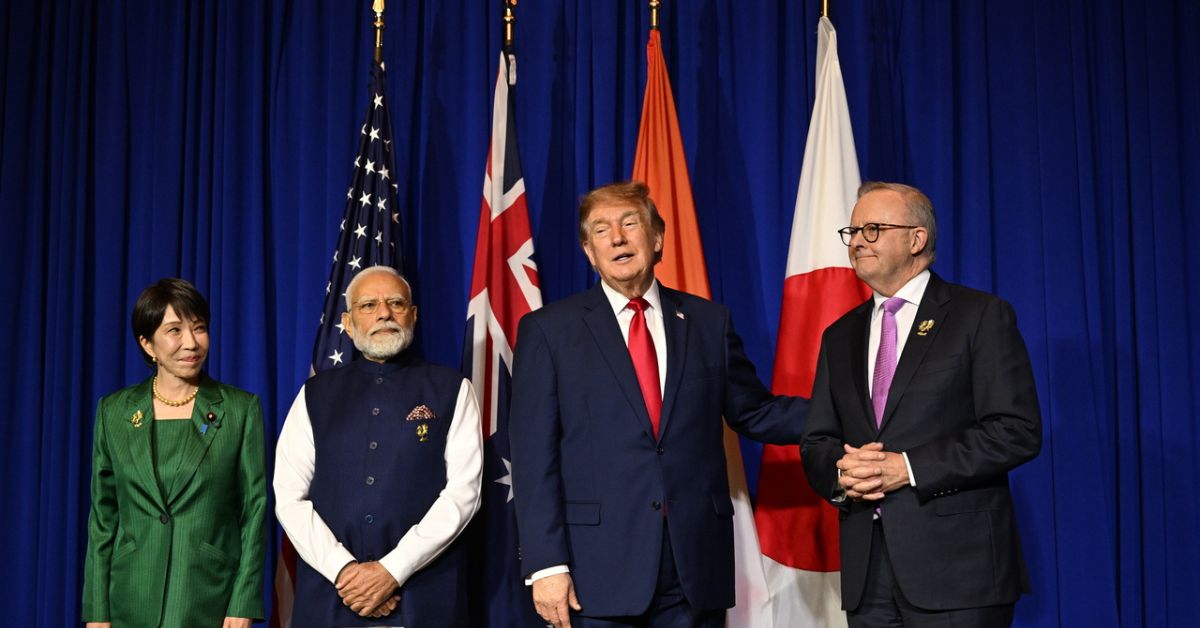

India, the United States, Australia and Japan have announced a new Indo-Pacific Maritime Surveillance Collaboration, with patrol aircraft from the four countries scheduled to participate in a maritime exercise in 2027. The initiative was unveiled at the Quad Leaders’ Summit in Manila on 17 November 2026, alongside measures on cybersecurity, cable connectivity and business cooperation.
The meeting brought together Prime Minister Narendra Modi, US President Donald Trump, Australian Prime Minister Anthony Albanese and Japanese Prime Minister Sanae Takaichi.
What will the maritime surveillance initiative deliver?
The Indo-Pacific Maritime Surveillance Collaboration aims to improve information sharing and maritime domain awareness, helping participating countries develop a clearer picture of activity at sea.
Under the initiative, the countries’ P-8 and P-3C patrol aircraft are scheduled to fly in a maritime exercise for the first time in a Quad framework in 2027.
The leaders also committed to keeping maritime transit corridors open, safe and resilient. Their joint statement linked regional cooperation with freedom of navigation and overflight, critical supply-chain security and disaster assistance.
Japan’s official account said the leaders discussed developments in the East China Sea and South China Sea, opposing unilateral changes to the status quo through force or coercion. They also addressed the Middle East, including Iran, and emphasised safe navigation, energy security and efforts towards de-escalation.
How is cable cooperation expanding?
The Quad welcomed an expansion of Australia’s contribution to its Partnership for Cable Connectivity and Resilience to include electricity cables. The stated objective is stronger regional energy security and connectivity.
Leaders also welcomed forthcoming undersea cable projects in the Indian Ocean. The announcement did not identify individual projects, investment amounts or commissioning schedules.
The cable partnership builds on an established infrastructure agenda. India’s Ministry of External Affairs has described the Quad’s approach as drawing on members’ expertise in manufacturing, delivering and maintaining cable infrastructure.
That agenda also includes the Ports of the Future Partnership, announced in 2024 to exchange information and best practices and mobilise public and private investment in quality port infrastructure across the Indo-Pacific.
What was announced on cybersecurity and business ties?
The leaders launched Enhanced Quad Cybersecurity Cooperation in response to the increasing number and scale of cyber incidents in the region. Japan’s account described its objective as an open and secure cyberspace.
They also agreed to continue cooperation on trusted artificial intelligence technologies and confirmed plans for an inaugural Quad Business Leaders’ Forum in early 2027.
The summit placed these initiatives within four cooperation areas: maritime and transnational security, economic prosperity and security, critical and emerging technologies, and humanitarian assistance and emergency response. Leaders reaffirmed support for the central role and unity of the Association of Southeast Asian Nations.
How does the package build on earlier maritime initiatives?
The Quad’s maritime cooperation has developed through successive programmes. The Indo-Pacific Partnership for Maritime Domain Awareness, announced in 2022, provides regional maritime agencies with near-real-time data to help address illicit activity, including illegal fishing, and support responses to humanitarian and climate-related events.
In 2024, the grouping announced the India-led Maritime Initiative for Training in the Indo-Pacific, designed to help partner countries use available monitoring tools, enforce maritime laws and secure their waters.
The same summit launched an Indo-Pacific Logistics Network pilot focused on shared airlift capacity for civilian disaster response. These earlier initiatives provide context for the Manila package, which adds a new surveillance collaboration and a scheduled aviation exercise to the Quad’s maritime agenda.
The 2027 exercise will be a concrete next step, while the cable, cyber and business announcements establish additional areas for implementation.
 Join our WhatsApp channel for more updates:
 Subscribe to our YouTube channel for more updates: