




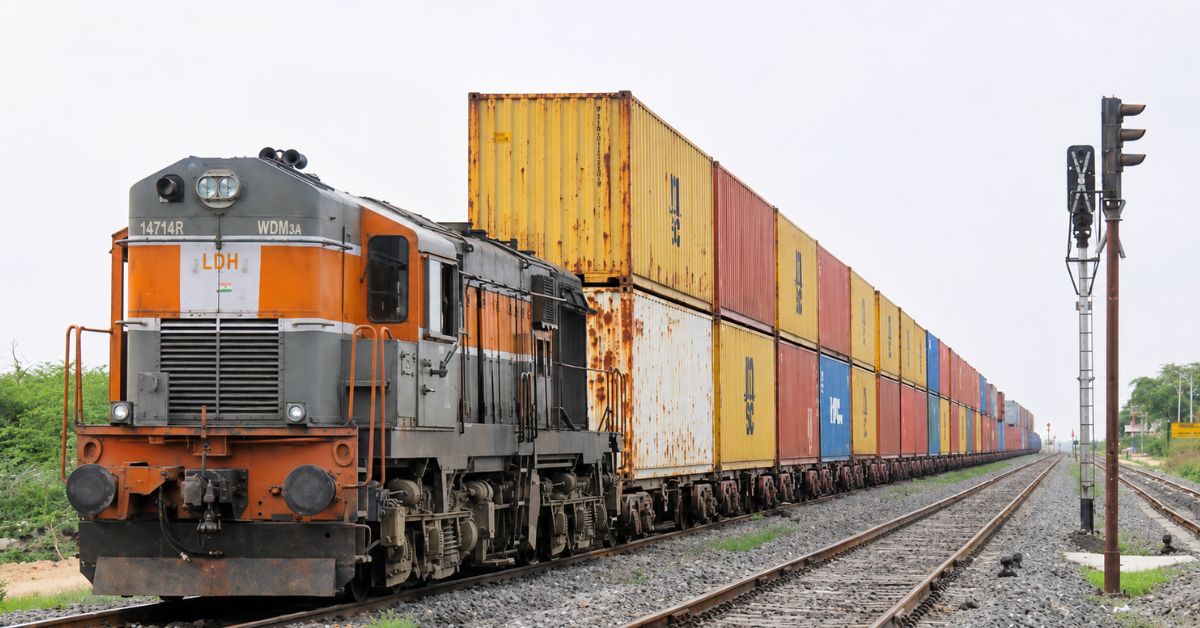

India’s transport sector faces an uneven near-term outlook, with rail container volumes declining for an eighth consecutive month and airport passenger traffic remaining subdued, according to JM Financial’s November 2026 sector update. The weakness contrasts with stronger container handling and cargo growth at ports.
The divergence highlights an important distinction for logistics businesses: rising maritime throughput is not producing equivalent growth across inland container transport, while aviation’s passenger segment faces separate demand pressures.
How did rail container traffic perform in October?
Rail container volumes fell 3.3 per cent year-on-year to 7.9 million tonnes in October 2026. Over the same month, overall container handling, measured in twenty-foot equivalent units (TEUs), increased 26.8 per cent.
At Jawaharlal Nehru Port Authority (JNPA), rail container evacuation rose 6.8 per cent to 107,000 TEUs. JM Financial nevertheless described the improvement as modest relative to the expansion in overall container handling.
The figures measure different activities and units. Rail tonnage records the weight of containerised cargo transported, while TEUs measure container capacity handled. Their growth rates indicate contrasting trends but cannot, by themselves, establish an equivalent change in rail’s national market share.
Why is the port performance stronger?
JM Financial’s assessment of October port activity showed aggregate cargo at major and non-major ports increasing 18.7 per cent year-on-year, compared with 6.3 per cent growth in September.
Major ports handled 93.6 million tonnes, an increase of 22.5 per cent. Non-major ports handled 68.4 million tonnes, up 13.8 per cent.
Coastal cargo was a particularly strong contributor, reaching a reported record of 31.6 million tonnes, with year-on-year growth of 80.8 per cent. The brokerage linked the wider improvement to external trade, capital-goods movement, coastal shipments and bulk commodities, including coal and iron ore.
These figures cover a broader cargo base than containerised rail traffic. Growth in coastal or bulk movements therefore should not be interpreted as demand that will necessarily translate into additional container train volumes.
Has the port–rail gap appeared before?
JM Financial had identified a similar imbalance earlier in the year. Its January 2026 logistics review, published on 23 February, recorded a 16 per cent increase in JNPA’s container throughput alongside a 2 per cent decline in rail evacuation.
The port’s rail coefficient, representing the proportion of container traffic moved by rail, fell to 13.6 per cent from 16 per cent in January 2025. The brokerage described that as the lowest level since April 2024.
National rail container volumes were still growing at that stage, rising 4 per cent year-on-year in January. The subsequent eight-month contraction reported for October therefore marks a deterioration from the early-year performance.
What is happening to airport passenger traffic?
Organic airport passenger movement declined 3.9 per cent year-on-year in October. Domestic passengers fell approximately 5 per cent, while international passenger traffic increased around 1 per cent.
JM Financial expects passenger growth to improve after December 2026 as the comparison with the previous year becomes more favourable. It nevertheless remains cautious about prolonged weakness at certain airports. These figures concern passengers, rather than air cargo.
What should logistics operators watch next?
The immediate indicators are whether higher port throughput begins to support sustained inland container movements, and whether airport passenger growth improves beyond the benefit of a weaker comparison base.
October’s results suggest that port volumes, rail container activity and passenger aviation need to be assessed separately. For freight operators, the practical question is how much maritime growth generates additional inland transport demand, rather than assuming that stronger port totals will benefit every logistics segment equally.
 Join our WhatsApp channel for more updates:
 Subscribe to our YouTube channel for more updates: