



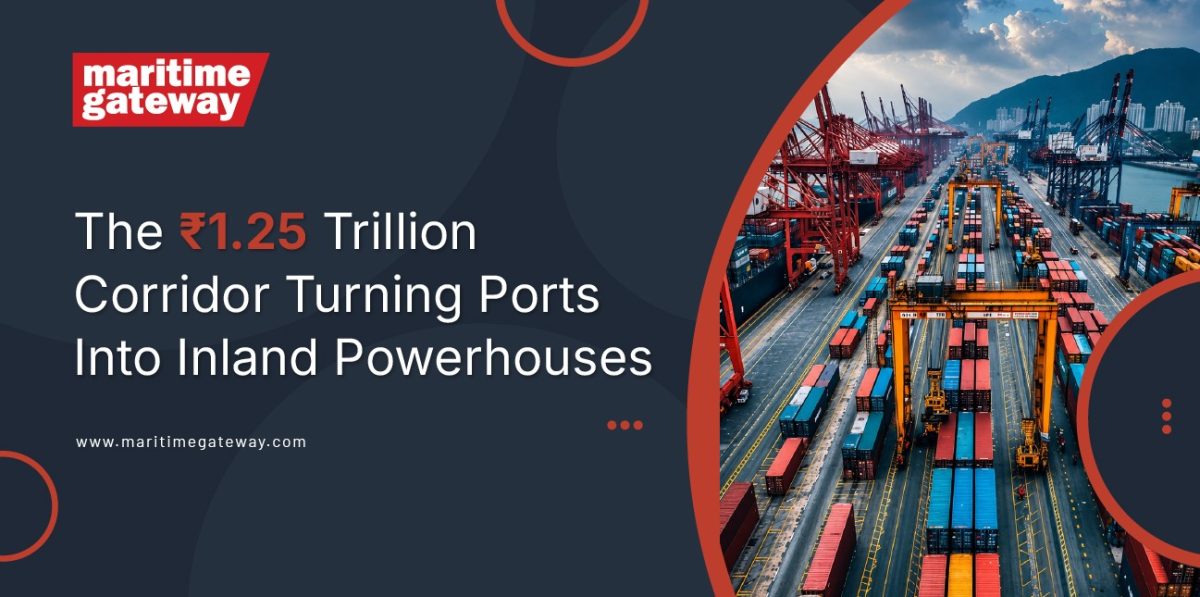

Picture a container leaving a factory in Jamnagar and reaching Mundra Port in the time it once took just to clear local traffic. That is no longer a hypothetical—it is happening today, as India pushes through one of its most ambitious infrastructure transformations yet: the rail freight corridor and highway connectivity upgrade to ports. From dedicated freight rail lines running at double the speed of conventional tracks to last-mile highways engineered specifically to feed cargo into port gates, this quiet revolution is redrawing how goods move from India’s industrial heartland to the world.
For years, India’s ports were the strongest link in a weak chain. World-class terminals, deep drafts, and rising throughput meant little when the road or rail leading up to the port gate turned into a bottleneck. That gap between what a port could handle and what actually reached it has been the single biggest drag on India’s logistics competitiveness. The rail freight corridor and highway connectivity upgrade to ports currently underway is a direct response to that gap, and the early numbers suggest it’s working.
Why Port Connectivity Has Been India’s Missing Link
India moves close to 95% of its trade by volume through its seaports. Yet for decades, the story of Indian logistics was one of ports operating far below their evacuation potential simply because the rail and road links behind them couldn’t keep pace. Logistics costs in India have historically hovered around 14–16% of GDP—nearly double the global benchmark of 8–10% seen in more efficient trading economies. That gap has translated directly into higher landed costs for exporters and importers alike.
This is precisely why the rail freight corridor and highway connectivity upgrade to ports has become a national priority rather than a regional infrastructure footnote. Programs like Sagarmala, Bharatmala Pariyojana, and the Dedicated Freight Corridor (DFC) network are no longer running as isolated ministry projects—they’ve been folded into the PM Gati Shakti National Master Plan, a geospatial platform designed to make sure road, rail, and port planning finally move in sync instead of in silos.
The Rail Freight Corridor Story: From Bottleneck to Backbone
The clearest evidence of momentum sits with the Dedicated Freight Corridor network. The Eastern DFC was completed in 2023, and the Western Dedicated Freight Corridor — spanning 1,506 km between Jawaharlal Nehru Port (JNPT) and Dadri in Uttar Pradesh — reached full commissioning by March 31, 2026, with its final JNPT–New Saphale (Vaitarna) stretch completing the last-mile rail link into India’s busiest container gateway.
The scale of what this rail freight corridor upgrade means for port connectivity is hard to overstate. JNPT alone accounts for nearly 52% of India’s containerized cargo. Before DFC connectivity, the port could evacuate cargo via roughly 27 freight trains a day. With full corridor access, that capacity jumps to as many as 100 freight trains daily. Rail’s current share of JNPT’s cargo movement — around 17–18% — is projected to climb to 25–30% as high-capacity, double-stack trains take over routes that were previously dominated by trucks.
The numbers across the wider DFC network tell a similar story of acceleration. Daily freight traffic on the corridor climbed from an average of 247 trains a day in 2023–24 to 371 trains a day by early 2025. By January 2026, the network had set a new single-day record of 892 interchange trains across Indian Railways zones — a sign that the rail freight corridor isn’t just built, it’s being actively used at industrial scale.
And the corridor network is still expanding. The Union Budget 2026-27 announced a new Dankuni (West Bengal) to Surat (Gujarat) freight corridor, roughly 2,100 km long, which the Railway Board fast-tracked for pre-construction work almost immediately. Detailed project reports are also underway for an East Coast Freight Corridor connecting Kharagpur to Vijayawada, an East-West Corridor, and a North-South Corridor—a signal that the rail freight corridor and highway connectivity upgrade to ports strategy is shifting from a west-coast pilot into a genuinely pan-India network.

Odisha’s Freight Corridor Moment
Nowhere is this expansion more relevant to the eastern seaboard than Odisha. The proposed East Coast Dedicated Freight Corridor around 1,115 km—is planned to link the Kalinga Nagar industrial hub to southern India while tying into the existing Eastern DFC for onward western connectivity. For a state whose export economy runs on steel, alumina, and mineral-based cargo, this rail freight corridor extension is a direct answer to a long-standing complaint from exporters: that Odisha’s production strength has never been fully matched by its evacuation infrastructure.
Paired with ongoing port-connectivity works at Paradip and other Odisha ports under Sagarmala, the rail freight corridor and highway connectivity upgrade to ports isn’t just a Mumbai-Gujarat story anymore it’s becoming the infrastructure spine for the entire East Coast’s trade ambitions.
Highways Doing the Last-Mile Heavy Lifting
Rail corridors solve the long-haul problem. But the final few kilometers—from the national highway to the port boundary—have historically been where cargo movement slowed to a crawl. That’s where the highway connectivity upgrade to ports piece of the puzzle comes in, led largely through Bharatmala Pariyojana and Sagarmala’s port-connectivity pillar.
Under Bharatmala, 18 port-connectivity projects spanning 424 km have been identified specifically to link inland manufacturing clusters electronics hubs in Uttar Pradesh, mineral belts in Rajasthan, agri-processing centres in Madhya Pradesh — directly to coastal ports; 189 km of that stretch is already commissioned. Sagarmala’s own tally is more granular still: of 294 identified rail and road-port connectivity projects, 84 have been completed (63 rail, 21 road) and another 66 are under active implementation. As of mid-2026, 144 additional projects 42 rail and 102 road—remain in the planning pipeline, underscoring that the highway connectivity upgrade to ports agenda is far from finished; if anything, it’s entering its most intensive execution phase.
The integration between these highway projects and the rail freight corridor network is deliberate, not coincidental. Under PM Gati Shakti, highway alignments are now being planned to sync directly with port access roads, Inland Container Depots (ICDs), and Multi-Modal Logistics Parks (MMLPs). EY infrastructure studies cited in industry analysis point to logistics cost savings in the range of 30–50% where this synchronized planning has been applied—a substantial number for exporters operating on thin trade margins.
There’s also a fresh example of how road and rail thinking are converging at the state level. In June 2026, Maharashtra’s chief minister proposed a dedicated rail freight corridor specifically to link JNPT and the upcoming Vadhvan Port with the Samruddhi Expressway, effectively proposing to weave a new rail freight corridor around an existing highway spine, rather than treating road and rail upgrades as separate tracks (literally and figuratively).
What This Means in Commercial Terms
Numbers on a policy document only matter if they change how cargo actually moves and there’s growing evidence that they are. Private logistics players have begun redesigning entire service networks around DFC access. One major port operator now runs more than 90 container trains, including double-stack services, connecting inland markets to gateways like Mundra and Nhava Sheva, backed by eight rail-linked inland container terminals. In one case, a dedicated rail service for an industrial client consolidated up to 45 containers into a single train movement on the Ahmedabad–Jamnagar–Mundra route, shifting nearly 700 km of cargo flow off highways and onto rail.
This is the real payoff of the rail freight corridor and highway connectivity upgrade to ports: fewer trucks queuing at port gates, shorter dwell times, more predictable transit windows, and a lower carbon footprint per ton moved. DFCCIL’s plan to build 114 Gati Shakti Multi-Modal Cargo Terminals along the freight corridor network designed to aggregate cargo from industrial clusters and ICDs before it reaches port rail sidings should extend these gains well beyond the handful of mega-ports that have seen the first wave of investment.
For exporters and freight forwarders, the practical implications are straightforward:
– Predictability over speed alone. The bigger win from rail freight corridor access isn’t just faster transit; it’s fewer variables between factory gate and vessel berth.
– Lower effective logistics cost. With India targeting a cut in logistics costs from the 14–16% of GDP range toward single digits, better port connectivity is the single largest lever available to policymakers.
– New east-coast options. As the East Coast Freight Corridor and Odisha’s port-connectivity works mature, exporters currently routing cargo through congested western gateways may find competitive alternatives opening up on the eastern seaboard.
– Multimodal planning is now the default, not the exception. Any new manufacturing or warehousing decision should factor in proximity to both an upgraded highway corridor and a DFC-linked rail terminal—the two are increasingly designed to work together.
The Cost Side of the Equation — and Where the Friction Still Lies
None of this has come cheap, and it’s worth being upfront about that. The Eastern and Western DFCs together span 2,843 km across nine states and 77 districts, built at a cost of roughly ₹1.25 trillion, with an additional ₹210 billion spent on land acquisition alone a nearly two-decade build from first approval to final commissioning. The upcoming corridors, including the East Coast, East-West, and North-South freight lines, carry a combined estimated cost of close to ₹4.5 lakh crore. These are not quick-turnaround projects, and anyone tracking the rail freight corridor and highway connectivity upgrade to ports should expect execution timelines measured in years, not quarters.
The highway side carries its own friction points. Bharatmala Pariyojana’s Phase I was only around 50% complete as of March 2024, with full completion now pushed to 2027–28, a reminder that port-connectivity road projects often compete for the same funding, contractors, and land-acquisition bandwidth as the rest of the national highway program. Land acquisition, in particular, remains the single biggest variable affecting how quickly any individual highway connectivity upgrade to ports actually reaches the ground.
There’s also a coordination challenge baked into the model itself. Connectivity projects within port limits are executed by the port authorities themselves, while everything beyond the boundary wall falls to the Ministry of Railways, the Ministry of Road Transport and Highways, or state governments. PM Gati Shakti’s geospatial planning layer exists precisely to stop these agencies from working at cross-purposes, but multi-ministry execution at this scale inevitably means some projects will outpace others. Exporters planning multi-year supply chain investments around a specific corridor or highway stretch should treat announced completion dates as directional rather than guaranteed and build in contingency for the sections that haven’t yet broken ground.
The Road (and Rail) Ahead
India’s Vision 2047 goals for logistics don’t stop at commissioning individual freight corridors or highway stretches. The intent behind the rail freight corridor and highway connectivity upgrade to ports is structural: to make port-led growth the default mode of India’s trade economy, not a bonus feature layered onto it after the fact. With the Western and Eastern DFCs now operational, a third corridor already fast-tracked, and highway-to-port link projects moving from planning to execution at a scale of hundreds of kilometers a year, the direction of travel is clear even if pockets of the network still lag.
The next two to three years will be the real test. If the East Coast Freight Corridor, the Dankuni–Surat line, and the remaining Sagarmala road-and-rail projects land on schedule, India’s ports could finally operate at the capacity their berths and cranes have long promised, with the hinterland finally able to keep its promise with India chasing export growth well beyond its current $825 billion mark; that alignment between rail, road, and port infrastructure may end up mattering more than any single mega-project on its own.
What does this mean for your supply chain planning? If your cargo routes through JNPT, Mundra, Paradip, or any of the ports along the emerging East Coast corridor, now is the time to revisit routing assumptions built on the old bottlenecks; they may no longer apply.
Join industry leaders at the Smart Logistics Summit & Awards 2026 on 13th August as we discuss the infrastructure, connectivity, and logistics strategies shaping the future of Eastern India’s maritime ecosystem.
 Join our WhatsApp channel for more updates:
 Subscribe to our YouTube channel for more updates: