
Two of Gujarat’s best-known manufacturing clusters are ready to move beyond production at scale. Their next chapter will be written in quality systems, logistics, technology and export readiness.

From manufacturing clusters to global supply-chain partners
Rajkot and Morbi are among the most recognizable manufacturing centers in Gujarat’s Saurashtra region. Their industrial identities are distinct but complementary. Rajkot is known for engineering, foundries, machine tools, auto components, castings and precision manufacturing. Morbi has grown into a major center for ceramics and tiles, supplying construction markets in India and overseas.
The idea of “Engineering Global Reach” captures this transition. It is not simply about manufacturing more or exporting larger volumes. It is about building the systems that let local manufacturers serve international customers reliably, from quality assurance and logistics to technology and market access. The timing is favorable, as global buyers reassess their supply chains and industrial regions compete for higher-value investment.
The region’s manufacturing base has attracted national attention. At the Vibrant Gujarat Regional Conference for Kutch and Saurashtra, inaugurated in Rajkot on 11 January 2026, the Prime Minister highlighted Rajkot’s extensive MSME ecosystem and the importance of Morbi’s tile industry. The conference placed ceramics, engineering, ports and logistics, green energy and skills at the centre of the region’s investment agenda.
Two clusters, complementary strengths
Rajkot: a diverse engineering base
Rajkot’s manufacturing ecosystem has grown around entrepreneurship, specialized workshops, industrial estates and dense networks of small and medium-sized enterprises. Its capabilities span castings and forgings, machine tools and industrial machinery, bearings, fasteners and metal components, automotive parts, electric motors and pumps, and precision components.
This diversity lets the city serve many industries and adapt to changing demand. The task now is to translate that breadth into dependable supply relationships. Global customers expect tight tolerances, on-schedule deliveries and the ability to scale without compromising quality, which calls for documented processes, consistent measurement, traceability, timely delivery and confident communication across borders.
Morbi: a ceramic cluster with international relevance
Morbi has built a strong identity around ceramic tiles, sanitaryware and related products. A Gujarat Industrial Development Corporation (GIDC) sector profile describes the town as a major ceramic manufacturing centre with more than 1,800 ceramic and tile units and substantial installed capacity.
Much of the cluster’s edge comes from concentration: specialised labour, equipment suppliers, raw materials and deep production know-how, all within close reach. Global buyers, however, also weigh product consistency, design, technical specifications, environmental credentials, delivery reliability and a supplier’s ability to manage changing orders. Morbi’s future depends not only on how many tiles it can produce, but on how efficiently and sustainably it can deliver the right products to the right markets.
Why the two matter together
Rajkot’s engineering ecosystem can support machinery, maintenance and technical services, while Morbi brings large-scale production and international commercial experience. A more connected regional ecosystem, with shared testing, training and logistics facilities, would help both cities compete internationally while keeping their distinct identities.
What “Engineering Global Reach” really means
The phrase has two dimensions. Engineering is the ability to design, develop, manufacture and improve products that meet demanding technical requirements. Global reach is the ability to take those products into international markets and serve customers consistently across distance, regulation and supply-chain complexity.
The two must work together. A manufacturer with excellent production capability can still struggle abroad if buyers cannot verify quality, shipments are unpredictable or documentation is incomplete. Equally, a company with access to overseas buyers will find them hard to retain if quality fluctuates or delivery dates slip.
International buyers increasingly judge suppliers by the value they bring to a wider operation. An engineering firm may need to supply inspection reports, support design changes and deliver to the customer’s production schedule; a ceramic producer must guarantee dimensional accuracy, colour consistency, sound packaging and reliable replenishment.
These capabilities turn a supplier chosen mainly on price into a long-term partner. A lower price may win the first order; dependable performance, responsive service and technical capability are what win the repeat business.
A changing global landscape
In 2026, supply-chain diversification, digitalisation, and shifting energy, freight and trade conditions are reshaping sourcing decisions, opening real opportunities for capable Indian clusters.
Three trends deserve particular attention. First, buyers are looking beyond the factory gate. The true cost of a component or tile includes inland transport, port handling, freight, insurance, inventory, customs procedures and the cost of delays. A supplier with a slightly higher ex-works price can still be the better choice if it delivers reliably and shares accurate shipment information.
Second, differentiation matters more than ever. For Rajkot’s engineering firms, it could come from precision, application-specific design, shorter development cycles, specialised materials or smaller customised batches. For Morbi’s ceramic producers, it could mean distinctive formats, specialised finishes, performance characteristics and design-led collections for particular architectural and commercial needs.
Third, sustainability has become a commercial consideration. For ceramics, kiln energy consumption is the central issue; for engineering firms, material efficiency, scrap recovery, electricity use and responsible sourcing. Claims must be backed by measurable data, because international customers increasingly ask for it.
Building export readiness
Export growth requires more than finding a foreign buyer. It requires the commercial and operational capability to serve that buyer well.
Quality assurance and international specifications
For engineering businesses, robust quality systems mean calibrated measurement equipment, documented inspection procedures, material traceability, process control and certifications relevant to the products and customers involved. For ceramic manufacturers, they mean testing for water absorption, breaking strength, abrasion resistance and dimensional variation, among other properties. Standards differ by destination, and reliable testing pays for itself by reducing rejected consignments and rework.
A professional export process
Many smaller manufacturers have strong production expertise but no dedicated export team. A structured export operation typically covers:
Market research to identify suitable countries, customers and product segments.Product documentation covering specifications, packaging, pricing and compliance.Clear processes for quotations, order confirmation and payment terms.Production planning that builds in export orders and delivery dates.Coordination with freight forwarders, customs brokers and logistics providers.Shipment tracking, proactive customer communication and after-sales support.
Choosing the right markets
International demand is not one uniform opportunity. Tile preferences, building regulations, purchasing channels and competition vary widely between countries, as does demand for particular engineering products. Market selection works best when it rests on a product-specific assessment of demand, landed prices, duties, distribution needs and credit risk, rather than on a country’s overall import volume.
Logistics: the infrastructure behind global reach
For many exporters, the journey begins with road transport from the factory, and the performance of that first leg shapes the entire shipment. Congestion, uncertain transit times, scarce vehicles and poor coordination can cause delays before cargo even reaches a port.
Effective planning covers vehicle and container availability, packaging, consolidation, terminal schedules and customs documentation. For ceramics, packaging and careful handling are critical, since breakage can erode the margin on an otherwise successful order.
Gujarat’s coastline gives the region excellent access to maritime trade, but proximity alone does not make a port the best option. Exporters should compare the full chain, including inland haulage, terminal costs, sailing schedules and connections to the target market. Where it suits the cargo, multimodal solutions combining road, rail and sea can improve reliability and total cost.
Between two suppliers at similar prices, the one offering predictable dispatch, accurate documentation and timely updates will usually win the relationship. Logistics coordination is therefore a strategy for customer retention, working-capital management and export growth.
Technology that earns its place
Technology can lift productivity, quality and responsiveness, provided investment follows real operational needs. Many manufacturers can begin with practical steps: digital production records, maintenance schedules, inventory tracking and quality data. More advanced operations can add automated inspection, connected equipment and data-driven process optimisation.
In Rajkot, the right tools can improve machining accuracy, reduce rework and optimise material use. In Morbi, process monitoring can reveal how kilns perform, where energy is consumed and why defects occur. Digitalisation should also extend beyond the shop floor, linking customer orders, production schedules, inventory, dispatch documents and shipment status. Technology delivers lasting advantage when it improves measurable outcomes such as yield, on-time dispatch and energy use per unit.
Energy resilience: a strategic priority
Energy is among the most important inputs in ceramic manufacturing. Kilns require sustained high temperatures, and any interruption to fuel supply can halt production, reduce efficiency and delay orders. Reports in March 2026 of constrained gas availability in Morbi, and the knock-on effects for factories, workers and transport businesses, underlined how central energy security has become to the cluster’s competitiveness.
Manufacturers can respond by improving kiln efficiency, monitoring energy use by line, evaluating fuel flexibility, adopting renewable electricity, recovering waste heat and preparing contingency plans, choosing the mix that suits their kilns and budgets. Rajkot’s engineering firms stand to gain too, as more efficient motors, compressed-air systems and processes lower operating costs and support steadier output. Over time, energy resilience protects production schedules and reassures customers who depend on reliable deliveries.
Infrastructure and regional planning
Industrial estates, roads, utilities and testing facilities shape how efficiently businesses can grow. GIDC has developed a wide network of industrial estates across Gujarat, including specialised industrial areas.
The January 2026 regional conference also placed the Saurashtra Economic Regional Master Plan in focus, setting out a long-term, manufacturing-led development vision for the region. For manufacturers, its value will lie in what it delivers on the ground: land and utilities for expansion, reliable road links to logistics gateways, accessible testing and certification, and common facilities that smaller firms cannot build alone.
MSMEs and skills: the backbone of growth
Small and medium-sized enterprises are at the heart of both clusters. Their specialised knowledge and flexibility make them valuable contributors to larger supply chains, yet many face constraints when expanding abroad, including limited working capital, difficulty financing equipment, gaps in export knowledge and restricted access to testing. A stronger ecosystem would improve their access to:
Finance: working capital and investment funding for export orders and technology upgrades.Skills: training in quality systems, modern manufacturing, digital tools and export documentation.Shared infrastructure: testing laboratories, training centres and common services.Market access: buyer-seller meetings, trade fairs and export advisory support.Collaboration: partnerships with larger companies, engineering service providers and logistics operators.
People matter as much as machinery. As factories modernise, demand will grow for technicians, quality specialists, maintenance professionals and export coordinators. Manufacturers, training institutions and industry associations can work together on practical programmes in CAD/CAM, CNC operation and programming, metrology, industrial automation, ceramic process technology, energy efficiency and supply-chain management.
Challenges to address along the way
Price pressure from domestic and international competitors can squeeze the margins needed for investment, so firms must decide where to compete on cost and where to differentiate. Working capital and payment risk rise with longer export cycles, making customer credit checks, sound payment terms and currency management essential. Environmental and resource constraints around energy, water and waste call for responsible, efficient operations. Finally, coordination across suppliers, transporters, forwarders, ports, customs intermediaries and overseas customers remains one of the region’s biggest levers for improvement.
A five-stage roadmap
Manufacturers, industry associations and regional stakeholders can approach the next phase in five practical stages:
Assess the factory. Identify bottlenecks, quality gaps, energy costs, delivery issues and opportunities for process improvement.Strengthen the product. Improve specifications, testing, documentation and differentiation to match target-market requirements.Build export readiness. Select markets, establish pricing and payment processes, prepare documentation and develop buyer relationships.Improve logistics and digital coordination. Build reliable factory-to-port arrangements and connect order management, production planning and dispatch data.Scale sustainably. Invest in appropriate technology, workforce development, energy efficiency and customer relationships as demand grows.
None of this requires large investments at once. Firms can start where the benefit is clearest and build capability over time.
Measuring success by the end of the decade
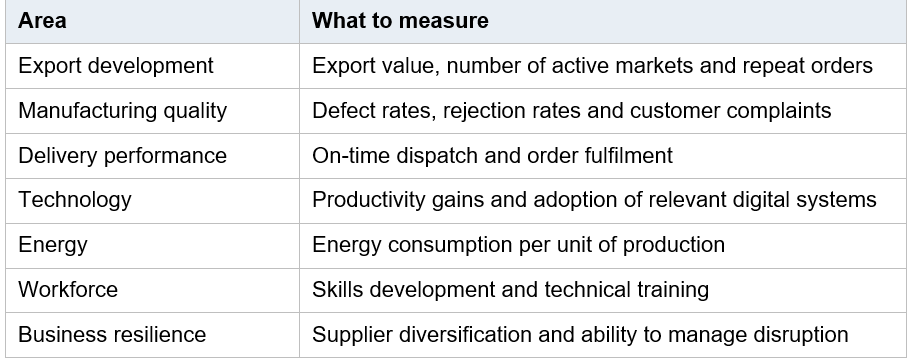
Success should not be judged only by factory counts, capacity or investment announcements. A more meaningful test is whether manufacturers are becoming more productive, reliable, technologically capable and connected to international customers.
Conclusion: engineering the next chapter
Rajkot and Morbi built their industrial identities through entrepreneurship, specialised manufacturing and strong production networks. The long-term prize is a manufacturing base that competes on more than low prices: one known for dependable engineering, consistent quality, responsive service and efficient delivery.
The next phase is about connecting these strengths to the expectations of global business: raising quality, investing in the right technology, strengthening logistics, developing skilled people, managing energy and environmental risk, and building export operations that sustain long-term customer relationships.
Engineering Global Reach is ultimately about making local manufacturing globally dependable. By strengthening the systems behind production, from factory processes to export delivery, Rajkot and Morbi can build a more resilient, higher-value and internationally connected manufacturing ecosystem.
 Join our WhatsApp channel for more updates:
 Subscribe to our YouTube channel for more updates: