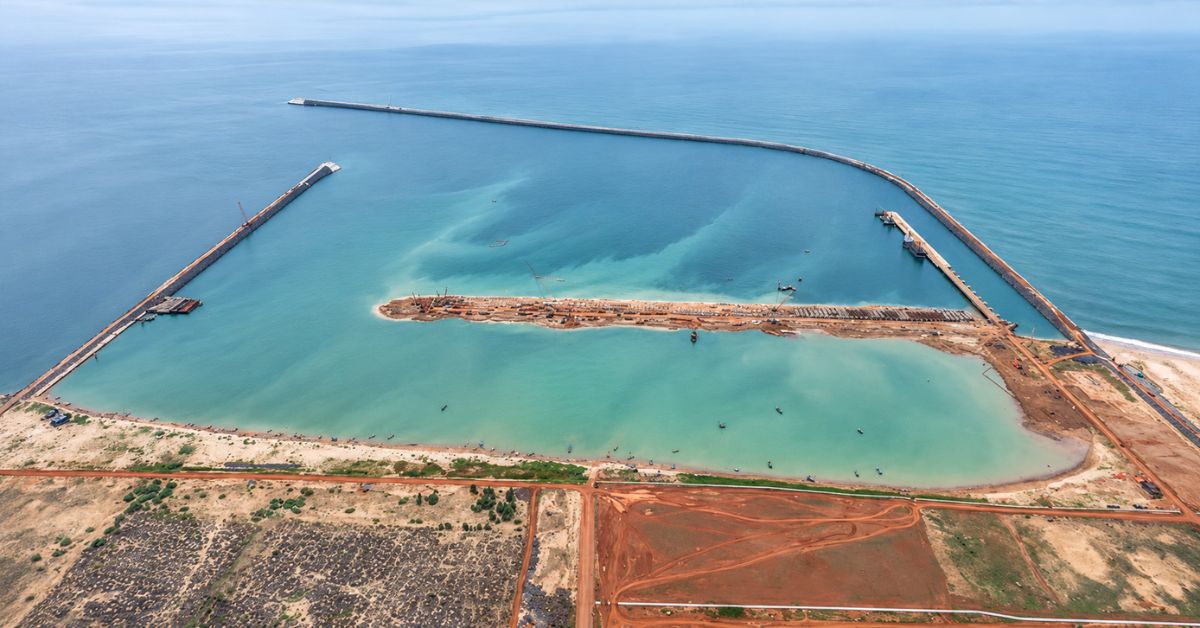

Ramayapatnam Port in Andhra Pradesh has received Customs port status, completing a regulatory step towards handling international cargo. The Central Board of Indirect Taxes and Customs (CBIC), under the Ministry of Finance, issued the notification on 16 November 2026, authorising the unloading of imports and loading of exports at the port.
The designation establishes the port’s status under Customs law. It does not, by itself, confirm the completion of construction or the commencement of commercial shipping operations.
What does the CBIC notification authorise?
Notification No. 93/2026-Customs (N.T.), published as S.O. 6235(E), was issued under Section 7(1)(a) of the Customs Act, 1962.
It amends Notification No. 62/1994-Customs (N.T.), dated 21 November 1994, by inserting Ramayapatnam as item six under the Andhra Pradesh entry. The authorisation covers the unloading of imported goods and loading of export goods, including any class of such goods.
The amendment provides the statutory basis for Ramayapatnam to function as an import and export gateway, subject to applicable Customs procedures and operational requirements. It does not prescribe a commercial launch date or announce the arrival of a first cargo vessel.
How does Customs designation relate to cargo handling?
Customs port notification and approval of specific cargo-handling locations are separate elements of the regulatory framework.
Under Section 8 of the Customs Act, the Principal Commissioner or Commissioner of Customs can approve places within a Customs port for loading and unloading goods and define the boundaries of the Customs area. These provisions govern where cargo can be handled and held under Customs supervision.
CBIC’s explanation of the framework distinguishes the designation of a port from the approval of specific handling locations and Customs-area limits. For shipping lines, cargo owners and logistics providers, the November notification therefore establishes a necessary legal foundation, while operational arrangements remain relevant to the start of services.
What capacity is planned at Ramayapatnam?
Ramayapatnam is a non-major port under the administrative control of the Andhra Pradesh government. A parliamentary reply in July 2025 put its first-phase cargo-handling capacity at 34.04 million tonnes per annum.
The same reply stated that the port’s master plan envisaged capacity reaching 138.54 million tonnes annually by 2045–46. This is a long-term development projection, rather than capacity currently available for cargo operations.
The first phase comprises four berths, including one coal berth and three multipurpose berths. Recent reporting placed the development investment at ₹4,929.39 crore, with construction undertaken through an engineering, procurement and construction contract.
How is the operating concession being structured?
The Andhra Pradesh Maritime Board has also been pursuing the selection of a private operator. Reporting in late October identified JSW Infrastructure and a consortium of Bothra Group and Kakinada Seaports as competing bidders.
The proposed concession runs for 30 years, with provision for an extension of up to 20 years. Its commercial structure includes a ₹1,500-crore upfront premium and revenue-sharing payments. The board is also to retain a non-dilutable 12% equity interest in the port-operating company in consideration for the land provided.
The Customs notification now adds to these development and operating arrangements. The next material milestones for trade users will be confirmation of operational readiness, the commencement schedule and the cargo services available at the new gateway.
 Join our WhatsApp channel for more updates:
 Subscribe to our YouTube channel for more updates: