





Summary
Lloyd’s Register and India’s Sagar Defence Engineering have signed an MoU to create practical pathways for the certification, assurance and regulatory acceptance of autonomous and remotely operated maritime systems. The partnership will cover verification, testing, safety cases and class readiness and aims to help unmanned vessels move from concept to approved operation.
Article
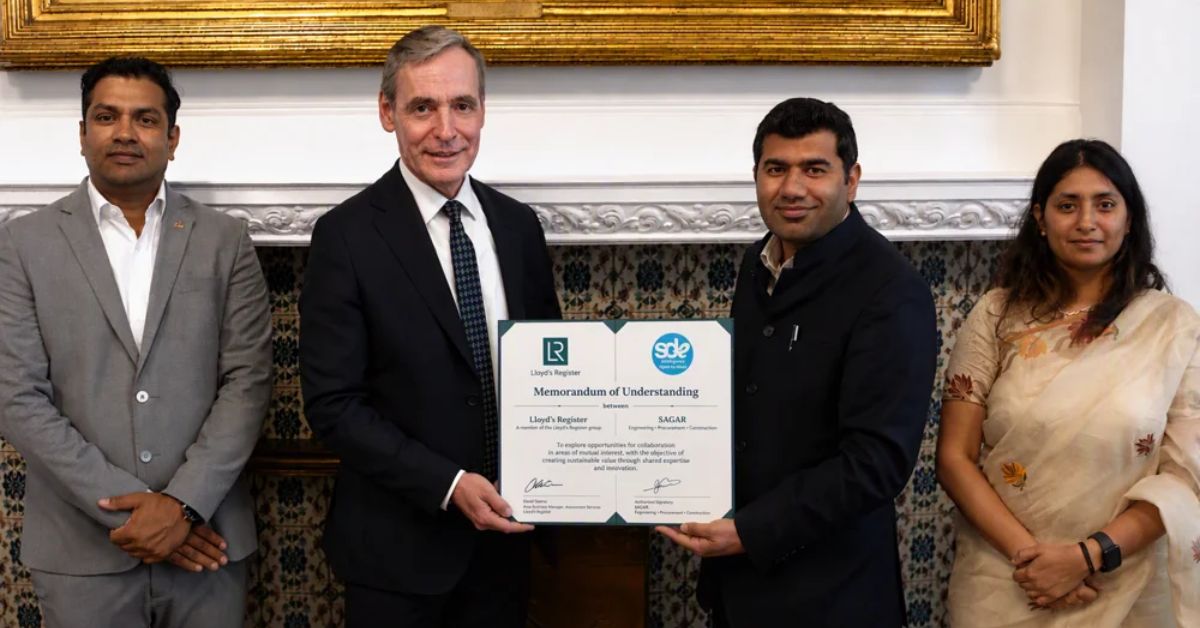
Pune: Classification society Lloyd’s Register (LR) and Sagar Defence Engineering Limited (SDEL) have signed a Memorandum of Understanding to develop practical routes for autonomous systems certification, covering the safe assurance and regulatory acceptance of autonomous and remotely operated maritime platforms.
The agreement was signed in the presence of David Lloyd, Vice President, Naval and Government Business at LR, along with SDEL Director Mridul Babbar, Plant Director Ankit Kumar and Chief Human Resources Officer Sanyukta Singh.
What does the partnership aim to do?
As interest in autonomous and remotely operated systems grows across commercial, government and defence sectors, developers and operators face pressure to show that new systems can operate safely, reliably and in line with evolving regulations.
The MoU combines LR’s expertise in classification, assurance and regulatory compliance with SDEL’s experience in developing autonomous and remotely operated platforms. The two aim to bridge the gap between technological innovation and operational deployment, helping autonomous systems move from concept to approved operation.
What will the two companies work on?
The collaboration will focus on:
- Classification, certification and operational acceptance of autonomous systems
- Practical approaches to verification, validation and testing
- Classification readiness assessments and assurance methodologies
- Operational concepts, mission profiles and safety cases
- Engagement with regulators, government agencies and industry to shape certification pathways
The partners also aim to help develop the rules, guidance and assurance frameworks needed for wider industry adoption of autonomous maritime technologies.
Who is Sagar Defence Engineering?
Founded in 2015, Sagar Defence develops unmanned surface vessels, aerial systems and underwater platforms, along with the autonomy software that runs them. Its customers include the Indian Navy, Coast Guard and energy sector, and it reported FY2025 revenue of about ₹108 crore.
The company has passed several milestones in recent years. One of its autonomous surface vessels completed a 1,500 km voyage from Mumbai to Thoothukudi without human intervention, in an effort supported by the Indian Navy. In December 2025, it opened a plant in Pune to co-produce the Wave Glider autonomous surface vessel with Liquid Robotics, a Boeing company.
Sagar Defence is also building an autonomous maritime shipbuilding and systems development centre at Juvvaladinne Fishing Harbour in Andhra Pradesh’s Nellore district, with an initial investment of about ₹45 crore and trial production planned from October 2026. It recently received an industrial licence to manufacture surface and underwater military vessels, placing it among a small group of private Indian firms authorised to build vessels for the Navy and Coast Guard.
Why does it matter?
Certification is one of the biggest barriers to wider use of autonomous vessels. Developers can show working technology in trials, but navies, coast guards, port authorities and commercial operators need independent assurance that systems meet safety and regulatory standards before deploying them at scale.
For India, where unmanned platforms are being developed for coastal surveillance, logistics, seabed survey and naval missions, a structured route to classification could speed adoption. The partnership also gives LR a closer role in a fast-growing Indian autonomy segment, as global rules for autonomous shipping continue to evolve.
FAQs
What did Sagar Defence and Lloyd’s Register agree?
They signed an MoU to develop practical pathways for the certification, assurance and regulatory acceptance of autonomous and remotely operated maritime systems.
What areas will the partnership cover?
Verification, validation and testing, classification readiness, assurance methods, operational concepts, mission profiles and safety cases.
Who is Sagar Defence Engineering?
A company founded in 2015 that develops unmanned surface, aerial and underwater systems and autonomy software for defence and commercial users.
Why is certification important for autonomous vessels?
Operators and regulators need independent assurance that autonomous systems are safe and compliant before deploying them widely.
What other recent milestones has Sagar Defence reached?
It completed a 1,500 km autonomous voyage from Mumbai to Thoothukudi, opened a Wave Glider co-production plant in Pune and received a licence to build military vessels.
 Join our WhatsApp channel for more updates:
 Subscribe to our YouTube channel for more updates:



