
Summary
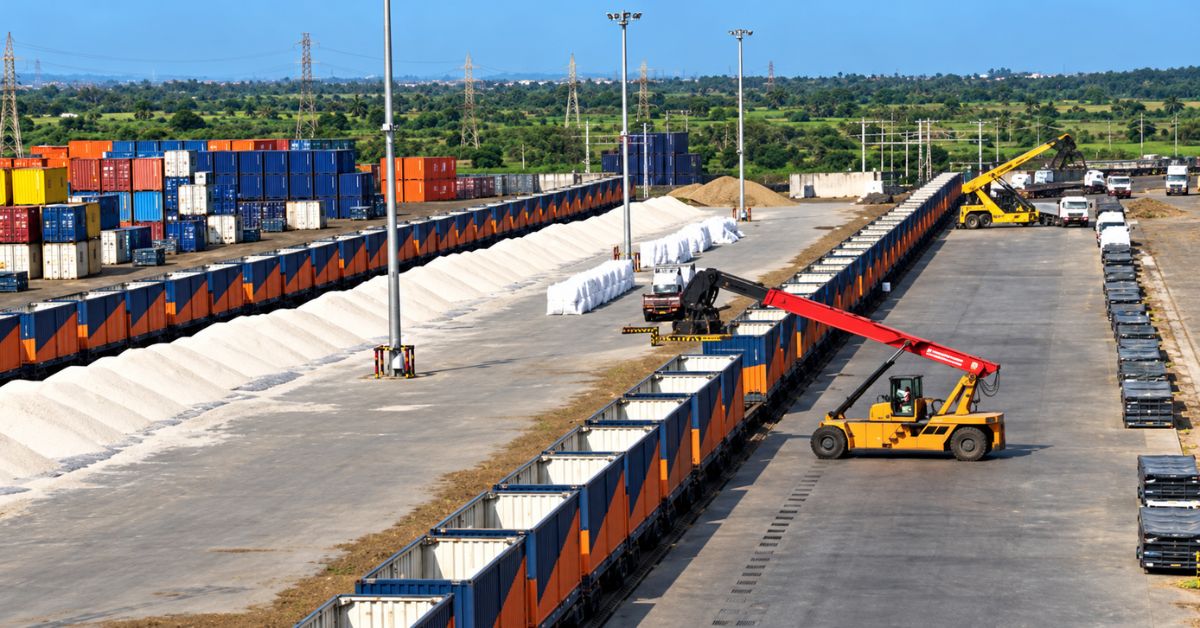
A specialised salt container train linking Shivlakha in Kutch with Mithapur is offering a new transport option designed to protect cargo and improve payloads. Flagged off on 15 September, the service uses lightweight stainless-steel containers, with terminal officials estimating logistics savings of around 11% under the reported operating arrangement.
Specialised containers address cargo-handling challenges
The salt container train between Shivlakha Gati Shakti Cargo Terminal and Mithapur introduces equipment designed around the handling requirements of Gujarat’s salt industry.
Railway Minister Ashwini Vaishnaw flagged off the salt-loaded service on 15 September 2026, alongside the inauguration of the Shivlakha terminal. The movement therefore predates the latest October account of its operational benefits.
The containers allow loading through the top and unloading from the side. Their lightweight stainless-steel construction is intended to address difficulties associated with conventional transport, including moisture absorption and cumbersome handling.
The railway ministry presented the initiative as a means of making salt movement easier while improving loading and unloading efficiency.
Higher payload supports estimated savings
Mohammed Arshad, terminal head at Shivlakha, said each new container can carry approximately 35.5 tonnes of salt, compared with the previously cited range of 28–30 tonnes.
He estimated savings of around 11%, explaining that the additional payload allows more cargo to move at the same transportation cost.
That estimate reflects the operating comparison described by the terminal official. It does not establish a uniform reduction in railway tariffs or guarantee the same savings for every customer.
Ahmedabad Divisional Railway Manager Ved Prakash identified two top openings for loading and a side-opening arrangement for unloading. Loaded containers can also be lifted onto trailers for further movement.
The equipment therefore combines a higher reported payload with flexibility for handling beyond the rail journey.
Cargo protection matters alongside freight cost
Moisture exposure is a longstanding concern when salt moves in conventional open wagons. Wet cargo can become more difficult to handle and may affect product quality.
Tejabhai Kangad, president of the Gandhidham Chamber of Commerce, identified protection from moisture-related damage as an important advantage of the specialised containers.
For producers and traders, the commercial assessment consequently extends beyond the quoted transport charge. Cargo condition at arrival, unloading requirements and losses during movement also influence the overall outcome.
The service addresses these practical concerns through equipment adapted to the commodity, rather than relying solely on additional train capacity.
Shivlakha forms part of a wider terminal programme
The September launch accompanied developments at five Gati Shakti Cargo Terminals in Gujarat.
Alongside Shivlakha’s inauguration, terminals at Bhimasar in Kutch, Devaliya in Morbi and Chandisar in Banaskantha were dedicated to the nation. A foundation stone was laid for another terminal at Linch in Mahesana.
At the event, Vaishnaw said 150 Gati Shakti Cargo Terminals had been commissioned nationally.
The ministry linked the Gujarat facilities with stronger connections between local production centres, ports and inland markets. These terminal developments provide the broader infrastructure setting for the specialised salt movement, although they should not be interpreted as additional stops on the Shivlakha–Mithapur service.
Mithapur provides an industrial destination
Mithapur has a longstanding salt and chemical manufacturing base.
Tata Chemicals began operations there in 1939, developing production around the area’s salt resources. Its manufacturing activities include salt, soda ash, sodium bicarbonate and other chemicals.
In an earlier announcement, the company reported that its Mithapur facility achieved one million tonnes of soda ash production during FY2025–26.
These operations provide context for the destination’s industrial significance. However, the train announcement does not identify the full customer allocation, contract volumes or intended application of each consignment. The existence of manufacturing capacity should therefore be distinguished from confirmed demand assigned to this particular service.
Regular utilisation will determine wider impact
For Kutch’s salt producers, the immediate development is access to a transport format that combines enclosed handling with a higher reported payload.
Its longer-term value will depend on equipment availability, service frequency and coordination between loading terminals, railway operations and receiving facilities.
The published information does not establish a fixed departure schedule or annual cargo commitment. Those details will matter as businesses assess whether the arrangement fits their dispatch requirements.
The initial movement demonstrates a commodity-specific logistics approach. Sustained use will show how effectively its handling and payload advantages translate into repeatable commercial benefits.
FAQs
Where does the service operate?
Between Shivlakha Gati Shakti Cargo Terminal in Kutch and Mithapur, Gujarat.
When was it flagged off?
On 15 September 2026 by Railway Minister Ashwini Vaishnaw.
How much salt can each container carry?
Approximately 35.5 tonnes, according to the Shivlakha terminal head.
What savings have been estimated?
Around 11% under the operating comparison described by the terminal official.
How are the containers handled?
They are loaded through top openings and unloaded through a side-opening mechanism.
 Join our WhatsApp channel for more updates:
 Subscribe to our YouTube channel for more updates: