



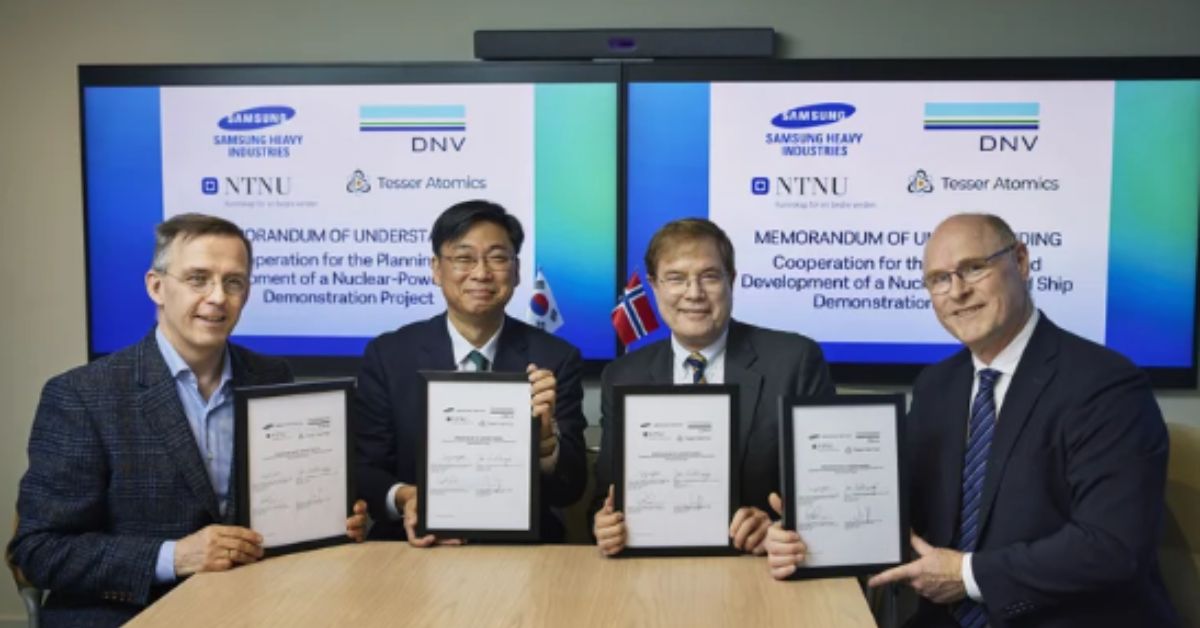

Samsung Heavy Industries (SHI) and US reactor developer Tesser Atomics have agreed to develop a nuclear-powered liquefied natural gas (LNG) carrier intended for commercial operations between the United States and Europe. Their memorandum of understanding, signed on 19 November 2026, establishes an exclusive partnership for the demonstration project, aimed at testing nuclear propulsion in ocean-going cargo transport.
The initiative has also brought together classification society DNV and the Norwegian University of Science and Technology (NTNU). In a separate announcement on 23 November, DNV confirmed a four-party agreement covering concept development, safety assessment and an approval roadmap for the proposed vessel.
What does the development agreement cover?
Under the bilateral agreement, Samsung Heavy Industries will be Tesser’s exclusive shipbuilding partner for the demonstration, while Tesser will provide the reactor technology exclusively for that project.
The partners intend to combine ship design and construction expertise with nuclear plant development and licensing work. Their objective is to demonstrate whether a nuclear-powered LNG carrier can operate on an established commercial route and provide evidence for subsequent applications.
The agreement remains a development partnership. No firm shipbuilding contract, construction timetable, project cost or financing package has been disclosed. Vessel capacity and delivery specifications also remain unannounced.
Which reactor technology is proposed?
The vessel concept will use Tesser’s Triton, a compact fluoride-salt-cooled high-temperature reactor designed for marine applications.
According to the developer, the design combines tri-structural isotropic (TRISO) nuclear fuel with low-pressure molten salt coolant. It also incorporates online refuelling, allowing fuel replacement while the reactor operates. These are proposed design capabilities, rather than performance demonstrated aboard the planned vessel.
The distinction between the ship’s cargo and propulsion is important: the project concerns a carrier transporting LNG while using a nuclear reactor as its power source.
How will the partners divide responsibilities?
SHI will lead vessel concept development and marine integration, including construction feasibility. Tesser will oversee the nuclear plant and reactor-specific safety and licensing activities.
DNV will contribute classification, maritime risk assessment and verification expertise. Its work will include hazard identification and development of a safety assessment framework.
NTNU will coordinate research, funding proposals and consortium development, alongside feasibility studies, modelling, simulation and testing. The initial task is to establish a practical route from concept development through approval, construction and commissioning.
The project originated in Norway’s NuProShip research programme and continues within the NTNU-led SFI SAINT maritime nuclear research centre. The LNG carrier is intended to serve as one of its demonstration projects, with the partners also considering whether the concept could eventually extend to container ships and other vessel types.
What regulatory work remains?
Commercial deployment will require progress beyond ship and reactor design. The partners’ programme includes addressing nuclear licensing, maritime safety and classification requirements, while legal and insurance considerations also form part of the wider research effort.
At the international level, the International Maritime Organization (IMO) is developing updated safety provisions for nuclear-powered ships. Its published workplan identifies 2030 for adoption of a revised Code of Safety for Nuclear Ships and amendments to Chapter VIII of the International Convention for the Safety of Life at Sea (SOLAS).
That regulatory timetable does not constitute approval of the Samsung–Tesser vessel. The project’s next substantive milestones are a defined concept, safety assessment and approval pathway, followed by the commercial and construction decisions required to deliver a demonstration ship.
 Join our WhatsApp channel for more updates:
 Subscribe to our YouTube channel for more updates: