




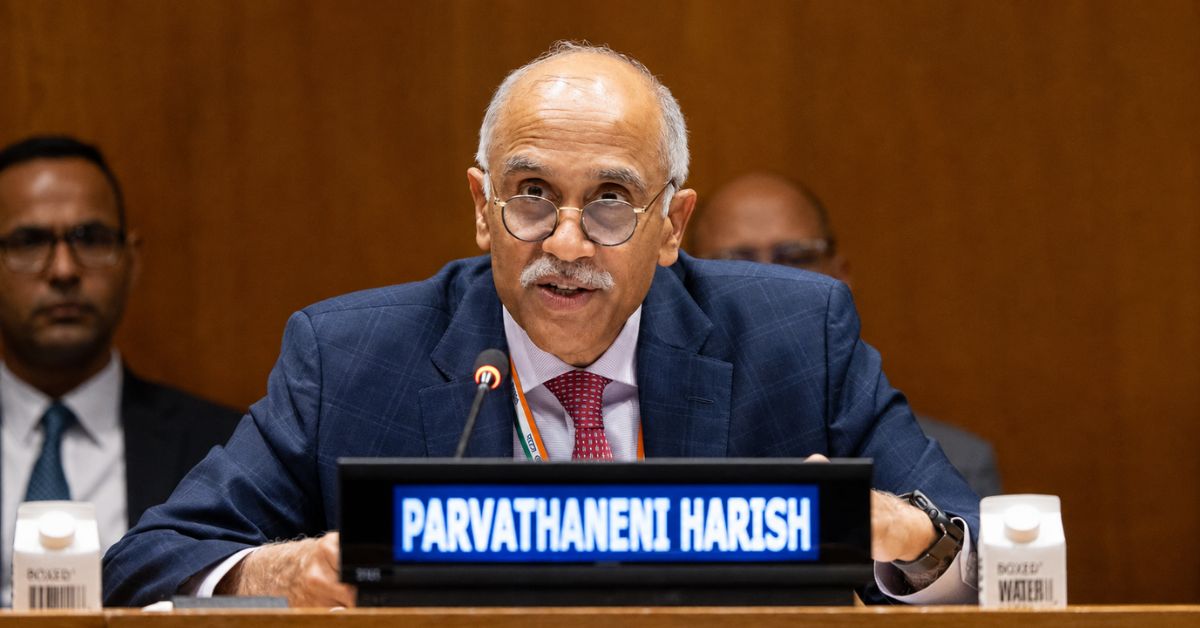

India has called on the international community to work collectively to safeguard critical sea lanes, emphasising that secure and predictable maritime trade routes are indispensable for uninterrupted movement of food, fertilisers and fuel.
Addressing a UN Security Council debate, India’s Permanent Representative to the UN, Ambassador Harish Parvathaneni, said food insecurity remains one of the gravest humanitarian consequences of armed conflict, adding that today’s conflicts increasingly generate ripple effects far beyond the immediate theatre of hostilities.
Underscoring the need to preserve the safety and freedom of navigation for commercial shipping in accordance with international law, Parvathaneni said secure and predictable maritime trade routes are indispensable for the uninterrupted movement of food, fertilisers, fuel and other essential commodities. He said disruptions to commercial shipping during conflicts can have cascading effects far beyond the immediate region, disproportionately affecting food-importing developing countries and humanitarian operations.
Parvathaneni said the international community must therefore work collectively to safeguard critical sea lanes and maritime infrastructure, while ensuring that legitimate commercial trade and humanitarian shipments are able to proceed without undue impediment. He called for facilitating safe, rapid and unimpeded humanitarian access, supporting de-confliction arrangements where appropriate, and ensuring that the Council’s own measures, including sanctions regimes, do not inadvertently impede humanitarian assistance or legitimate food and agricultural trade.
He added that predictable and affordable access to fertilisers, quality seeds, technology and concessional finance remains indispensable, particularly for developing countries, and that open, transparent and rules-based trade in food and agricultural inputs also remains essential.
Addressing the debate, UN Secretary-General Antonio Guterres noted that 2025 saw not only the highest number of armed conflicts since World War II, but also among the highest levels of global acute hunger on record.
 Join our WhatsApp channel for more updates:
 Subscribe to our YouTube channel for more updates: