
Summary
The Indian Coast Guard rescued all 20 crew members from the bulk carrier Sigma Pearl off Andhra Pradesh on 29 October after the vessel became stranded during Cyclone Arnab. A helicopter and patrol vessel Sujay supported the evacuation near Antaravedi, where rough seas complicated the operation.
All crew brought to safety
The Sigma Pearl crew rescue was completed on Thursday, 29 October 2026, with the Indian Coast Guard evacuating all 20 seafarers from the Marshall Islands-flagged bulk carrier off Andhra Pradesh’s coast.
The 180-metre vessel was stranded near Antaravedi in Dr BR Ambedkar Konaseema district after encountering severe weather associated with Cyclone Arnab.
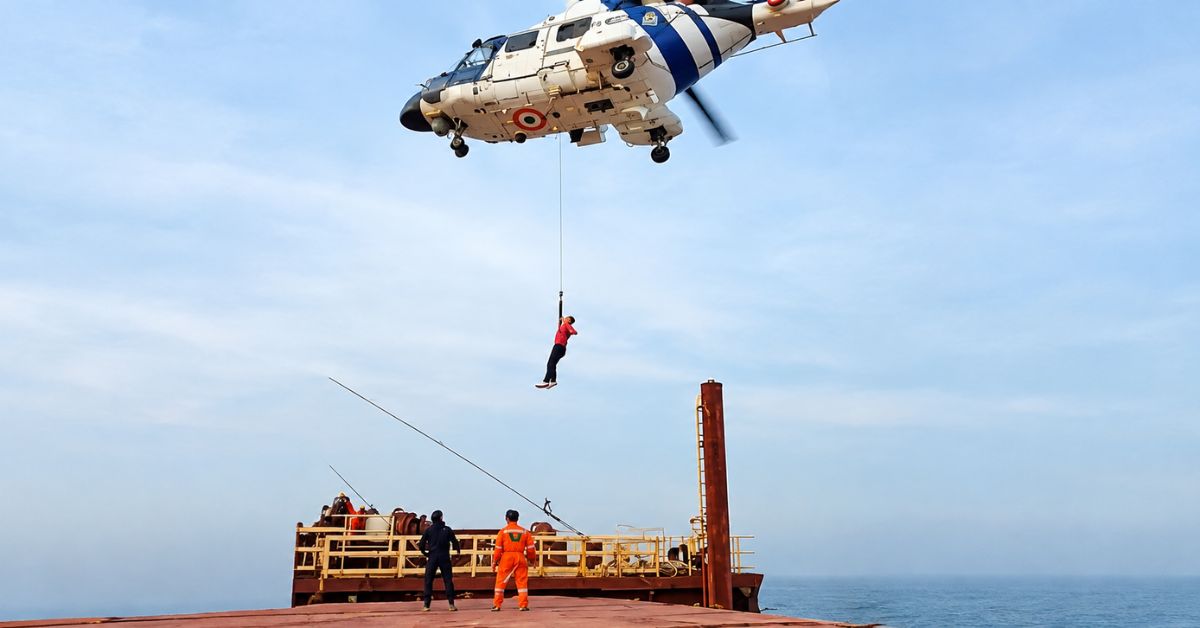
The Coast Guard used a helicopter to airlift the crew, with offshore patrol vessel Sujay supporting the operation. The successful evacuation brought the immediate emergency involving those aboard to an end.
Grounding followed reported propulsion problems
Sigma Pearl, identified by IMO number 9414773, had departed Visakhapatnam for Singapore after discharging sulphur cargo.
The vessel reportedly developed propulsion problems and drifted towards the coast before grounding near the Ravva offshore oil and gas field in the Krishna–Godavari Basin.
The reported machinery failure remains subject to investigation. The available information does not establish the precise technical fault or whether the cyclone directly caused it.
Maritime agencies, including the Mercantile Marine Department and port authorities, were coordinating with the Konaseema district administration. Plans reported after the evacuation envisaged towing the vessel once weather conditions permitted.
The rescue of the crew should therefore be distinguished from recovery of the ship, which requires a separate assessment of its condition and the arrangements needed to move it safely.
Air and sea assets supported the response
The response combined a Coast Guard helicopter with Sujay, allowing rescuers to operate around a vessel affected by difficult sea conditions.
Local authorities in West Godavari district also supported the operation. A helipad at Mogalthur was used in coordinating the rescue effort.
Earlier updates described an operation still in progress; the subsequent confirmation that all 20 crew had been evacuated represents the completed outcome.
The ship had sailed from Visakhapatnam on 27 October, before the cyclone crossed the Andhra Pradesh coast the following day. Its intended onward destination was Singapore.
Cyclone preparations preceded the incident
National emergency preparations had begun before the storm reached the coast.
On 26 October, Cabinet Secretary T. V. Somanathan chaired a National Crisis Management Committee meeting to review readiness across potentially affected states and Union Territories.
At that stage, the India Meteorological Department forecast that Arnab would cross the Andhra Pradesh and Yanam coasts as a very severe cyclonic storm.
The preparedness review covered shelters, evacuation arrangements, disaster-response teams and district control rooms. Army, Navy, Air Force and Coast Guard rescue resources, including ships and aircraft, were placed on standby.
The Coast Guard had also guided vessels and boats towards shore facilities and issued alerts to others ahead of the approaching storm.
These were precautionary measures announced before landfall, rather than a description of the conditions subsequently measured at Sigma Pearl’s location.
Rescue coordination remains a core maritime function
The Indian Coast Guard is responsible for conducting and coordinating search-and-rescue missions within India’s maritime search-and-rescue region.
Its coordination structure divides that region into three areas, served by Maritime Rescue Coordination Centres at Mumbai, Chennai and Port Blair. This framework supports the mobilisation of assistance when merchant vessels, fishing boats or other craft encounter distress.
Internationally, the Maritime Search and Rescue Convention provides the framework for organised responses to emergencies at sea. It promotes coordination between responsible rescue organisations and cooperation with neighbouring services when required.
The convention’s approach reflects the practical reality that maritime emergencies can involve a ship registered in one country, seafarers from others and rescue assets supplied by the coastal state.
For the shipping industry, the incident highlights the importance of maintaining reliable communications and access to coordinated assistance during extreme weather. With the crew safely evacuated, attention can turn to the vessel’s recovery and establishing the circumstances that led to its grounding.
FAQs
How many crew members were rescued?
All 20 crew members were evacuated safely.
Where was Sigma Pearl stranded?
Near Antaravedi, off Andhra Pradesh’s coast, in the vicinity of the Ravva offshore field.
Which Coast Guard assets participated?
A helicopter and offshore patrol vessel Sujay supported the rescue.
What caused the vessel to become stranded?
Reports indicate propulsion problems followed by drifting and grounding during severe weather. The precise cause remains subject to investigation.
Was the vessel also recovered?
The confirmed development concerns the crew’s evacuation. Towing was being planned subject to suitable conditions.
 Join our WhatsApp channel for more updates:
 Subscribe to our YouTube channel for more updates: