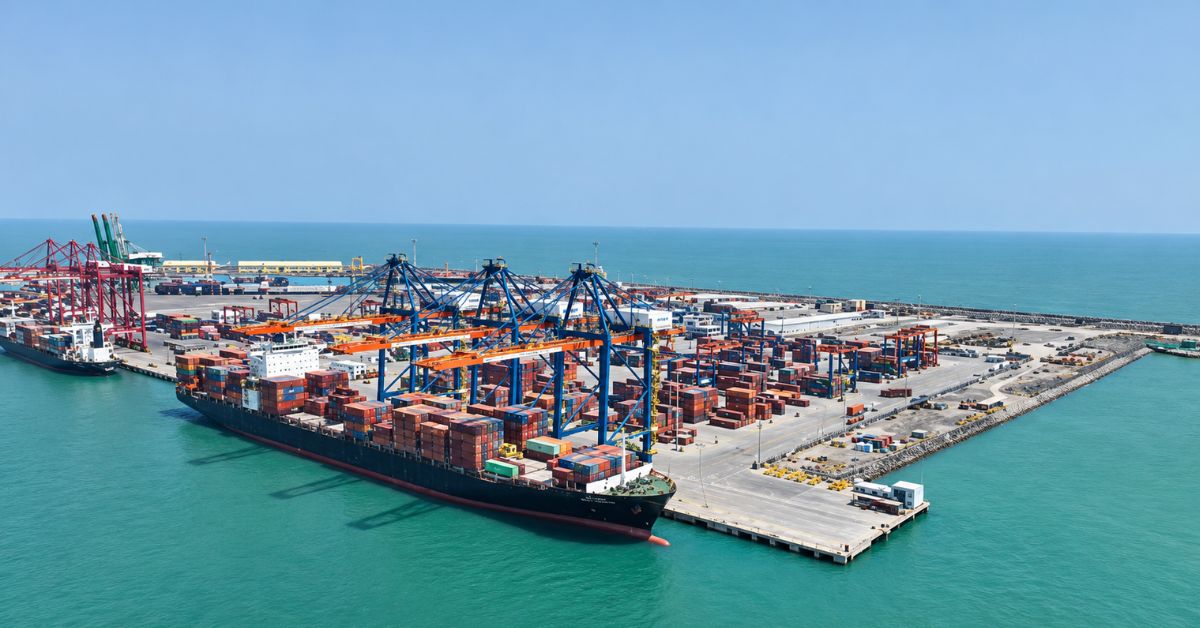

Adani Ports and Special Economic Zone (APSEZ), Megha Engineering and Infrastructures (MEIL), and Vishwa Samudra Engineering are competing for the ₹11,733.28-crore marine infrastructure package at V.O. Chidambaranar (VOC) Port in Thoothukudi, Tamil Nadu. The proposed contract covers works supporting a larger outer harbour container development, following two unsuccessful procurement rounds under an earlier project structure.
The latest competition concerns infrastructure to be developed under the Hybrid Annuity Model (HAM). Container terminal equipment and operations form a separate component of the wider project. No contract award has been announced in the reports.
What will the outer harbour project include?
The restructured development combines marine infrastructure with two container terminals. Its total appraised cost is approximately ₹17,167 crore, comprising ₹11,733.28 crore for the HAM component and ₹5,434.09 crore for terminal development under the Design, Build, Finance, Operate and Transfer (DBFOT) model.
The marine works include breakwaters, rock bunds, wharfs, capital dredging and reclamation. The project also provides for two 1,000-metre berths and a gate-access corridor incorporating a six-lane road.
Terminal development will include cargo-handling equipment, container-yard infrastructure, operational buildings, utilities and railway facilities. The two terminals are designed for a combined annual capacity of 5.2 million twenty-foot equivalent units (TEUs).
How have bidder qualification requirements changed?
VOC Port Authority amended the tender’s experience requirements, replacing a dredging-and-reclamation eligibility condition with a criterion based on breakwater construction in India.
The revised condition permits participation where the bidder, or a consortium member, has executed at least two kilometres of breakwater construction in a single eligible project during the five years preceding the bid deadline.
APSEZ’s relevant experience includes Vizhinjam’s 2.96-kilometre breakwater. MEIL constructed a 2.325-kilometre breakwater at Machilipatnam, while Vishwa Samudra is developing a 3.435-kilometre breakwater at Mulapeta. These projects underpin the companies’ participation in the competition.
Why was the project restructured?
The earlier proposal sought to develop the outer harbour through a public-private partnership, but procurement failed twice. Applicants did not meet qualification requirements in the first round, while the subsequent round attracted no bids.
Following those setbacks, the port commissioned a revised detailed project report and separated the basic marine infrastructure from the revenue-generating container terminal operations.
The revised plan also increases the proposed vessel draft from 16 metres to 18 metres, allowing the harbour to accommodate container ships with capacities of up to 24,000 TEUs. This represents a larger vessel-handling requirement than the earlier 18,000-TEU design.
How will the hybrid annuity payments work?
Under the appraised HAM framework, the port authority will pay 45% of the relevant phase’s bid project cost during construction through ten instalments, subject to the specified price-index adjustments.
The concessionaire will arrange the remaining financing, with repayment through 20 half-yearly instalments beginning 180 days after completion of the respective phase.
The appraisal provides for a four-year construction period and a ten-year annuity period. The separate DBFOT terminal concessions envisage 30-year terms, including a two-year construction period.
What does the project mean for southern India’s trade?
The outer harbour is intended to give VOC Port the infrastructure needed to handle larger container vessels and expand its role in regional maritime trade.
The development has a long planning history, with initial announcements in the Union Budgets of 2013 and 2014 and renewed attention from 2022. The current procurement represents another step towards implementation, but bidder participation alone does not establish a construction start or commissioning date. Those milestones will depend on contract award and subsequent execution.
 Join our WhatsApp channel for more updates:
 Subscribe to our YouTube channel for more updates: