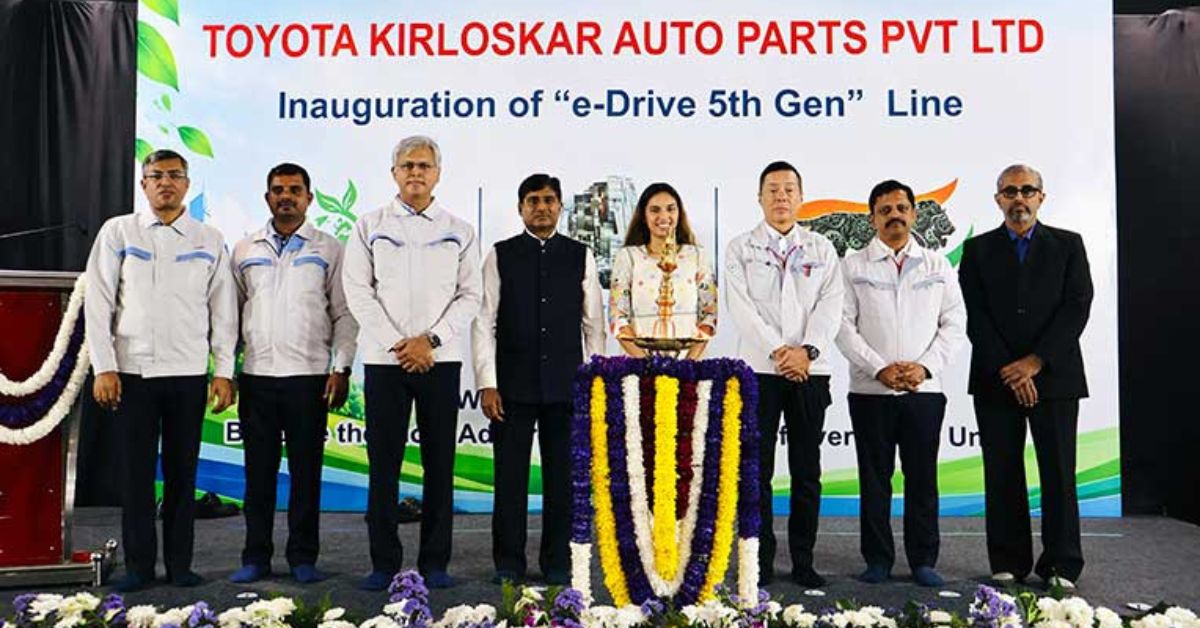

Toyota Kirloskar Auto Parts (TKAP) has expanded its hybrid powertrain manufacturing capacity with a new ₹460-crore E-Drive production line at Bidadi, near Bengaluru, Karnataka. Announced on 16 November 2026, the investment adds capacity for 200,000 units annually, taking the company’s total E-Drive capacity to 360,000 units a year.
The expansion is intended to increase domestic production of advanced automotive components, reduce import dependence and strengthen the local supplier network supporting hybrid vehicles.
S. Selvakumar, Principal Secretary, Commerce and Industries Department, Government of Karnataka, inaugurated the line in the presence of Manasi Tata, Vice Chairperson of Toyota Kirloskar Motor, and Tabrez Ahmed, Managing Director of TKAP.
How much manufacturing capacity does the expansion add?
The additional line more than doubles TKAP’s E-Drive manufacturing capacity. It will operate alongside the fourth-generation line commissioned in 2022, expanding the company’s ability to manufacture a key component of Toyota’s hybrid electric powertrain.
Ahmed said production requires advanced automation, specialised manufacturing processes and stringent quality controls. He identified supplier development and workforce skills as priorities accompanying the investment. Tata said the project reflected confidence in India’s manufacturing capabilities and the localisation of electrified technologies.
How does E-Drive production support automotive exports?
TKAP’s move into electrified components began in 2022, when it established an E-Drive facility to supply Toyota Kirloskar Motor in India and overseas markets. Toyota’s announcement at the time identified Japan and other countries as export destinations, positioning Bidadi within the group’s international component supply chain.
Toyota’s 2023 sustainability report subsequently recorded the inclusion of E-Drive units and electrified powertrain components in TKAP’s exports. It also described in-house machine building and accessory development undertaken by the hybrid production line to increase localisation.
This history gives the latest capacity expansion an export-manufacturing context, alongside its role in supplying domestic vehicle production. Earlier company disclosures establish overseas supply activity, although they do not determine how the additional capacity will be divided between Indian customers and export markets.
What is the connection with production-linked incentives?
TKAP’s E-Drive programme has already secured recognition under India’s Production Linked Incentive (PLI) scheme for Advanced Automotive Technology (AAT) products.
In February 2024, the company announced that its electrified transaxle, marketed as E-Drive, had received a Domestic Value Addition certificate. The product also met AAT testing requirements and was certified by the Automotive Research Association of India.
Toyota said the certification made TKAP eligible for incentives under the scheme. The development marked a step in establishing local manufacturing capability for advanced powertrain assemblies, beyond the company’s traditional component portfolio.
Established in 2002, TKAP manufactures automotive rear axles, propeller shafts and transmission units. Its subsequent expansion into electrified transaxles has broadened the range of components produced within Toyota’s Indian manufacturing network.
How does the project fit Toyota’s Karnataka investment programme?
The expansion follows Toyota’s broader investment commitments in Karnataka. In May 2022, the group outlined a ₹4,800-crore programme involving Toyota Kirloskar Motor, TKAP and Toyota Industries Engine India.
The announcement included a ₹4,100-crore memorandum of understanding covering Toyota Kirloskar Motor and TKAP, with a further ₹700 crore associated with Toyota Industries Engine India. The programme focused on electrification, component localisation and manufacturing development.
Toyota also identified supplier capability and training as integral to that programme. The new Bidadi line extends this manufacturing strategy by increasing the scale of domestic E-Drive production within an established automotive cluster.
 Join our WhatsApp channel for more updates:
 Subscribe to our YouTube channel for more updates: