




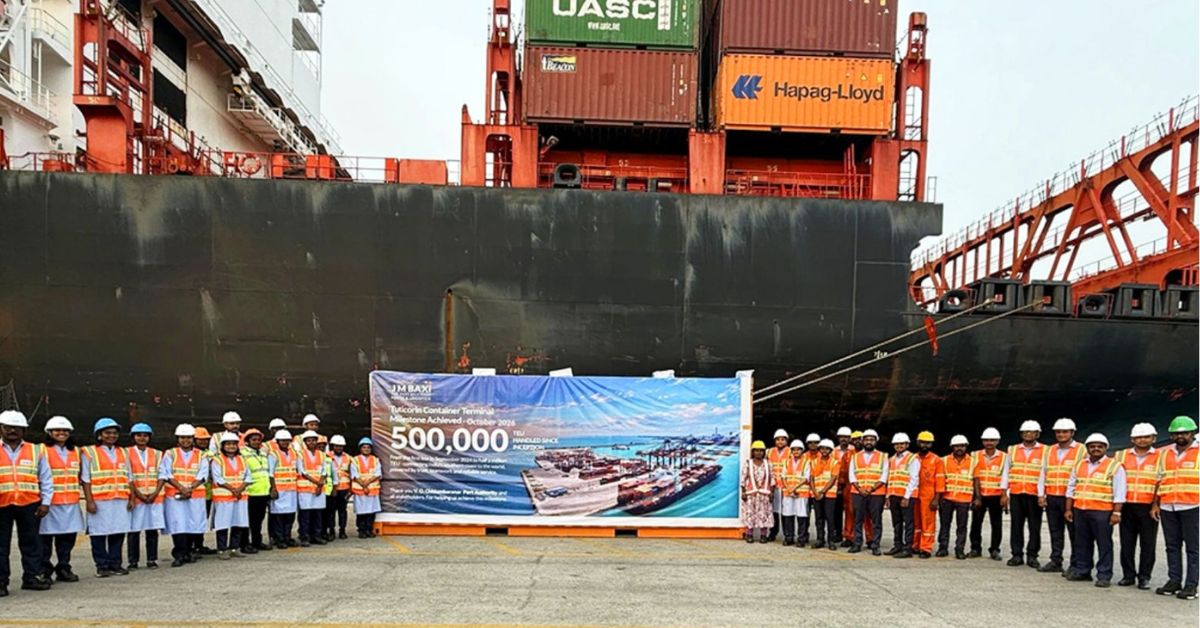

Tuticorin Container Terminal at V.O. Chidambaranar Port in Tamil Nadu has handled a cumulative 500,000 twenty-foot equivalent units (TEU) since commencing operations in September 2024, marking a throughput milestone approximately two years into its operations.
The J M Baxi-operated terminal announced the achievement while recognising the contribution of its employees, particularly women working across departments and in leadership roles. It also acknowledged the support of V.O. Chidambaranar Port Authority, vessel operators, shipping lines, customers and other stakeholders.
The figure represents total container throughput since operations began, rather than volumes handled during a single financial or calendar year.
How was the container terminal developed?
Tuticorin International Container Terminal was inaugurated on 16 September 2024 by Union Minister of Ports, Shipping and Waterways Sarbananda Sonowal. Prime Minister Narendra Modi addressed the inauguration through a video message.
Developed with an investment exceeding ₹434 crore, the facility was inaugurated with a stated annual handling capacity of 600,000 TEU. It became the port’s third container terminal, adding infrastructure for containerised trade through the southern Tamil Nadu gateway.
The project originated in a concession agreement signed on 3 September 2022 between the port authority and Tuticorin International Container Terminal Private Limited, part of the J M Baxi Group.
The agreement covered the conversion of Berth No. 9 into a container terminal under a design, build, finance, operate and transfer model. At the time of signing, the project’s estimated cost was ₹434.17 crore, with planned additional capacity of 600,000 TEU annually.
The original completion target was December 2024. Operations began in September that year, ahead of that schedule.
What infrastructure supports container handling?
According to J M Baxi’s terminal specifications, the facility has a 370-metre quay and covers approximately 10 hectares. Its berth offers a draught of up to 14.2 metres.
Container-handling equipment comprises three rail-mounted quay cranes and nine rubber-tyred gantry cranes. The quay cranes transfer containers between vessels and the terminal, while the yard cranes support container stacking and retrieval.
The operator identifies the terminal as a facility serving both export-import and coastal cargo, with road and rail connections to industrial corridors across its southern Indian hinterland.
Women’s participation features in the milestone
The terminal’s announcement placed particular emphasis on women’s contribution to its operating performance. It described women as a significant part of the workforce, including employees leading different departments.
At the September 2024 inauguration, the government reported that women accounted for 40% of the terminal’s employees. That figure relates to the opening period; the latest milestone announcement did not specify an updated workforce percentage.
J M Baxi’s environmental, social and governance report for 2024–25 also documented the deployment of two women as truck drivers at the Tuticorin terminal.
The company said it arranged the necessary heavy-vehicle licences and provided four months of specialised driving and safety training. Following assessment and certification by its safety team, the employees began operating independently. The initiative extended women’s participation into heavy-vehicle operations within the terminal.
Which markets does the terminal serve?
The terminal’s hinterland extends across Tamil Nadu, Karnataka and Kerala. J M Baxi places the facility within 14 nautical miles of international east-west shipping lanes, giving it proximity to a major maritime trade corridor.
Its combination of coastal and international cargo handling provides an additional container gateway for businesses in these states. The 500,000-TEU milestone records the volume handled since that infrastructure entered service, adding an operating benchmark to the terminal’s development history.
 Join our WhatsApp channel for more updates:
 Subscribe to our YouTube channel for more updates:




