



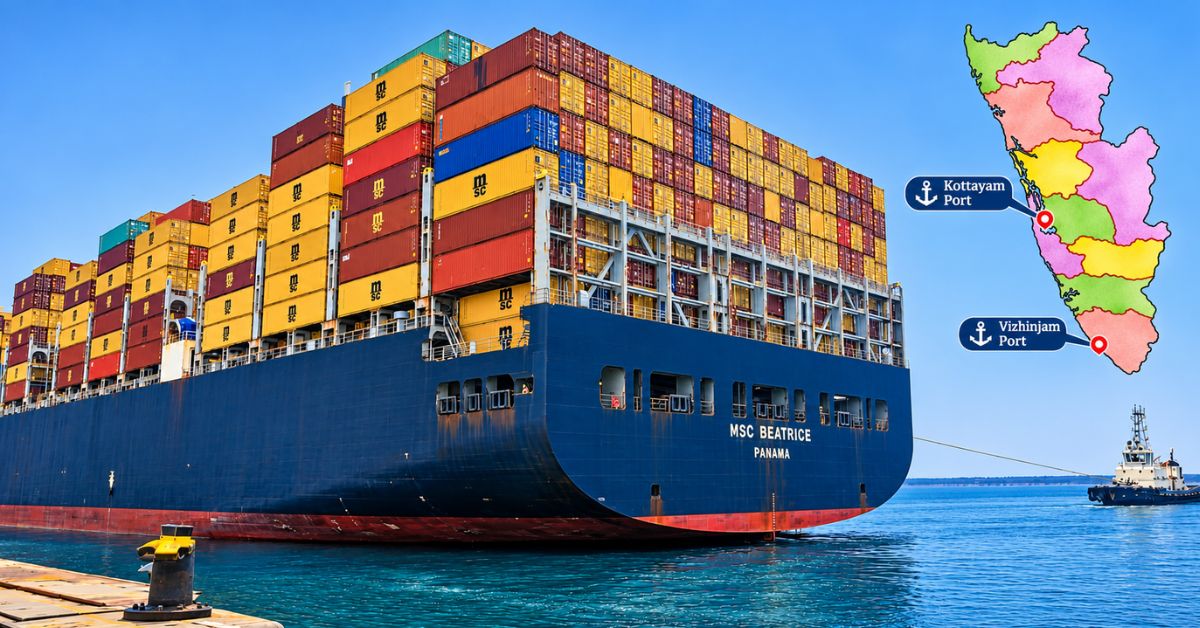

Vizhinjam International Seaport is set to move around 1,500 tonnes of natural rubber imported from Africa for tyre manufacturer MRF to the Kottayam Inland Container Depot (ICD), establishing a new logistics arrangement for customs clearance and onward delivery. Announcing the movement on 21 November 2026, Vizhinjam International Seaport Limited (VISL) described it as the first major import consignment linking the port with Kottayam ICD.
The shipment comprises 60 containers covered by three Bills of Lading, each accounting for 20 containers. The containers have been discharged at Vizhinjam and are expected to reach Kottayam by road on 23 November.
Why has MRF chosen the Vizhinjam route?
MRF has designated Vizhinjam as the Port of Destination to avoid the existing transhipment arrangement through Mumbai. According to VISL, that routing can take up to a month.
Using Vizhinjam for discharge, followed by inland clearance at Kottayam, is expected to shorten transit time and reduce logistics costs. However, the announcement does not quantify the anticipated savings or specify a revised end-to-end delivery time.
The arrangement connects the seaport with an inland customs facility, allowing the importer to complete clearance closer to its regional distribution operations. The movement announced for this consignment is by road.
How will customs clearance and delivery work?
At Kottayam ICD, the containers grouped under each Bill of Lading will undergo customs verification, examination and other mandatory procedures.
Once Customs grants Out of Charge (OOC) clearance, the containers will continue on the same trucks to MRF’s centralised warehouse in Kochi. The sequence combines port discharge, inland clearance and warehouse delivery within one transport arrangement.
How could exporters benefit from the import movement?
The proposal also provides for the reuse of empty containers. After the rubber is unloaded at MRF’s warehouse, the containers could be returned to Kottayam ICD’s yard and made available for export cargo.
Exporters currently often arrange for empty containers to be transported from Kochi to Kottayam before loading their goods. Locally available equipment generated by imports could reduce this repositioning requirement and support faster container reuse, according to the announcement.
This remains an intended benefit of the arrangement, with actual savings dependent on matching the available containers with exporters’ requirements.
What infrastructure does Kottayam ICD offer?
Kottayam Port and Container Terminal Services began full operations as a customs station in 2012. Kerala’s Economic Review 2025 identifies it as the state’s only ICD and records cargo handling of 60,575 tonnes during 2024–25.
Situated on the Kodoor River, National Waterway 9, the facility connects with Vembanad Lake and has inland-waterway access towards Cochin through National Waterways 3 and 9. Its existing role is to serve importers and exporters in the central Travancore region.
The terminal lists a 40,000-square-foot warehouse, container yards, reach stackers and container-stuffing equipment among its facilities. It also provides electronic data interchange connectivity for cargo-related processes.
How does this support Vizhinjam’s gateway business?
Vizhinjam began commercial operations in 2024 and direct export-import operations in August 2026, according to VISL. The MRF movement adds an inland cargo connection to the port’s role in international transhipment.
The initiative forms part of Mission Samudra’s objectives to strengthen Kerala’s maritime trade and cargo transportation. Its practical focus is on linking an import shipment with inland clearance, warehouse delivery and the potential return of equipment into the export supply chain.
 Join our WhatsApp channel for more updates:
 Subscribe to our YouTube channel for more updates: