



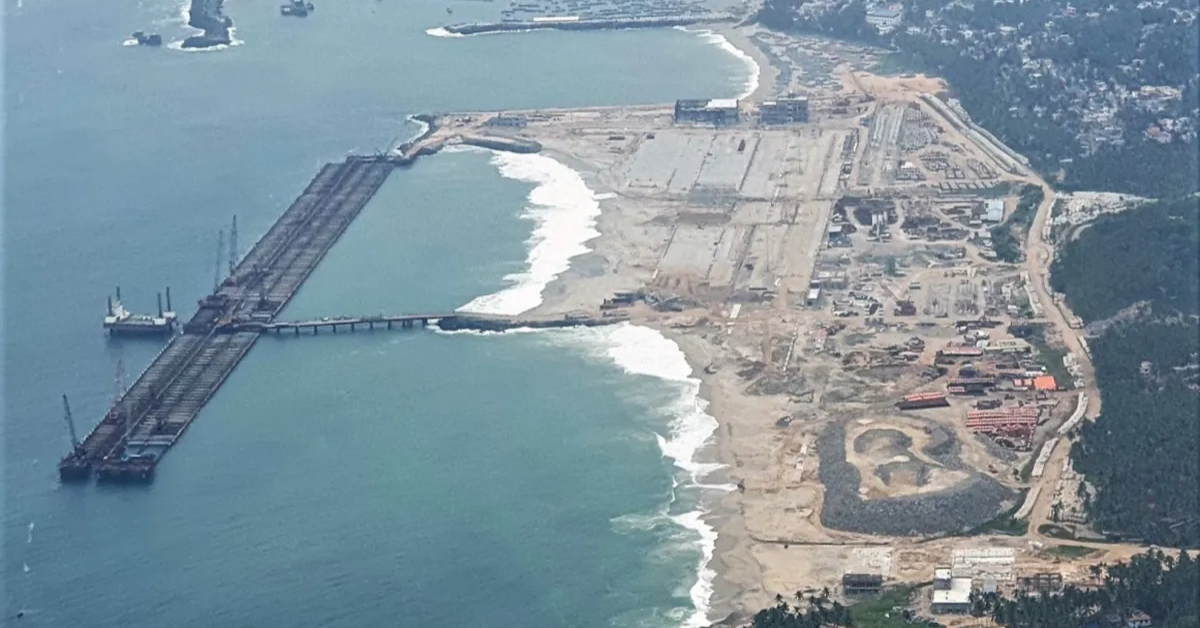

Vizhinjam International Seaport Limited has launched a major expansion drive by signing three strategic Memorandums of Understanding aimed at strengthening the port’s auxiliary infrastructure, with the first phase of projects involving a total investment of approximately ₹800 crore to be executed through public-private partnership models. VISL CEO Sreekumar K. Nair announced the initiative, which represents the first significant infrastructure expansion at Vizhinjam since the port’s commercial launch in December 2024.
The most commercially significant of the three MoUs is with Indian Oil Corporation Limited to establish a dedicated oil bunkering facility at Vizhinjam — a project requiring approximately 20 acres of land that, once operational, will position the port as a competitive marine fuel supply hub on one of the world’s most heavily trafficked shipping lanes. Bunkering capability is a critical value-added service for any transshipment port seeking to maximise revenue per vessel call: ships refuelling at Vizhinjam generate bunker sales revenue alongside port dues and terminal handling charges, making the IOC partnership a direct revenue diversification play alongside the port’s core transshipment business.
Why Bunkering Is Strategically Essential for Vizhinjam
Vizhinjam’s location on the East-West mainline shipping route — directly on the lane between the Strait of Malacca and the Suez Canal — makes it a natural bunkering candidate for vessels transiting between Asia and Europe. Major transshipment hubs including Singapore, Colombo, and Port Klang have long combined transshipment cargo handling with large-scale bunkering operations, using the latter to increase the commercial attractiveness of port calls for major shipping lines. Vizhinjam’s first full year achieved 1.296 million TEUs entirely through MSC’s mainline vessel commitment. Adding a bunkering facility transforms each MSC call from a pure container exchange into a multi-service port visit — improving the commercial relationship and creating additional incentive for MSC to continue and deepen its Vizhinjam commitment.
The IOC partnership is particularly apt given that the Hormuz crisis has created acute awareness of the strategic importance of having sovereign bunkering infrastructure on Indian-controlled territory along global shipping lanes. The expansion’s ₹800 crore investment, structured through PPP, will also encompass the two other MoUs signed alongside the IOC agreement — details of which are expected to be announced in the coming days. Coming alongside the imminent launch of gateway cargo operations in the second week of May and the port’s record 1.296 million TEU first-year transshipment performance, the expansion signal confirms Vizhinjam’s trajectory from promising startup to maturing strategic maritime hub.
 Join our WhatsApp channel for more updates:
 Subscribe to our YouTube channel for more updates: