



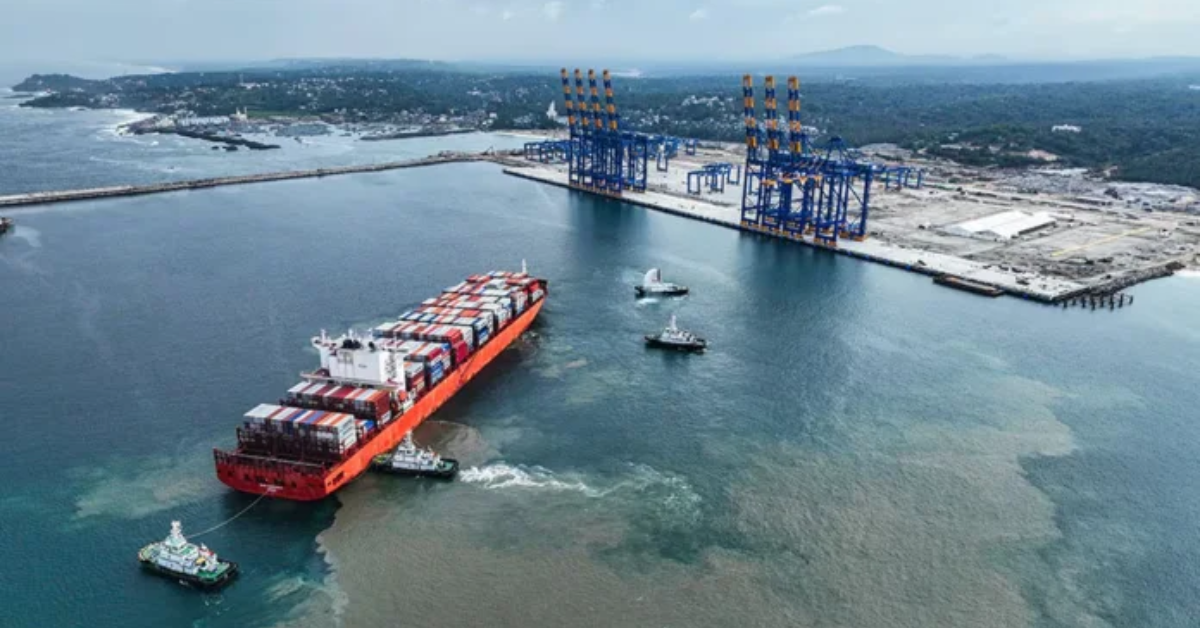

Kerala’s Vizhinjam International Seaport has become a magnet for diverted traffic, with nearly 100 vessels from eight global lines queuing for berths as US-led Gulf tensions block UAE routes via the Strait of Hormuz.
Located just 10 nautical miles from prime east-west shipping lanes, the Adani Ports-operated deepwater transshipment hub draws Europe/South America/China/Singapore callers bypassing northern UAE congestion. Phase 1’s 800m container berth—handling two mother ships or four feeders—books solid, especially Mediterranean Shipping Company (MSC) slots, forcing waits amid Hormuz blockade fallout nearing 50 days.
The surge underscores Vizhinjam’s strategic edge: natural 20m draught accommodates ultra-large 24,000 TEU vessels, slashing fuel/time versus Mumbai/Mundra treks (500+ nm north). Yet, capacity constraints cap revenue from crores in diverted cargo—current ops at 1 million TEU annual run rate versus 6.5 million design.
Expansion accelerates: Phase 2A (₹8,900 crore) adds 1,800m quay by 2027 for three mother ships; full Phase 2B targets five by 2028, plus breakbulk/liquid berths. Hormuz thaw (oil -10%) and Sagarmala’s ₹25,000 crore Maritime Fund (SFC’s $1bn raise) fuel ramp-up, eyeing 20% Colombo diversion capture.
National logistics wins big. Vizhinjam decongests west coast—JNPA/Mundra at 95% utilisation—via ULIP dashboards (Maharashtra MoU model) and DFC southern links for Kochi-Thiruvananthapuram evacuations. CONCOR/RVNL rail synergies (new ED Civil) promise 15% hinterland shift, greening under EU CBAM. Gulf conflict reroutes inflate rates 150%; Vizhinjam’s queue signals India’s transshipment pivot amid 3.2% trade rebound.
Challenges persist: crane shortages delay turns; labour ramp-up lags. Adani targets 95% ops by Q2 FY27, leveraging Hormuz volatility for market share. As global lines eye alternatives—Singapore/Port Klang strained—Vizhinjam emerges as resilient hub, blending geography with ₹21,000 crore infra.
 Join our WhatsApp channel for more updates:
 Subscribe to our YouTube channel for more updates: