
Summary
V.O. Chidambaranar Port has added a container connection linking Thoothukudi with China and Vietnam following the arrival of Nawata Bhum on 18 October 2026. Operated by Regional Container Lines, the service expands routing choices for southern Tamil Nadu’s manufacturers and traders, including onward connections through Kattupalli.
New service begins at DBGT.
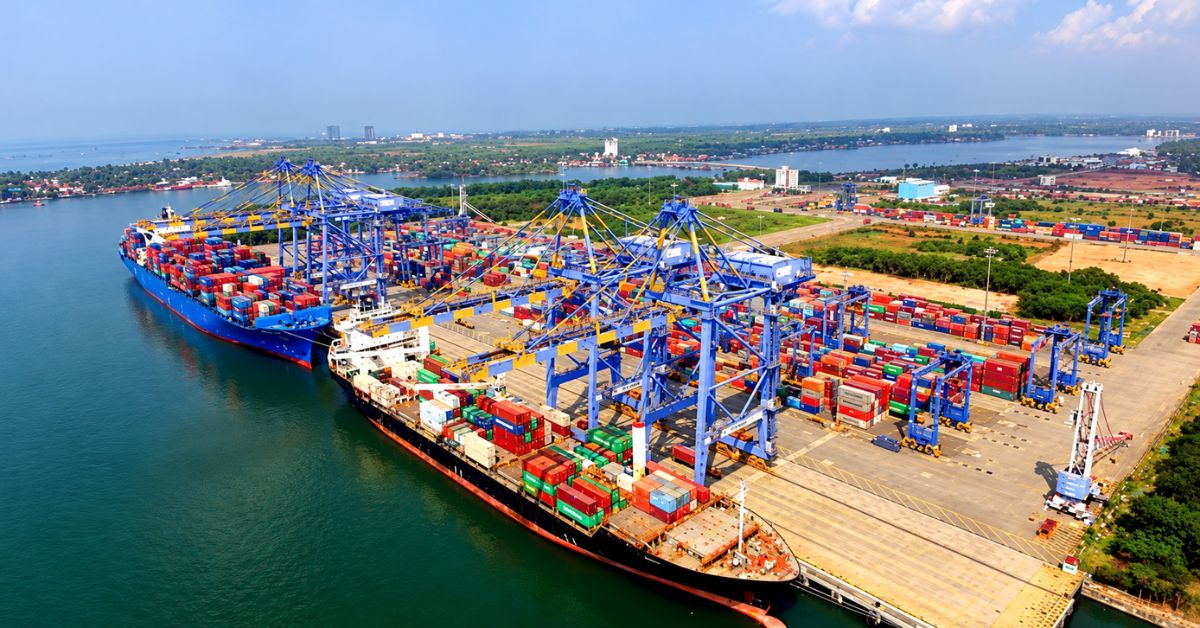
The VOC Port China–Vietnam service commenced with the Singapore-flagged Nawata Bhum calling at Dakshin Bharat Gateway Terminal (DBGT), bringing another international container connection to the Thoothukudi gateway.
The rotation links Qinzhou in southern China, Haiphong in Vietnam, Thoothukudi, Kattupalli and Vietnam’s Chu Lai before returning to Qinzhou.
Announced transit times are 13 days from Qinzhou to Thoothukudi and 12 days from Haiphong. Chakiat Shipping Services Pvt Ltd, Tuticorin, is the vessel’s local agent.
The connection is expected to serve industries in the port’s hinterland, including solar-panel and electric-vehicle manufacturers, while widening shipping options for other exporters and importers.
Frequency could increase with demand
The service will initially operate on a bi-weekly schedule, with an increase to weekly frequency envisaged if market demand supports it. A weekly operation therefore remains a prospective expansion rather than the launch arrangement.
Nawata Bhum has an approximate capacity of 1,100 TEUs, a length of 147.82 metres and a beam of 23.38 metres.
The rotation also provides an additional option for shipping lines and non-vessel-operating common carriers to move outbound cargo from Thoothukudi through Kattupalli for onward transhipment. This gives the service a role beyond the direct movement of containers between the named Chinese, Vietnamese and Indian ports.
More routing options for manufacturers
For businesses sourcing components or selling finished products overseas, an additional service creates another basis for comparing gateway access, sailing schedules and freight offers.
The commercial opportunity is particularly relevant where suppliers and customers are located near the ports included in the rotation. Importers can evaluate the announced transit times alongside inland transport requirements, while exporters gain another route into the regional shipping network.
Actual savings will depend on shipment-specific factors, including freight rates, equipment availability, terminal charges and connections. The service announcement does not establish a uniform reduction in logistics costs.
For cargo moving through Kattupalli, the overall journey will also depend on the timing and availability of the connecting vessel. Shippers will need to assess the complete transport chain when comparing this option with existing routes.
Container traffic provides an established base
VOC Port handled approximately 442,000 TEUs during April–September 2026, an increase of 3.18% from around 428,000 TEUs in the corresponding period a year earlier.
The figures provide context for the new connection: it enters an established container market where additional services can broaden cargo owners’ choices.
DBGT operates at Berth VIII within VOC Port. The terminal provides the handling interface for the new call, connecting the vessel operation with local cargo delivery and receipt arrangements.
Earlier investment targets additional capacity
The service launch follows a separate infrastructure announcement earlier in October covering projects worth ₹753.68 crore at VOC Port.
The largest component is the proposed ₹517.19-crore conversion of Berth No. 7 into a container terminal, with planned annual capacity of 420,000 TEUs. Its design includes a 370-metre quay, approximately ten hectares of backup area, three quay cranes and nine rubber-tyred gantry cranes.
The package also includes road and truck-parking infrastructure intended to support movement beyond the waterfront. These developments are separate from the newly inaugurated shipping service and should be assessed according to their own implementation schedules.
Earlier, in February 2026, the port announced another programme covering connectivity improvements, power infrastructure and digital systems. This included a digital twin platform for monitoring and operational optimisation.
Together, the service addition and infrastructure programmes address complementary requirements: access to shipping networks and the ability to handle cargo efficiently.
For southern Tamil Nadu’s trading community, the immediate development is the availability of another China–Vietnam connection. Its longer-term contribution will depend on sustained bookings, dependable schedules and the operator’s ability to match capacity with demand.
FAQs
Which ports are included in the service?
The rotation covers Qinzhou, Haiphong, Thoothukudi, Kattupalli and Chu Lai before returning to Qinzhou.
Who operates the service?
Regional Container Lines operates it, with Chakiat Shipping Services acting as the local vessel agent.
What are the announced inbound transit times?
Thirteen days from Qinzhou and 12 days from Haiphong to Thoothukudi.
Will the service operate weekly?
It initially has a bi-weekly schedule. Weekly frequency is planned subject to demand.
Where did the inaugural vessel berth?
Nawata Bhum called at Dakshin Bharat Gateway Terminal on 18 October 2026.
 Join our WhatsApp channel for more updates:
 Subscribe to our YouTube channel for more updates: