




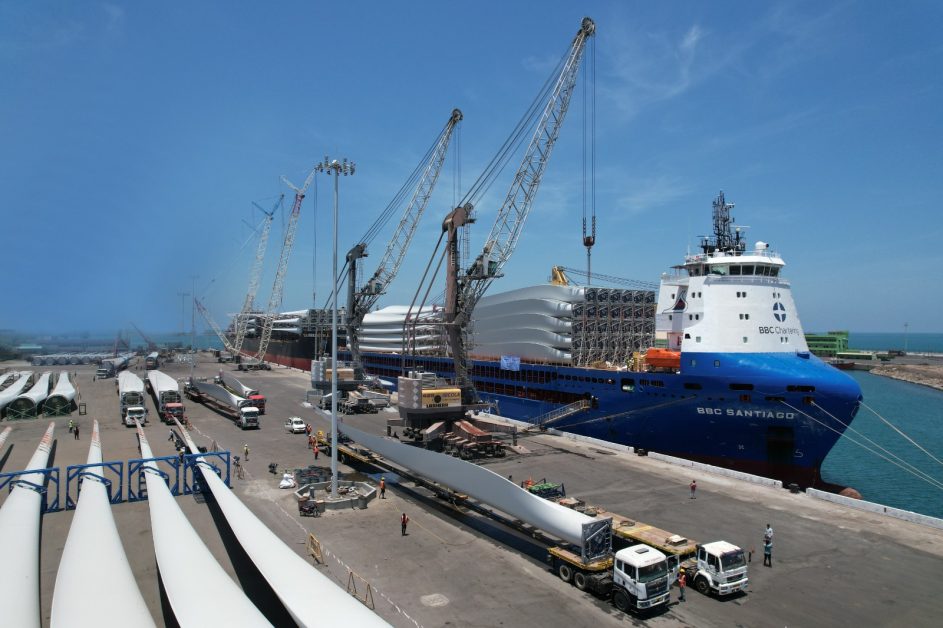

V.O. Chidambaranar Port Authority (VOC Port) handled 2,188 wind turbine blades between April and August 2026, marking a 74.5% increase from the 1,254 blades handled during the corresponding period of FY 2025-26.
The number of vessels carrying wind turbine blade consignments also rose during the period, increasing to 52 from 39 vessels in the year-ago period. The figures point to rising demand for port infrastructure capable of handling large and over-dimensional components used in renewable-energy projects.
VOC Port records sustained growth in wind-energy cargo
The latest increase follows a broader rise in wind turbine blade volumes handled by the port over recent financial years. VOC Port handled 2,030 blades in FY 2023-24, followed by 2,635 blades in FY 2024-25 and a record 4,922 blades in FY 2025-26.
The FY 2025-26 volume was 86.8% higher than the previous financial year.
The growth comes as India’s renewable-energy sector expands and wind-energy projects require logistics infrastructure capable of moving increasingly large components from ports to project locations.
Dedicated infrastructure for wind turbine components
VOC Port has allocated 1,00,000 square metres of exclusive open space outside the Customs-notified area and another 1,44,000 square metres within the Customs-notified area for storing wind turbine blades and related components.
Berths 5, 6 and 7 also provide a combined paved area of approximately 1,00,000 square metres for cargo handling and storage.
The port has handled wind turbine blades measuring up to 90.2 metres in length. Its handling operations are supported by harbour mobile cranes, personnel trained in over-dimensional cargo operations and road connectivity linking the port with its hinterland.
VOC Port highlights role in renewable-energy logistics
Shri Susanta Kumar Purohit, IRSEE, Chairperson, V.O. Chidambaranar Port Authority, said: “The transition towards clean energy is creating a new class of logistics requirements for Indian ports. Renewable-energy projects increasingly depend upon the efficient movement of large and specialised components, and ports will have an important role in enabling this supply chain. VOC Port is steadily building the infrastructure, handling capability and connectivity required to serve this growing sector.”
“The sustained growth in wind turbine blade handling demonstrates both market confidence and our operational capability. Our effort is to strengthen VOC Port as a dependable logistics gateway for renewable-energy cargo, aligned with India’s Panchamrit commitments and the national clean-energy transition under the leadership of the Hon’ble Prime Minister Shri Narendra Modi and the continued guidance of the Hon’ble Union Minister for Ports, Shipping and Waterways, Shri Sarbananda Sonowal.”
As wind turbines and their components increase in size, transportation and handling requirements are expected to become more demanding. Ports handling such cargo require adequate storage areas, specialised equipment, trained personnel and suitable road connectivity to move components efficiently into the hinterland.
The increase in wind turbine blade volumes at VOC Port reflects the growing logistics requirements associated with India’s renewable-energy supply chain and the port’s role in handling large-scale wind-energy components.
 Join our WhatsApp channel for more updates:
 Subscribe to our YouTube channel for more updates: