



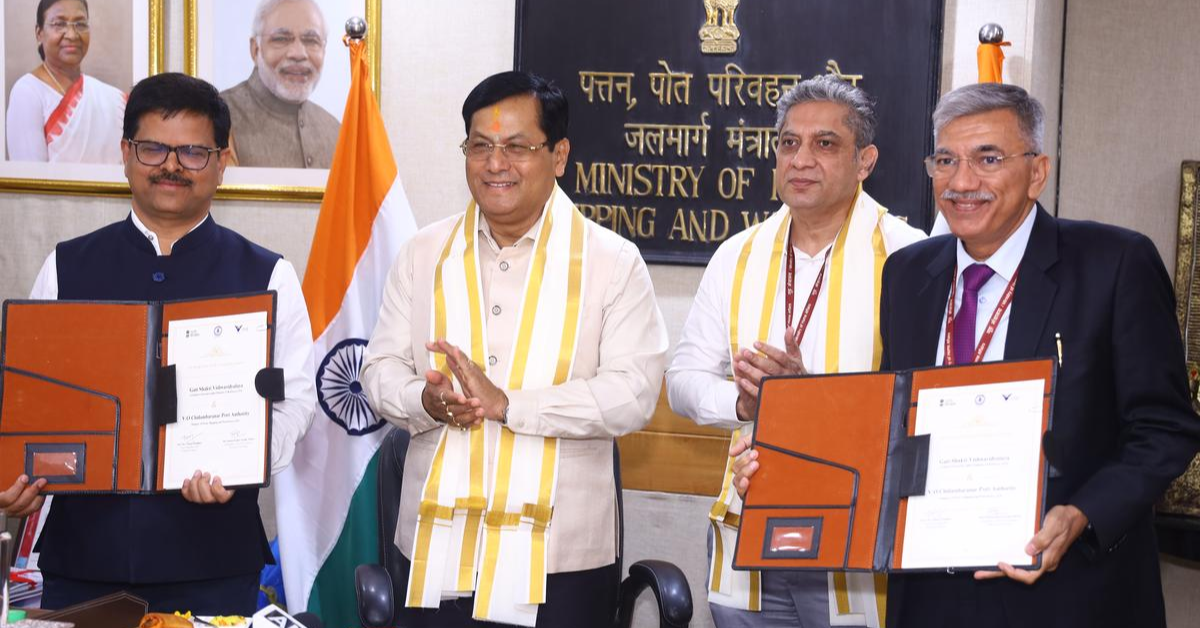

Union Minister for Ports, Shipping and Waterways Sarbananda Sonowal has launched a set of new initiatives at V.O. Chidambaranar (VOC) Port in Tuticorin aimed at advancing green energy, digital transformation and maritime education. The measures are part of the Centre’s broader push to turn VOC Port into one of India’s most advanced, sustainable and technology-driven port ecosystems.
Recent projects at VOC Port include India’s first port-based green hydrogen pilot facility, a planned green methanol bunkering and refuelling terminal, expanded solar and wind power capacity, and a digital twin platform for smarter operations and maintenance. Together, these initiatives are intended to support cleaner bunkering, green mobility, renewable energy integration and AI-enabled port management.
On the educational and heritage front, Sonowal has inaugurated the VOC Maritime Heritage Museum, focused on preserving and showcasing the port’s historical legacy and India’s maritime traditions. The port is also promoting community-focused initiatives, such as support for schools and maritime awareness programmes, as part of its CSR and skill-development agenda.
VOC Port has already rolled out a 400-kW rooftop solar plant, taking total rooftop solar capacity to 1.04 MW, along with plans for a 6 MW wind farm and additional ground-mounted solar capacity. It has also installed EV charging stations and deployed electric vehicles within the port premises, introduced a Green Port Policy, and is building specialised terminals for handling windmill components.
By combining clean energy projects, digital platforms and maritime heritage initiatives, VOC Port is positioning itself as a model for future-ready, sustainable ports under the Maritime India Vision framework. The new initiatives launched by Sonowal reinforce Tuticorin’s role in India’s green shipping corridors, coastal logistics and regional economic development.
 Join our WhatsApp channel for more updates:
 Subscribe to our YouTube channel for more updates: