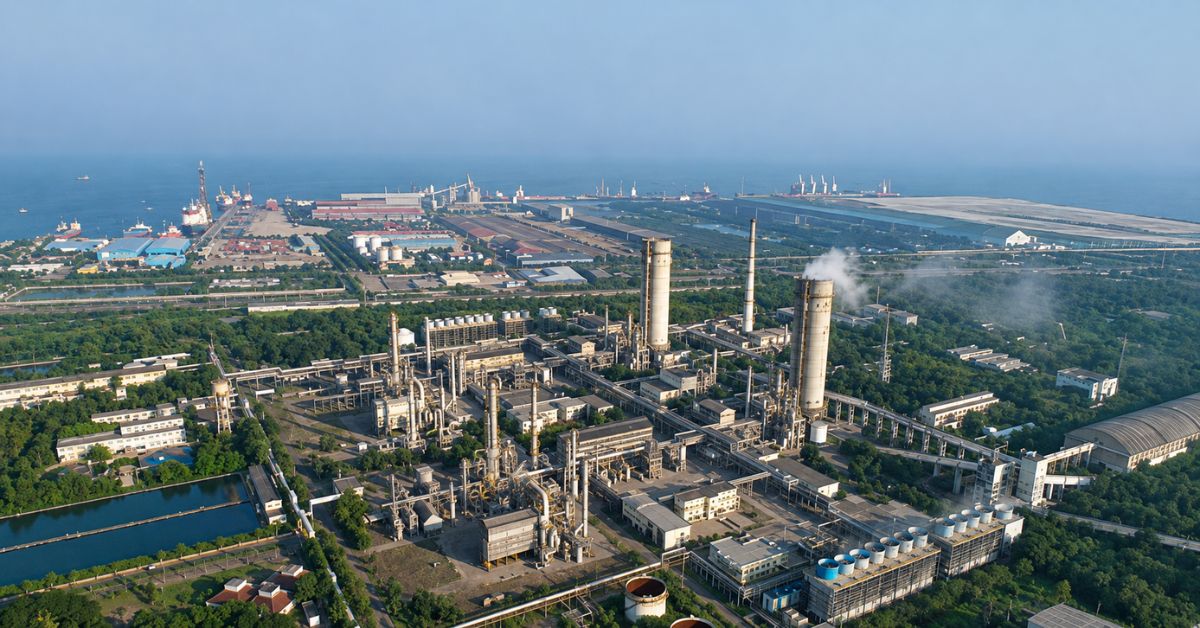

Waaree Energies plans to invest approximately ₹15,000 crore in a green ammonia project at Kakinada Special Economic Zone (SEZ) in Andhra Pradesh, with proposed annual production capacity of 1.2 million tonnes. The development would expand the solar manufacturer’s clean-energy business and add a substantial production facility near Kakinada Gateway Port.
The proposal, reported on 10 November, is being advanced through Waaree Clean Energy Solutions. Around 300 acres have reportedly been acquired within the SEZ for the project.
What is the project’s approval status?
The Andhra Pradesh government has reportedly approved the proposal under its Integrated Clean Energy Policy, 2024, and sanctioned incentives to support the investment.
A memorandum of understanding between the company and the state government is expected at the Andhra Pradesh Investment Summit in Visakhapatnam later this week. The agreement had not been reported as signed when the investment details emerged.
The available announcement does not specify a commissioning date, construction schedule, financing structure or customer agreements. The ₹15,000-crore figure therefore represents planned investment, while the 1.2-million-tonne capacity remains proposed production capacity.
Why does the Kakinada location matter?
The proposed location places the plant within an industrial area being developed around maritime connectivity. Kakinada Gateway Port is planned as an all-weather, deep-water, multi-cargo facility serving the surrounding industrial zone.
The port developer describes the project as a greenfield development on India’s east coast. It is distinct from the existing Kakinada Deep Water Seaport, which the SEZ developer identifies as approximately 30 kilometres away.
A dedicated railway connection between the proposed Gateway Port and Annavaram railway station is also planned. These developments provide the wider logistics context for locating large industrial projects in the SEZ, although no dedicated ammonia terminal, storage arrangement or shipping agreement has been disclosed for Waaree’s proposal.
How does the proposal fit Waaree’s hydrogen strategy?
Waaree Clean Energy Solutions, a wholly owned subsidiary of Waaree Energies, already participates in India’s green hydrogen programme.
In January 2025, the company disclosed an award from the Solar Energy Corporation of India for a 90,000-tonne-per-year green hydrogen production facility under the Strategic Interventions for Green Hydrogen Transition scheme. The disclosure does not establish that this award and the proposed Kakinada ammonia plant are the same project.
In February 2026, the subsidiary also signed an agreement with Zero Footprint Industries for a 2.5-megawatt alkaline electrolyser supporting hydrogen production in Uttar Pradesh. Waaree’s responsibilities include designing, installing, owning and operating the system, with hydrogen and oxygen supplied under a 15-year contract.
The companies separately signed a strategic agreement covering potential supply of 50 megawatts of electrolysers for decentralised hydrogen projects across northern India.
How is Kakinada’s green ammonia industry developing?
Waaree’s proposal would join other green ammonia investments in the region. The Asian Development Bank’s project documentation describes a separate AM Green development at Kakinada with planned capacity of about 1.09 million tonnes annually, comprising two production trains of 547,500 tonnes each.
That project combines renewable electricity, hydrogen production, ammonia synthesis, storage and port-based export logistics. Its first phase includes shared utilities intended to support both production trains.
Nationally, the Green Hydrogen Mission has an approved outlay of ₹19,744 crore and targets annual green hydrogen production capacity of five million tonnes by 2030. Its support framework includes electrolyser manufacturing, hydrogen production incentives, infrastructure, industrial hubs and shipping pilot projects.
The national target concerns hydrogen production, while Waaree’s proposed Kakinada capacity is for ammonia, a hydrogen derivative. The two measures should therefore be assessed separately when comparing project scale with national ambitions.
 Join our WhatsApp channel for more updates:
 Subscribe to our YouTube channel for more updates: